


Listen to the article
Fear Keeps Thousands of Immigrant Children from Minnesota Schools Amid Immigration Crackdown
In some ways, 10-year-old Giancarlo is one of the lucky ones. He still goes to school.
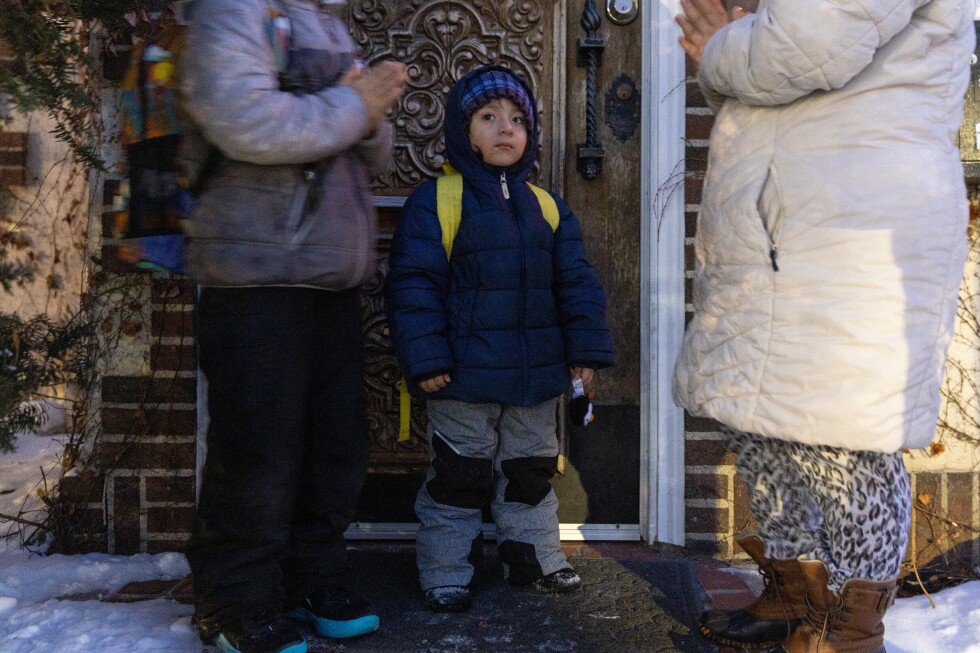
Each morning, he and his family bundle up and leave their Minneapolis apartment to wait for his bus. His little brother hefts on his backpack, even though he stopped going to day care weeks ago because his mom is too afraid to take him.
As they wait behind a wrought-iron fence, Giancarlo’s mother pulls the boys into the shadow of a tree to pray. It’s the only time she stops scanning the street for immigration agents.
“God, please protect my son when he’s not at home,” she says in Spanish.
For many immigrant families in Minnesota, sending a child to school now requires faith that federal immigration officers deployed around the state won’t detain them. Thousands of children are staying home, often for lack of door-to-door transportation — or simply trust.
The fear has materialized into reality for some. Several parents and children have been detained, including 5-year-old Liam Conejo Ramos, who with his father, originally from Ecuador, was taken into custody in the Minneapolis suburb of Columbia Heights as he was arriving home from school. They were sent to a detention facility in Texas but returned after a judge ordered their release.
In response to the crisis, schools, parents, and community groups have mobilized to help students safely get to class so they can continue learning, socializing, and having steady access to meals. For families still sending their children to school, the journey to and from the classroom has become one of the only risks they’re willing to take.
“I don’t feel safe with him going to school,” Giancarlo’s mother said, shaking her head. “But every day he wakes up and wants to go. He wants to be with his friends.”
School Remains a Haven in a Time of Tumult
Giancarlo’s Minneapolis elementary school is the best thing going for him these days. There’s soccer to play at recess. The recorder to learn. Giancarlo has set his eyes on learning the flute next year when fifth graders choose an instrument. He has “demasiado” — “too many” — best friends to name.
But his mother and brother’s home confinement weighs on him. He saves half the food he gets at school breakfast and lunch to share with them, and he’s lost four pounds this year. He takes extra care to bring pizza or hamburgers, treats the family used to eat in restaurants when his mom, an asylum-seeker from Latin America, was still working and they felt safe leaving the house. Giancarlo has also applied for asylum and his brother, Yair, has U.S. citizenship.
Sometimes only seven of Giancarlo’s classmates show up when there should be close to 30. “The teachers cry,” he said. “It’s sad.”
With as many as 3,000 federal officers roaming the state this year, some immigrant parents have made a calculated decision that their children are safer riding or walking with white Minnesotans who were strangers just weeks ago — rather than in their own cars or while holding their hands.
One mother, an immigrant from Mexico, has given up her housecleaning job, and her husband stopped going to his construction job to minimize their chances of being detained. Her 10-year-old, U.S.-born daughter is the only one leaving the house, getting a ride with another student’s parents to her private Christian school in Minneapolis.
“It raises my blood pressure,” the mother said, speaking on condition of anonymity out of fear of being targeted by immigration authorities.
Absenteeism Has Soared Across Schools in the Twin Cities Area
Under longstanding guidance that was thrown out by the Trump administration, schools and other “sensitive places” such as hospitals and churches previously were considered off-limits for Immigration and Customs Enforcement agents and other immigration officials. Children, no matter their immigration status, have a constitutional right to attend public school.
This winter, school absenteeism and the demand for online learning have surged as immigration officers showed up in school parking lots.
In St. Paul, over 9,000 students were absent on January 14, more than a quarter of the 33,000-student district, according to data obtained by the AP. In Fridley, a Minneapolis suburb, school attendance has dropped by nearly a third, according to a lawsuit the district filed this week trying to block immigration enforcement operations near schools.
Students have taken action, sending letters to St. Paul Superintendent Stacie Stanley begging her to offer online learning. Her voice shook as she read a letter from an elementary school student: “I don’t feel safe coming to school because of ICE.”
When the district introduced a temporary virtual learning option, over 3,500 students enrolled in the first 90 minutes. That number has since risen to more than 7,500 students.
An Escort from School — and Assurance for a Small Girl
After school on Wednesday, around 20 teachers and a retired principal packed into the front office at Valley View Elementary School — where Liam Conejo Ramos attends prekindergarten — for a briefing before walking home children who live nearby. School officials say several other students and over two dozen parents have been detained.
“We live in a place where ICE is everywhere,” said Rene Argueta, the school’s family liaison. Argueta, himself an immigrant from El Salvador, organized the teachers walking and driving students to and from their homes.
The day before, the group had run into federal officers in the neighborhood at dismissal time. Argueta felt it necessary to calm some of the teachers upset by the encounter.
“Your only goal is to bring the students home, no matter what you see,” he told the group. “We don’t approach ICE. We don’t take out our phones.”
After distributing walkie-talkies, Argueta and two other teachers met a group of 12 kids waiting for them in the hallway. Argueta took the hand of the youngest child, a boy in prekindergarten, and led the group outside.
Toward the back of the line, second grade teacher Jenna Scott chatted with a former student, now a third grader. She tried to keep the conversation light.
“I’m so excited to see your house,” Scott told her.
“Have you signed up for parent-teacher conference?”
“No, miss. ICE,” the girl said.
“I know. Tell your parents you can do it online this time.”
The third grader then ran to her home. Afterward, Scott said the 10-minute walk is a delicate dance. “You don’t want to scare the kids, but you also want them to walk quickly.”
The day before, Argueta said, they were walking the students home when they heard cars honking to warn that immigration agents were nearby. One little girl who was walking ahead started to panic and ran back toward Argueta.
“ICE viene,” or “ICE is coming,” she yelled.
He took her hand and kept walking. She asked if he was afraid.
No, he said.
She asked if he had papers, if he was in the country legally. Argueta has a green card and permission to work, but he lied. He told her he didn’t, so she wouldn’t feel alone.
Her hand relaxed in his. She smiled again.
He held her hand until they got to her doorstep and she went inside with her mother.
Fact Checker
Verify the accuracy of this article using The Disinformation Commission analysis and real-time sources.

12 Comments
This is a heartbreaking situation for immigrant families in Minnesota. Sending their children to school should not require such constant fear and vigilance. I hope officials can find a way to address their legitimate security concerns without causing such distress for vulnerable families.
It’s concerning to hear about children being kept home from school due to fear of detention. The authorities should work to reassure and support these families, not make them feel unsafe in their own communities.
While I understand the complexities of immigration enforcement, the impacts on innocent children and families described in this article are deeply troubling. We should be doing more to ensure all children have access to education without fear of detention or separation from their loved ones.
The detention of a 5-year-old is absolutely unacceptable. Officials need to find a way to address legitimate security concerns without traumatizing vulnerable children and tearing families apart.
This is a heartbreaking situation that highlights the real human costs of overzealous immigration policies. Forcing immigrant families to live in constant fear for their children’s safety and education is a moral failure. I hope leaders can find a more compassionate approach that upholds the rights and dignity of all.
The level of anxiety and distress these families are experiencing is truly tragic. No child should have to grow up in such an environment of fear and uncertainty. I hope officials can act quickly to restore a sense of safety and security.
It’s deeply upsetting to read about immigrant families in Minnesota living in such constant fear and trepidation over something as basic as sending their kids to school. This seems to run counter to the values of an open, just and welcoming society. I hope solutions can be found to address legitimate concerns without causing such immense hardship for vulnerable families.
The detention of a young child is particularly disturbing. Officials need to find a more humane and compassionate approach that doesn’t traumatize innocent kids and their families. The wellbeing of children should be the top priority.
This report highlights the tremendous challenges faced by immigrant families in Minnesota trying to provide their children with an education. It’s a troubling erosion of the basic rights and freedoms we should afford all members of our society, especially the young and innocent.
The detention of a 5-year-old child is deeply disturbing. Officials need to find a more humane and compassionate approach that doesn’t traumatize innocent kids and their families.
It’s disheartening to see immigrant families in Minnesota living in such constant fear and anxiety over sending their children to school. This seems to go against the core values of a free, open and welcoming society. I hope a solution can be found to address legitimate security concerns without causing undue hardship.
The story of young Giancarlo and his family really illustrates the human toll of these immigration policies. No child should have to live in that level of fear and uncertainty about their basic safety and education.