


Listen to the article
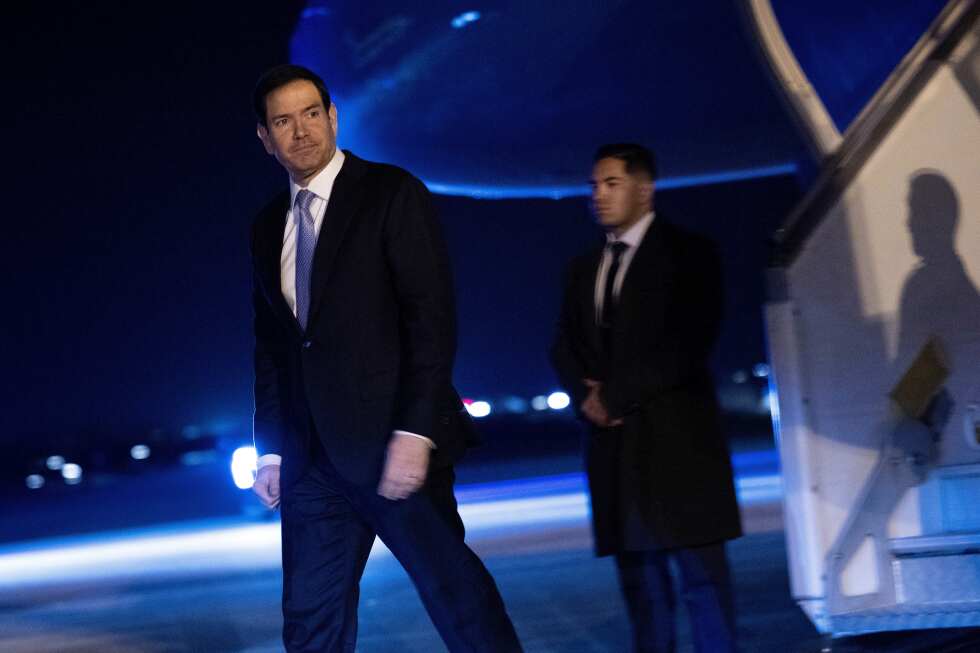
U.S. Secretary of State Marco Rubio arrived in France Friday for a Group of Seven meeting amid growing tensions with allies over the Iran conflict, just hours after President Donald Trump publicly berated NATO members for their lack of support.
The G7 gathering outside Paris comes at a critical moment as the U.S. faces significant pushback from traditional allies skeptical of American military actions in the Middle East. Rubio now faces the difficult task of defending U.S. strategy to fellow top diplomats from Britain, Canada, France, Germany, Italy, and Japan, particularly after Trump’s inflammatory comments.
“We are very disappointed with NATO because NATO has done absolutely nothing,” Trump declared during a Cabinet meeting Thursday, setting a confrontational tone just before Rubio’s diplomatic mission began.
The president’s frustration centers on what he perceives as inadequate allied support for U.S. operations in the Strait of Hormuz, where Iran’s actions have disrupted global oil shipments and contributed to rising energy prices. Trump’s comments reflected his longstanding criticism of the alliance, suggesting American protection of Europe isn’t reciprocated when U.S. interests are at stake.
“We’re there to protect NATO, to protect them from Russia. But they’re not there to protect us,” Trump said, later adding that he “never thought we needed them” and was “more doing a test.”
These remarks come despite NATO Secretary-General Mark Rutte’s recent acknowledgment of increased defense spending by European allies—a longtime demand of Trump’s administration. Rutte noted that while NATO members had previously been “overreliant on U.S. military might,” a “shift in mindset” had occurred among alliance members.
France, as G7 host, has been particularly vocal in its concerns. General Fabien Mandon, chief of the French defense staff, publicly complained this week about the lack of communication from Washington regarding military operations.
“They have just decided to intervene in the Near and Middle East without notifying us,” Mandon said. “We acted immediately, surprised by an American ally, who remains an ally, but who is less and less predictable and doesn’t even bother to inform us when it decides to engage in military operations. This affects our security. This affects our interests.”
Despite these tensions, France’s Defense Ministry reported that 35 countries participated in military talks about reopening the Strait of Hormuz “once the intensity of hostilities has sufficiently decreased,” suggesting some level of international coordination continues.
European allies have additional concerns about U.S. commitment to Ukraine as attention shifts to the Middle East. German Foreign Minister Johann Wadephul emphasized that joint support for Ukraine “must not crumble now. That would be a strategic mistake with a view to Euro-Atlantic security.”
Wadephul expressed hope for a unified G7 position on the Middle East situation, acknowledging the importance of ending the conflict “as quickly as possible, but also ending it sustainably,” which includes ensuring security in the strategic Strait of Hormuz.
For his part, Rubio attempted to strike an optimistic note before departing Washington, saying he was “looking forward to gathering with his G7 counterparts” and anticipated “great meetings.” On social media, he indicated the discussions would focus on “security concerns we share around the world and opportunities to address the situation in the Middle East and the Russia-Ukraine war.”
At Thursday’s Cabinet meeting, Rubio defended the administration’s approach, suggesting that countries “should actually be grateful that the United States has a president that’s willing to confront a threat like this.” He later added that with Iran threatening global shipping, nations that value international law “should step up and deal with it.”
The disagreements over the Iran conflict add to existing friction points with European allies, who remain concerned about Trump’s previous demands regarding Greenland and ongoing support for Ukraine against Russian aggression.
As the Iran war approaches its fourth week, Rubio’s diplomatic mission represents a critical test of America’s ability to align its strategic objectives with those of traditional partners whose cooperation remains essential to addressing complex global security challenges.
Fact Checker
Verify the accuracy of this article using The Disinformation Commission analysis and real-time sources.

16 Comments
This situation highlights the growing rift between the U.S. and its European allies on key foreign policy challenges. Rubio will have his work cut out for him trying to bridge those divides and forge a united front.
It will be interesting to see if Rubio can find common ground with the skeptical G7 ministers or if the meeting further entrenches the transatlantic differences.
The G7 meeting will be a crucial test of U.S. diplomacy. With Trump’s combative tone towards NATO, Rubio will need to tread carefully to avoid further alienating traditional American allies over the Iran issue.
Fostering unity and cooperation among the G7 powers will be essential if the U.S. hopes to mount an effective international response to Iran’s actions in the Strait of Hormuz.
Rubio’s mission to rally G7 support for confronting Iran reflects the Trump administration’s struggle to build a global coalition. The challenge will be convincing allies that American military action is warranted and will not lead to unintended consequences.
The optics of Rubio trying to sell an Iran war to reluctant G7 partners could further undermine U.S. credibility on the world stage if he fails to make a compelling case.
This G7 meeting is a crucial test of U.S. diplomacy under the Trump administration. Rubio will need to tread carefully to avoid further alienating traditional American allies over the Iran issue.
Fostering unity and cooperation among the G7 powers will be essential if the U.S. hopes to mount an effective international response to Iran’s actions in the Strait of Hormuz.
The U.S. faces an uphill battle trying to rally G7 allies behind a military confrontation with Iran. Rubio will need to present a compelling case that persuades skeptical partners to back the American position.
With tensions running high, the risks of miscalculation are concerning. Rubio will have to tread carefully to avoid further damaging transatlantic relations.
Rubio faces an uphill battle trying to rally G7 allies behind a military confrontation with Iran. The U.S. has struggled to gain broad international support for its aggressive Iran policy amid skepticism over the rationale and potential consequences.
I wonder if Rubio will be able to present a compelling case that persuades allies to back the U.S. position. Tensions are running high, and the risks of miscalculation are concerning.
Rubio’s mission to sell an Iran war to reluctant G7 allies reflects the Trump administration’s struggle to build a global coalition. The challenge will be convincing partners that American military action is warranted and won’t lead to unintended consequences.
The optics of this situation could further undermine U.S. credibility on the world stage if Rubio fails to make a compelling case to the skeptical G7 ministers.
This G7 meeting presents a critical test of U.S. diplomacy under the Trump administration. Rubio will need to navigate delicate tensions with allies who are skeptical of American military actions in the Middle East.
Fostering unity among the G7 powers will be essential if the U.S. hopes to mount an effective international response to the situation in the Strait of Hormuz.