


Listen to the article
Connecticut’s Pipeline Politics: Local GOP Opposition Challenges Trump’s Gas Agenda
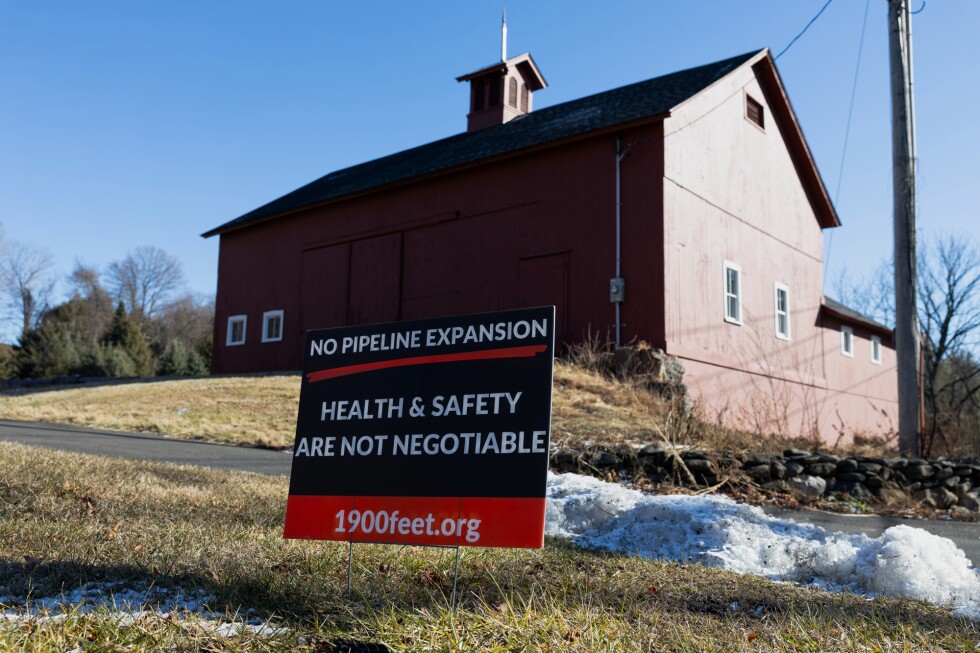
In a surprising twist of political alignment, conservative residents in Brookfield, Connecticut, are leading a fight against a $272 million expansion of the Iroquois Gas Transmission System, placing them at odds with the national Republican energy agenda championed by former President Donald Trump.
The focal point of the controversy is a proposal to add two new compressors to an existing station in Brookfield, which would increase the pipeline’s capacity by 125 million cubic feet of gas daily without installing new pipes. While the project has received tentative support from Democratic Governor Ned Lamont’s administration, it faces fierce opposition from an unusual coalition of environmental groups and local Republican officials.
State Senate Minority Leader Stephen Harding, who represents Brookfield, has emerged as a vocal critic. “These are health risks for our kids, for our families, these are environmental risks for everyone in our community,” said Harding at a public meeting in January. “This is being put up literally yards away from a school, a middle school, which my children are going to be attending.”
Brookfield, which narrowly voted for Trump in 2024 and has supported Republican presidential candidates in four of the last five elections, now finds its local GOP representatives challenging a cornerstone of the national Republican energy platform: the expansion of natural gas infrastructure.
The resistance in Brookfield reflects a broader pattern of local opposition to energy projects throughout Connecticut, regardless of political affiliation. Community pushback has delayed or derailed projects ranging from transmission lines to solar arrays and battery storage facilities across the state.
“The opposition to this runs across all party lines — unaffiliated, Democrat, Republican — and there are some good reasons for that,” explained Brookfield First Selectman Steve Dunn, a Democrat. He cited concerns about emissions, noise, vibrations, and the risk of explosion, especially given the facility’s proximity to Whisconier Middle School, located just 1,800 feet away.
State Representative Martin Foncello, another Republican opponent, noted that local resistance to the compressor station dates back more than two decades. Last month, he urged the Connecticut Department of Energy and Environmental Protection (DEEP) to deny the remaining permits, citing safety concerns and air quality issues.
The situation has created an unexpected alliance between local conservatives and environmental groups like the Sierra Club. “The negative impacts you’re going to have in Brookfield — the air pollution impacts, the climate impacts, the health impacts — should be a concern across all fossil fuel expansions,” said Samantha Dynowski, president of the state chapter of the Sierra Club.
Harding and Foncello defend their opposition by noting that the pipeline’s expanded capacity is primarily intended to serve New York, where the pipeline terminates after crossing under Long Island Sound. “Connecticut is getting no benefit, we’re not getting any increase in supply from this expansion,” Harding argued.
However, Iroquois representatives and energy experts suggest the situation is more nuanced. The pipeline currently delivers about 30% of its gas to Connecticut customers and power plants, and the proposed 8% capacity increase could indirectly benefit Connecticut consumers.
“It’s certainly targeted for the Long Island or New York market,” said Ira Joseph, a senior research associate at Columbia University’s Center on Global Energy Policy. “But I don’t think that in any way prevents potential new customers in Connecticut from emerging if they wanted to make those type of investments.”
Iroquois spokeswoman Ruth Parkins emphasized that the project would enhance reliability for Connecticut’s gas consumers since additional quantities would be flowing through the state and available for consumption most days throughout the year. She also pointed out Connecticut’s dependence on pipelines passing through other states for its natural gas supply.
Critics question the need for increased capacity given both New York and Connecticut’s pledges to reduce greenhouse gas emissions in coming decades. New York has even passed legislation to ban gas heating systems in most new buildings, though implementation was recently delayed by Governor Kathy Hochul.
In Brookfield, opponents have strategically focused their arguments on local impacts rather than broader climate concerns. “I think we’ve conscientiously said, from the standpoint of this project, if you make it about carbon, you run the risk it has some sort of political problems,” explained Daniel Myers, a resident organizing against the project.
Many local opponents suggest that if the compressor station expansion proceeds, DEEP should require Iroquois to use less-polluting technologies, such as all-electric motors. The company has rejected this option, citing an additional cost of $45-50 million and a three-year delay to upgrade electrical connections.
As Connecticut struggles with pipeline constraints and high energy costs, the Brookfield controversy highlights the tension between expanding natural gas infrastructure and addressing community concerns. For now, local Republican officials remain firmly opposed to the project in their backyard, even as they support increasing gas capacity elsewhere in the state.
Fact Checker
Verify the accuracy of this article using The Disinformation Commission analysis and real-time sources.

16 Comments
It’s encouraging to see Republicans and Democrats in Connecticut uniting against this natural gas project due to health and environmental risks. Thoughtful consideration of all stakeholder perspectives is crucial for these types of infrastructure decisions. Kudos to the local leaders for standing up for their community.
Absolutely, bipartisanship on issues like this is essential. The state should carefully weigh the concerns raised by the local community before moving forward.
The proposed expansion of the Iroquois Gas Transmission System raises valid concerns about the potential health and environmental risks, especially with a middle school nearby. I’m glad to see the local community, including Republican leaders, taking a strong stance against this project.
You’re right, the proximity to a school is a major issue that needs to be carefully considered. Kudos to the local officials for putting their community’s wellbeing first.
The bipartisan opposition to this natural gas project in Connecticut is a refreshing example of politicians putting their constituents’ concerns first. Responsible energy development requires balancing economic needs with environmental protection and public health. I hope the state takes the local community’s feedback seriously.
Agreed, this is a great case study in how elected officials should approach controversial projects – by prioritizing the wellbeing of the people they serve, regardless of party affiliation.
This case highlights the importance of considering local perspectives, even when they may clash with national agendas. I’m glad to see the Connecticut Republicans standing up for their constituents’ interests. Careful evaluation of the potential risks is crucial before moving forward with this pipeline expansion.
You make an excellent point. Local voices and community-level impacts should be central to these types of infrastructure decisions, not just national political priorities.
It’s refreshing to see political opponents come together on an issue like this. Protecting public health and the environment should transcend party lines. I hope the state takes the local concerns seriously and conducts a thorough review of this project.
Agreed, this is a great example of bipartisanship in action. Hopefully, the state will prioritize the wellbeing of the community over political interests.
This case highlights the importance of nuanced, localized approaches to energy projects, rather than one-size-fits-all national policies. I’m glad to see Republicans and Democrats in Connecticut collaborating to address the specific risks and concerns of their community. Responsible development requires balancing economic, environmental, and public health considerations.
Well said. Localized decision-making that incorporates diverse perspectives is crucial for managing the complex tradeoffs involved in energy infrastructure projects.
This is an interesting case of cross-party opposition to a natural gas project. It’s good to see local officials putting community concerns over partisan allegiance. Careful environmental and health impact assessment is crucial for these types of infrastructure decisions.
Absolutely, public safety and environmental protection should take priority over political affiliations. It’s encouraging to see bipartisan cooperation on this issue.
The bipartisan opposition to the Iroquois natural gas project in Connecticut is a refreshing example of politicians putting community interests above partisan loyalties. Careful evaluation of health and environmental impacts, especially with a school nearby, should be the top priority. I hope the state takes the local concerns seriously and conducts a thorough review.
Absolutely, this is a great demonstration of how elected officials should approach contentious issues – by prioritizing the wellbeing of their constituents over political allegiances.