


Listen to the article
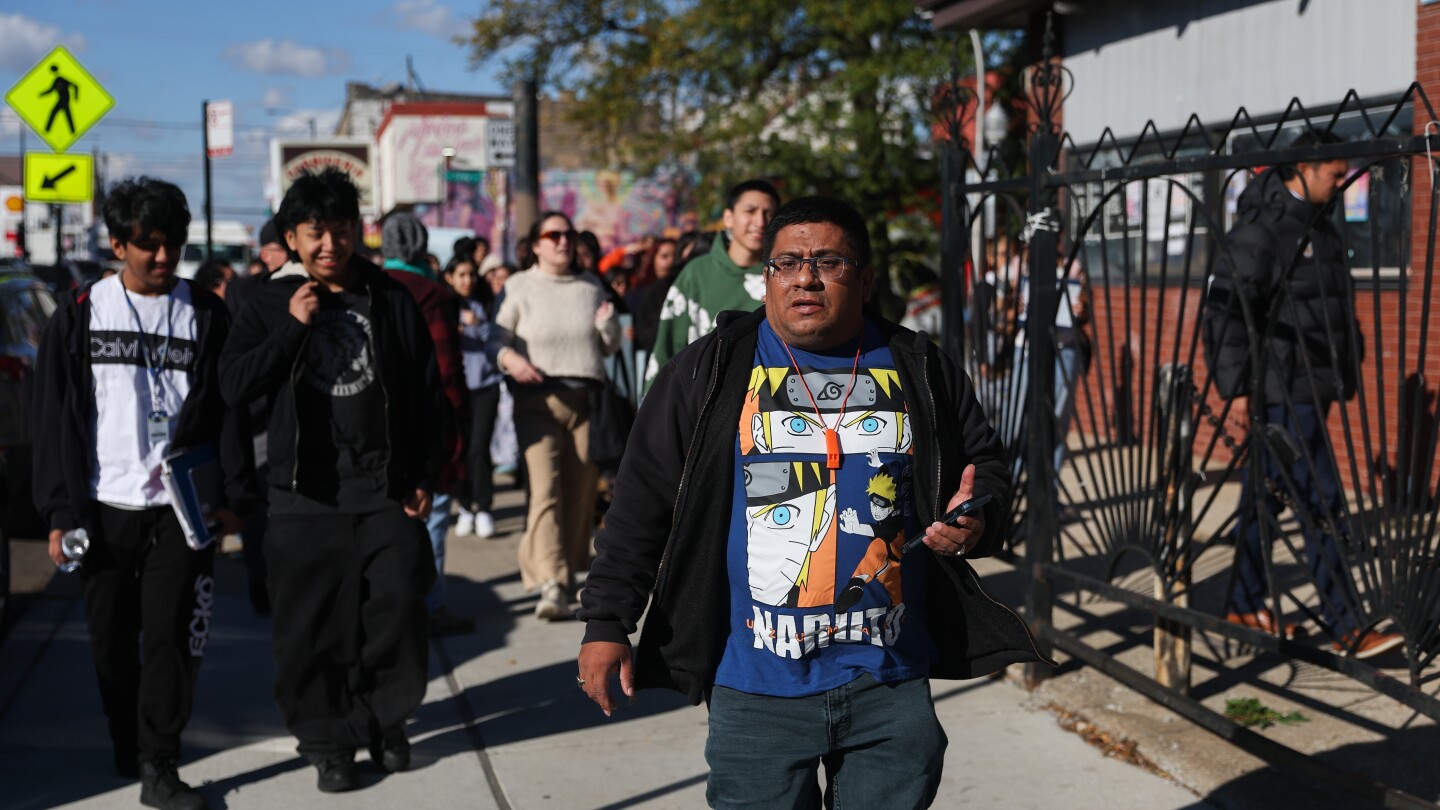
In the quiet early hours, Baltazar Enriquez begins his daily ritual in Chicago’s Little Village. With an orange whistle around his neck, he sets out on foot or by car, scanning the streets for immigration agents who have repeatedly targeted his predominantly Mexican neighborhood.
“We don’t know if they’re going to come back. All we know is we’ve got to get ready,” Enriquez tells thousands of Facebook followers during his morning broadcasts. “Give us any tips if you see any suspicious cars.”
As an unprecedented immigration crackdown enters its third month in Chicago, a growing coalition of residents is mounting organized resistance against what many describe as aggressive federal overreach. The response spans from established activists to everyday residents across socioeconomic lines, uniting the Democratic stronghold in a distinctive show of defiance.
The resistance has manifested in various forms: community patrols, rapid response teams, school escorts for children, vendor support initiatives, and the now-ubiquitous sound of whistles and car horns that signal agent presence. Participants say their approach represents a uniquely Chicago response that other cities targeted by the Trump administration for federal intervention are now looking to replicate.
“The strategy here is to make us afraid. The response from Chicago is a bunch of obscenities and ‘no,'” said Anna Zolkowski Sobor, whose North Side neighborhood recently witnessed agents deploy tear gas and tackle an elderly man. “We are all Chicagoans who deserve to be here. Leave us alone.”
Perhaps the most visible symbol of Chicago’s resistance is the orange whistle. Enriquez is credited with introducing this tactic, which has spread citywide. When blown, the whistles serve dual purposes: warning nearby residents about agent activity while simultaneously drawing witnesses who can record interactions or verbally challenge officers.
The confrontations have grown increasingly tense. Immigration officials have responded with escalating force, including one fatal shooting during a traffic stop. Agents have deployed tear gas, rubber bullets, and physical force in various incidents. In early November, Chicago police investigated shots fired at agents, though no injuries were reported.
“We don’t have guns. All we have is a whistle,” Enriquez emphasizes. “That has become a method that has saved people from being kidnapped and unlawful arrest.”
By October, the whistle campaign had gained such momentum that neighborhoods throughout Chicago began hosting “Whistlemania” distribution events, placing the devices in free book hutches and local businesses.
“They want that orange whistle,” said activist Gabe Gonzalez. “They want to nod to each other in the street and know they are part of this movement.”
Chicago’s resistance draws strength from the city’s communal character and deep organizing roots. Despite its 2.7 million population, residents describe the metropolis as functioning like interconnected small towns with Midwestern sensibilities of neighborly support.
When immigration agents began targeting street vendors, local cyclist Rick Rosales mobilized his advocacy group, Cycling x Solidarity. The group organized bike rides to visit vendors, buying out their inventory to reduce their exposure to risk while supporting their livelihoods. Similarly, Irais Sosa, co-founder of apparel store Sin Titulo, created a neighborhood program offering grocery deliveries and rideshare gift cards for families afraid to venture outside.
The grassroots nature of the resistance reflects Chicago’s storied history of community and labor organizing. Even Tom Homan, Trump’s “border czar,” acknowledged that Chicago-area residents were so familiar with their legal rights that conducting arrests during previous operations proved challenging.
When hundreds of federal agents descended on Chicago in September, activists quickly established an emergency hotline system that dispatches response teams to gather intelligence, including the names of those detained. Volunteers circulate videos, track suspicious vehicles, and follow agents’ cars while honking horns to disrupt operations.
The Department of Homeland Security reports more than 3,200 people suspected of immigration violations have been arrested during “Operation Midway Blitz.” Dozens of U.S. citizens and protesters have also faced charges ranging from resisting arrest to impeding officers.
Gregory Bovino, the Border Patrol commander who imported controversial tactics from Los Angeles operations, characterized Chicago as a “very non-permissive environment.” He attributed difficulties to the city’s sanctuary protections and local leadership, while defending agents’ actions despite ongoing lawsuits challenging their methods.
However, the intensity may soon shift elsewhere. Bovino recently told The Associated Press that U.S. Customs and Border Protection will target other cities, and DHS officials confirmed an immigration enforcement surge has begun in Charlotte, North Carolina, though they maintain operations won’t end entirely in Chicago.
Meanwhile, Chicago’s resistance strategies are spreading. Alonso Zaragoza, with a neighborhood organization in the immigrant-heavy Belmont Cragin area, has distributed hundreds of “No ICE” posters to local businesses. Organizers from Oregon and Missouri have reached out seeking advice.
“It’s become a model for other cities,” Zaragoza said. “We’re building leaders in our community who are teaching others.”
For Enriquez, who completes up to three patrol shifts daily, the work exacts a heavy toll. Federal agents have visited his home and questioned family members. A U.S. citizen relative was handcuffed during one encounter, and his car horn no longer functions due to overuse.
“This has been very traumatizing,” he acknowledges. “It is very scary because you will remember this for the rest of your life.”
Fact Checker
Verify the accuracy of this article using The Disinformation Commission analysis and real-time sources.

12 Comments
The article touches on the uniting of residents across socioeconomic lines in this resistance effort. This level of solidarity and collective action is admirable and could help sustain the movement over time. It will be interesting to see how the authorities respond to this organized pushback.
The article highlights the grassroots nature of this resistance, with everyday residents playing a central role. This suggests a genuine, community-driven approach, rather than a top-down or institutional response, which could make it more resilient.
The article emphasizes the uniquely Chicago flavor of this resistance movement, with its use of local resources and tactics. This suggests the importance of tailoring community responses to the specific context and needs of a particular city or region.
It’s heartening to see the diverse participation in this effort, from established activists to ordinary residents. This broad-based involvement could help sustain the movement and amplify its impact over time.
Interesting to see how Chicago residents are banding together to resist aggressive federal immigration enforcement. It’s a uniquely grassroots and community-driven response, leveraging things like whistles and patrols to help warn and protect vulnerable residents.
The article highlights the ingenuity and resilience of the Chicago community in the face of a crackdown. It’s heartening to see people coming together to support and protect each other.
I’m curious to see how effective these community-led efforts will be in mitigating the impacts of the federal immigration crackdown. The article highlights the potential for this Chicago model to be replicated elsewhere, which could strengthen resistance nationwide.
The use of whistles and car horns as warning signals reflects a creative, low-tech approach to rapidly disseminate information and mobilize the community. This speaks to the resourcefulness of the residents in the face of a challenging situation.
The article’s description of the community patrols, rapid response teams, and other coordinated activities suggests a high degree of organization and planning. This level of sophistication could be a key factor in the resistance’s effectiveness and ability to adapt to changing circumstances.
The use of technology, such as social media and communication networks, to rapidly disseminate information and coordinate responses is an interesting aspect of this resistance movement. It reflects the modern, interconnected nature of community organizing.
This seems like a creative, multi-pronged approach to push back against the immigration crackdown. The use of community patrols, rapid response teams, and communication networks reflects a sophisticated, organized effort to safeguard vulnerable residents.
The article emphasizes the diverse participation, from activists to everyday residents, which suggests a broad-based, grassroots movement. This level of community mobilization is impressive and could serve as a model for other cities facing similar challenges.