


Listen to the article
Congressional Funding Deal Collapses as Senate and House GOP Leaders Clash
For several hours Friday, in the stillness before dawn, the Senate appeared to have finally figured out how to fund most of the Department of Homeland Security before it faced the longest partial shutdown in U.S. history.
Senators handed House Speaker Mike Johnson, R-La., their deal and headed for the airports, seemingly confident of success.
Then it collapsed. Spectacularly.
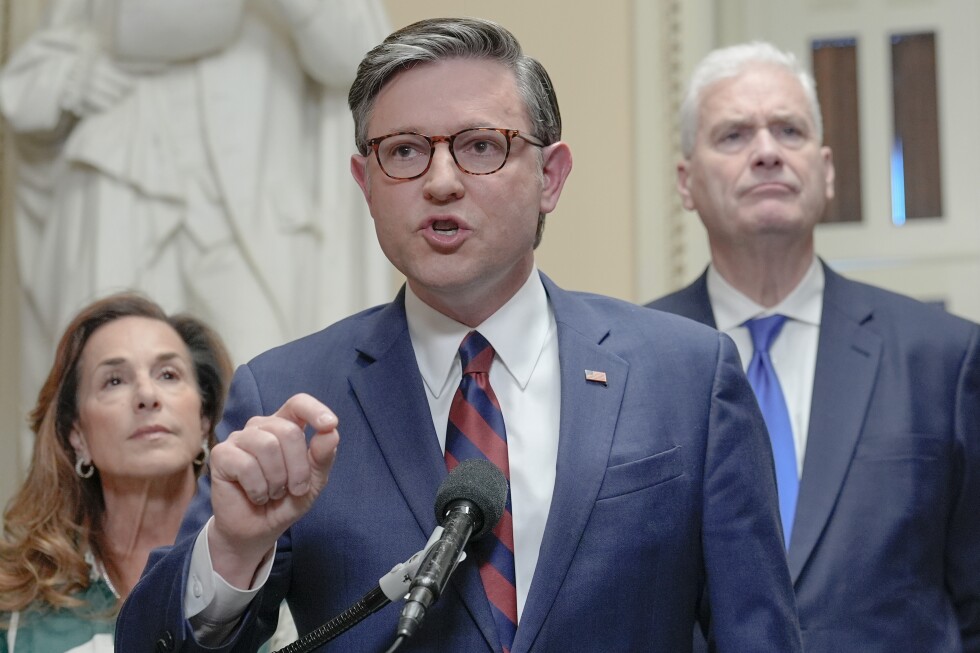
An incensed Johnson marched out of his office Friday afternoon. He angrily rebuked the plan that the Senate had unanimously agreed to as a “joke.”
“I have to protect the House, and I have to protect the American people,” Johnson told reporters.
It was a dramatic denunciation of a deal that his counterpart, Senate Majority Leader John Thune, R-S.D., had negotiated after weeks of effort, and the latest abrupt turn in a funding saga that has bedeviled top Republicans for much of the year.
The collapse leaves Congress, now on a two-week spring break, with no easy way out of the impasse that has left DHS in partial shutdown since mid-February. It also exposed a rare public rupture between the two Republican leaders in Congress, testing their alliances as they work to advance former President Donald Trump’s priorities before the November elections.
Senate Republicans had spent weeks negotiating with Democrats over new restrictions on the department’s immigration enforcement. After multiple failed votes and stalled talks, senators essentially settled on a compromise: They would exclude funding for U.S. Immigration and Customs Enforcement (ICE) and U.S. Border Patrol from the bill, while abandoning Democratic demands for new limits on these agencies.
Thune defended the compromise, noting that Congress had previously allocated money for immigration enforcement. He told reporters, “We can get at least a lot of the government opened up again and then we’ll go from there.”
When asked if he had secured Johnson’s approval for the deal, Thune indicated they had only exchanged text messages. “I don’t know what the House will do,” the senator admitted early Friday as the agreement came together.
The House Republican reaction was swift and furious. Rep. Nick LaLota, R-N.Y., reported that during a GOP conference call that morning, dozens of members across the ideological spectrum voiced opposition to the Senate’s actions.
“The Senate chickened out,” LaLota said. “The cowards there, only a few of them in the middle of the night with I think only three to five senators present on the floor, chickened out because they wanted to go home for two weeks. We need to raise the bar.”
This bitter divide threatens to complicate Republican leaders’ efforts to advance their agenda while they still control both chambers of Congress. Trump has identified legislation imposing strict new proof of citizenship requirements for voting as his top priority, but such measures face significant hurdles in the Senate, which requires a 60-vote threshold for most legislation.
Some Republicans are exploring alternative approaches, including a budget package that might incorporate elements of voter ID requirements. GOP lawmakers are also considering how to handle an anticipated White House request for war funding that could exceed $200 billion.
Meanwhile, Democrats have seized the opportunity to blame House Republicans for the ongoing partial shutdown. “They know this is a continuation of the shutdown because the Senate is gone,” said Rep. Katherine Clark of Massachusetts, the second-ranking House Democrat. “So they know fully well what they’re doing.”
The path forward remains unclear. A quick resumption of negotiations seems unlikely, as talks ended acrimoniously with each side blaming the other. Senate Democratic Leader Chuck Schumer of New York said he was proud of his caucus for “holding the line,” while Republican Sen. Susan Collins of Maine, who chairs the Senate Appropriations Committee, accused Democrats of being “intransigent and unreasonable.”
Thune expressed frustration, suggesting Democrats never intended to reach an agreement. “I felt like from the beginning, they just didn’t want to get to ‘yes,'” he said after the vote.
House Republicans appeared to celebrate their defiance of the Senate’s wishes. Rep. Virginia Foxx, R-N.C., described the Senate’s proposal as “nothing more than unconditional surrender masquerading as a solution.” She insisted the House “will not bend itself into submission by acquiescing.”
Those searching for a resolution to the shutdown seemed discouraged by the breakdown in inter-chamber communication. “This takes two chambers to get the job done,” noted Rep. Brian Fitzpatrick, a moderate Republican from Pennsylvania. “Apparently, there’s not enough communication between those chambers.”
As Congress begins its two-week recess, DHS remains caught in the middle of this political standoff, with no clear resolution in sight.
Fact Checker
Verify the accuracy of this article using The Disinformation Commission analysis and real-time sources.

5 Comments
The collapse of the funding deal is disappointing, as it leaves the Department of Homeland Security in partial shutdown. I hope the Republican leaders can find a compromise solution that protects national security interests.
This situation highlights the challenges of governing with narrow majorities in both chambers. The Republican leaders will need to demonstrate strong leadership to resolve the DHS funding impasse in a timely manner.
This is a complex political issue with valid concerns on both sides. I’m curious to see how the Republican leaders navigate this challenge and whether they can find a compromise that satisfies their respective constituencies.
It’s concerning to see such a public rift between the top Republican leaders in Congress. This partisan gridlock is not good for the country. I hope they can put aside their differences and find a bipartisan path forward.
This seems like a complex issue with competing priorities between the House and Senate GOP leaders. I’m curious to see how they’ll resolve the DHS funding impasse when Congress returns from recess.