


Listen to the article
House Democrats are set to oppose Senate Minority Leader Chuck Schumer’s spending deal with the White House, a move that threatens to extend the ongoing partial government shutdown, according to multiple sources familiar with the situation.
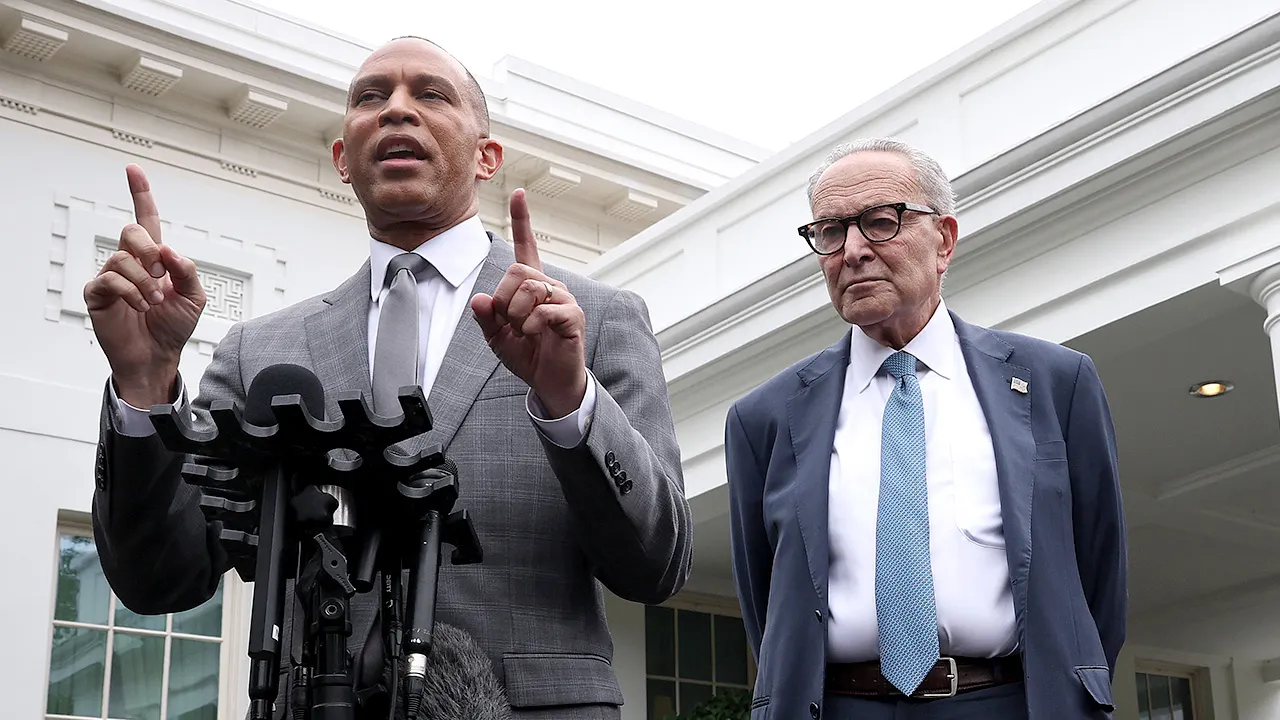
House Minority Leader Hakeem Jeffries has informed Speaker Mike Johnson that Republicans’ plan to fast-track the legislation on Monday evening would fail, according to four House GOP sources. This resistance means Johnson will need to rely heavily on his narrow Republican majority to navigate multiple procedural hurdles before a final vote can occur, likely no earlier than Tuesday.
The federal government entered a partial shutdown early Saturday morning after Congress failed to reach a budget compromise by the January 30 deadline. While some government agencies are already funded, spending remains uncertain for several key departments, including Defense, Transportation, Health and Human Services, and Homeland Security.
“House Democrats do not feel bound by the deal their counterparts in the Senate struck with President Donald Trump’s White House,” one source told Fox News Digital. The sources added that House Democrats are frustrated with Schumer for putting them in a position where they were expected to accept the agreement without input.
“Democrat division creates another government shutdown,” one House Republican lawmaker commented.
However, Republican leadership also faces challenges in securing votes within their own ranks. Several GOP members have expressed concerns about compromising with Democrats on immigration enforcement measures. Representative Anna Paulina Luna (R-Fla.) told Fox News Digital she would withhold support unless the bill includes an unrelated measure requiring proof of citizenship in voter registration processes.
Speaker Johnson had initially hoped to pass the legislation under “suspension of the rules,” which would expedite the process but require a two-thirds majority for passage. With Democratic opposition now apparent, the House Rules Committee will consider the legislation Monday afternoon before it faces a procedural rule vote and then a final passage vote.
House Majority Whip Tom Emmer signaled the anticipated Democratic resistance earlier Saturday, telling Fox News Live, “We can’t trust the minority leader to be able to get his members to do the right thing. That’s the issue.”
The compromise that passed the Senate on Friday combined five spending bills already approved by the House but notably excluded a bipartisan plan to fund the Department of Homeland Security. Instead, the deal would maintain DHS funding at current levels for two weeks while Democrats and Republicans negotiate a longer-term solution that would include modifications to Immigration and Customs Enforcement operations.
Democrats demanded these changes following federal law enforcement-involved killings of two U.S. citizens during anti-ICE demonstrations in Minneapolis. The politically sensitive nature of immigration enforcement has become a focal point of the funding dispute.
Jeffries made no firm commitments after the Senate passed the deal Friday, saying only, “The House Democratic Caucus will evaluate the spending legislation passed by the Senate on its merits and then decide how to proceed legislatively.”
The failure to quickly resolve the funding impasse risks disrupting paychecks for military personnel and airport workers, while also threatening funding for disaster management and federal healthcare services. The shutdown’s impacts will continue to grow the longer the legislative standoff persists.
The current situation highlights the complex dynamics between the two chambers of Congress and the growing polarization around immigration policy. With both parties digging in on their positions, finding a path forward that can satisfy competing demands remains a significant challenge for congressional leadership.
Fact Checker
Verify the accuracy of this article using The Disinformation Commission analysis and real-time sources.

14 Comments
The mining and energy sectors will be watching this closely, as a prolonged shutdown could disrupt permitting, inspections, and other regulatory functions that are critical for their operations. I wonder how this might impact commodity prices and project timelines.
You raise a good point. Instability in Washington can create uncertainty for businesses in these industries. Hopefully, a resolution can be reached soon to provide more clarity.
It’s concerning to see partisan divisions threatening to derail a budget agreement, especially on issues like defense and homeland security funding. I hope cooler heads can prevail and a compromise can be found.
Agreed. Partisan gridlock often leads to the worst outcomes for the American people. I’m hopeful the lawmakers can put politics aside and focus on the practical needs of the country.
This situation highlights the challenges of governing with a divided Congress. The House Democrats seem to be taking a tougher stance than their Senate counterparts. It will be interesting to see if they can leverage their position to extract concessions from the White House and Senate Republicans.
A prolonged shutdown could have serious implications for the mining and energy sectors, as it may disrupt critical regulatory functions. I wonder how this might impact commodity prices, project timelines, and overall investment sentiment in these industries.
Partisan gridlock is always concerning, as it can lead to suboptimal outcomes for the country. I hope the lawmakers are able to put politics aside and focus on finding a practical solution that meets the needs of all their constituents, including those in the mining and energy sectors.
Partisan gridlock is always concerning, as it can lead to suboptimal outcomes for the country. I hope the lawmakers are able to put politics aside and focus on finding a practical solution that meets the needs of all their constituents.
It’s disappointing to see the Senate and House Democrats take such divergent positions on this budget deal. Shutdowns are never good for the economy or public confidence in government. I hope they can find a way to compromise and get the government fully operational again soon.
This situation highlights the challenges of governing with a divided Congress. It will be interesting to see if the House Democrats can leverage their position to extract concessions from the White House and Senate Republicans.
That’s a good point. With slim majorities in both chambers, the parties may need to find creative ways to reach consensus. Compromise will likely be key to avoiding a protracted shutdown.
The mining and energy industries will be monitoring this closely, as a prolonged shutdown could disrupt permitting, inspections, and other regulatory activities critical to their operations. I wonder how this might impact commodity prices and project timelines in the near term.
This is an interesting development. It seems the House Democrats are taking a different stance from their Senate counterparts on the budget deal. I’m curious to see how this plays out and whether a compromise can be reached to avoid an extended shutdown.
Shutdowns are always troubling, as they can have real impacts on government services and the economy. I hope the parties can find a path forward that addresses the concerns of all sides.