


Listen to the article
Federal Immigration Agents Reportedly Using Disguises in Minnesota Crackdown
Luis Ramirez had been watching them for days – men dressed as utility workers lingering outside his family’s Mexican restaurant in suburban Minneapolis. Something didn’t add up. Their high-visibility vests and spotless white hard hats looked too pristine, and the Wisconsin-based electrical company advertised on their vehicle couldn’t be found online.
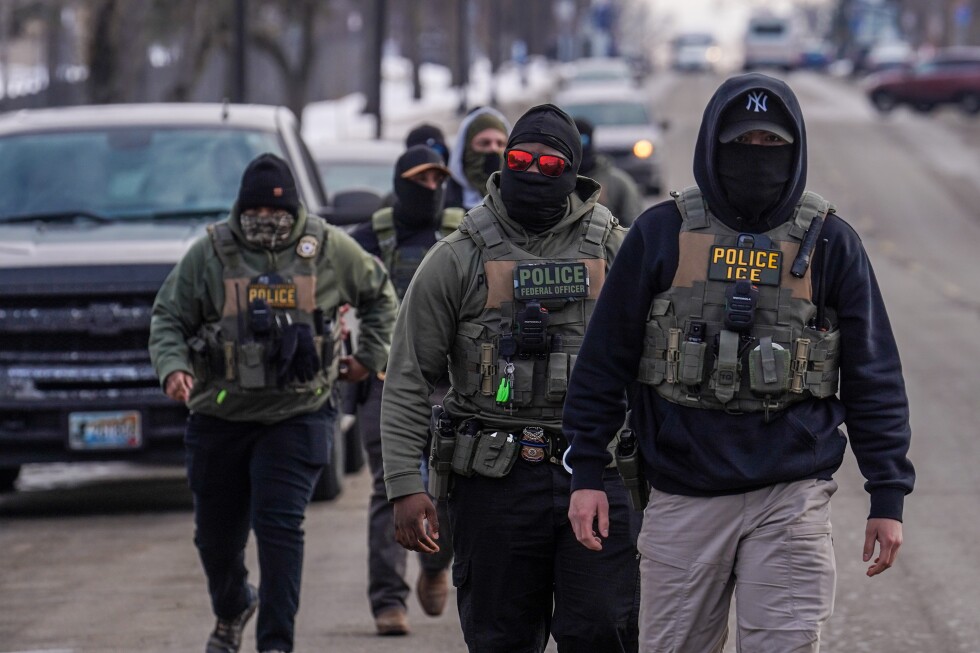
On Tuesday, when their Nissan returned to the parking lot, Ramirez confronted the men. He filmed as they hid their faces, revealing what appeared to be heavy tactical gear beneath their yellow vests.
“This is what our taxpayer money goes to: renting these vehicles with fake tags to come sit here and watch my business,” Ramirez shouted in the video.
While the Department of Homeland Security and Immigration and Customs Enforcement (ICE) did not respond to inquiries about whether the men were federal agents, incidents like these have become increasingly common in Minnesota amid an ongoing immigration enforcement operation.
Legal observers and local officials report a growing number of federal agents allegedly impersonating construction workers, delivery drivers and even anti-ICE activists. These tactics have heightened fears in immigrant communities already unsettled by increased enforcement activity.
“If you have people afraid that the electrical worker outside their house might be ICE, you’re inviting public distrust and confusion on a much more dangerous level,” said Naureen Shah, director of immigration advocacy at the American Civil Liberties Union. “This is what you do if you’re trying to control a populace, not trying to do routine, professional law enforcement.”
Immigration authorities have historically used deceptive tactics, known internally as “ruses,” to gain entry into homes without warrants. These practices reportedly became more prevalent during former President Trump’s first term, leading to an ACLU lawsuit that accused immigration agents of violating constitutional rights by posing as local law enforcement during home raids.
A recent settlement restricted such practices in Los Angeles, but ICE deceptions remain legal elsewhere in the country. However, observers note that the current undercover operations in Minnesota appear to represent a significant escalation.
The tactics may partly be a response to Minnesota’s organized networks of citizen observers who track and report ICE activity. At the Bishop Henry Whipple Federal Building in Minneapolis, a hub of ICE operations, activists have reported seeing agents departing in vehicles with stuffed animals on dashboards or Mexican flag decals on bumpers. Pickup trucks loaded with lumber or tools have also been frequently spotted.
“We’ve seen an increase in the cowboy tactics,” said Jose Alvillar, lead organizer for the immigrant rights group Unidos MN. He noted that federal agents have repeatedly shown up at construction sites dressed as workers, though these visits hadn’t resulted in arrests. “Construction workers are good at identifying who is a real construction worker and who is dressing up as one.”
Local officials, including Democratic Governor Tim Walz, have alleged that ICE agents have been swapping license plates or using fake ones – a violation of state law. Candice Metrailer, an antiques dealer in south Minneapolis, believes she witnessed such an attempt firsthand when two men visited her shop looking for “recent” license plates.
After becoming suspicious, Metrailer checked the plate number of their vehicle in a crowdsourced database used by local activists. The database showed an identical Ford with the same plates had been photographed leaving the Whipple building seven times and had been reported at the scene of an immigration arrest weeks earlier.
Supporters of the immigration crackdown argue that the volunteer network of ICE-tracking activists has forced agents to adapt their methods. “Of course agents are adapting their tactics so that they’re a step ahead,” said Scott Mechkowski, former deputy director of ICE enforcement and operations in New York City. “We’ve never seen this level of obstruction and interference.”
However, Mechkowski also noted that in his nearly three decades in immigration enforcement, he hadn’t seen ICE agents disguising themselves as uniformed workers while making arrests.
Earlier this summer, a DHS spokesperson confirmed that a man wearing a high-visibility construction vest was an ICE agent conducting surveillance. In Oregon, a natural gas company recently published guidance to help customers identify legitimate employees after reports of federal impersonators circulated.
For Ramirez, the restaurant worker, the encounter has left him on high alert. He recently stopped a locksmith he feared might be a federal agent, before quickly realizing the person was a local resident.
“Everybody is on edge about these guys, man,” Ramirez said. “It feels like they’re everywhere.”
Fact Checker
Verify the accuracy of this article using The Disinformation Commission analysis and real-time sources.

10 Comments
I’m curious to learn more about the legal justification for these alleged tactics. Impersonating utility workers or delivery drivers to conduct immigration raids seems like a questionable tactic that could undermine the credibility of legitimate enforcement efforts.
That’s a good question. The use of disguises and subterfuge raises serious concerns about the methods and motivations behind these operations. Transparency and accountability should be the top priorities.
This is deeply concerning. Using disguises to conduct immigration enforcement operations is a troubling tactic that erodes trust between authorities and the community. Transparency and accountability should be paramount, not deception.
Agreed. Impersonating utility workers or delivery drivers to carry out raids is an abuse of power and undermines the integrity of law enforcement efforts.
If true, these ICE tactics are deeply troubling. Eroding public trust and creating an atmosphere of fear and uncertainty is no way to conduct law enforcement operations, regardless of one’s views on immigration policy.
Exactly. Resorting to deception and impersonation is a concerning abuse of authority. This approach seems more designed to sow fear than to uphold the law effectively and fairly.
While immigration is a complex issue, these reported tactics seem heavy-handed and counterproductive. Fostering fear and suspicion within local communities is not an effective or ethical approach to enforcement.
I share your concerns. Using disguises and subterfuge to target immigrant-owned businesses is a troubling escalation that could have serious consequences for community relations.
This is a troubling development that merits close scrutiny. The reported use of disguises and deception by federal agents erodes public trust and appears to violate principles of ethical law enforcement. The long-term consequences could be quite damaging.
I agree. These alleged tactics seem like an abuse of power that could backfire and further inflame tensions in the community. A heavy-handed approach is unlikely to produce positive outcomes.