


Listen to the article
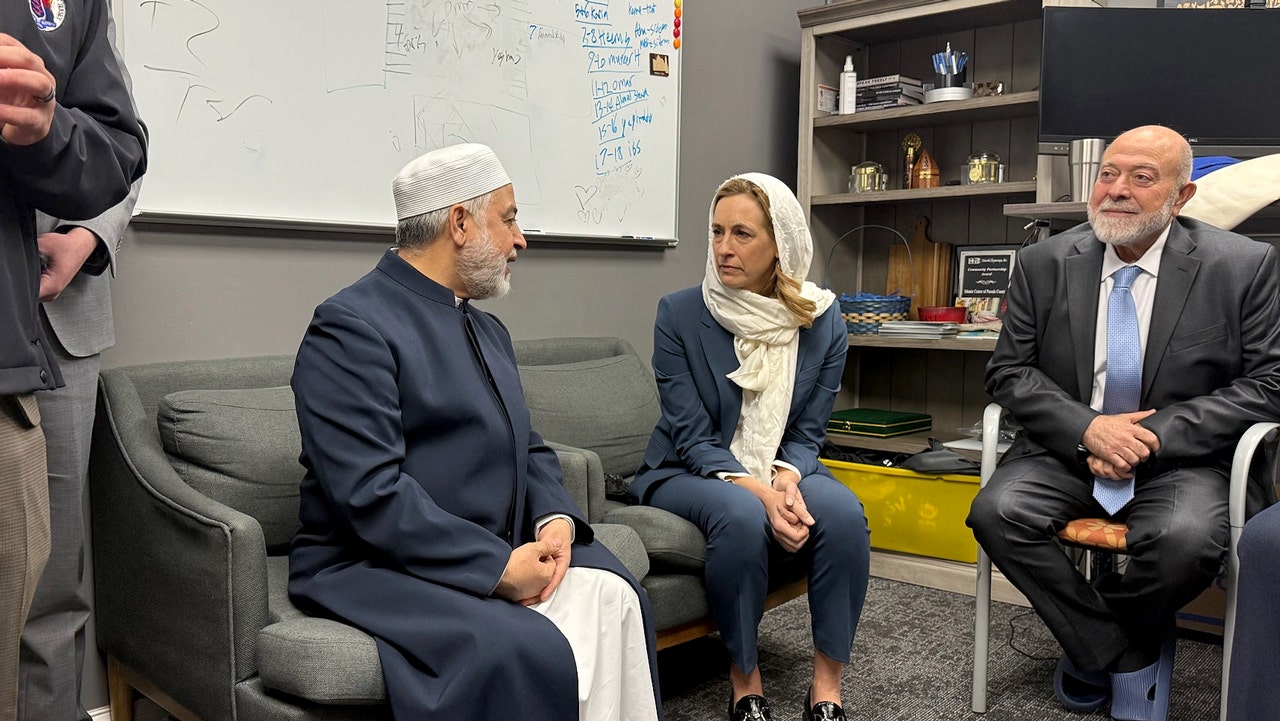
New Jersey Governor Mikie Sherrill recently attended Eid al-Fitr celebrations at the Islamic Center of Passaic County, where she engaged with the local Muslim community as they marked the end of Ramadan. Photos shared on the governor’s social media showed her wearing a hijab and interacting with congregants, including the mosque’s longtime spiritual leader, Imam Mohammad Qatanani.
“Thank you to the Islamic Center of Passaic County for welcoming me to join their celebration as the holy month of Ramadan comes to a close,” Sherrill wrote in her post. “I wish our Muslim neighbors a safe, joyous, and peaceful Eid al-Fitr.”
The governor’s visit has drawn attention due to Qatanani’s controversial immigration history. The Palestinian-born cleric has been at the center of a protracted legal battle spanning nearly two decades after federal authorities sought to deport him, citing alleged ties to Hamas and claims he failed to disclose a prior detention in Israel on his green card application.
Qatanani has consistently denied these allegations throughout the legal proceedings, maintaining that while he was detained in Israel, he was never convicted of any wrongdoing. His case highlights the complex intersection of immigration policy, national security concerns, and religious leadership within American Muslim communities.
The legal journey began in the mid-2000s when the federal government initiated deportation proceedings. In 2008, an immigration judge ruled in Qatanani’s favor, finding the government’s evidence, including Israeli court documents, to be unreliable. The judge determined that prosecutors had failed to prove Qatanani had engaged in terrorist activity as alleged.
Court records from the proceedings raised significant questions about the reliability of statements attributed to Qatanani, with some suggesting they may have been obtained under coercive conditions. This factor contributed to multiple rulings that ultimately favored the imam’s case to remain in the United States.
The long-running case came to a resolution in 2025 when a federal appeals court blocked his deportation. The court ruled that immigration officials had acted improperly when attempting to reverse his legal permanent resident status. Specifically, the Board of Immigration Appeals was found to have “exceeded its authority” by trying to use an agency regulation in a manner inconsistent with procedures established by Congress.
It’s worth noting that the court’s decision focused primarily on procedural matters rather than directly addressing the underlying allegations. The ruling determined that federal authorities had failed to follow required procedures after missing deadlines to challenge a key ruling that had granted Qatanani permanent residency.
Despite the controversy, Qatanani has maintained significant support within New Jersey’s Muslim community, where he continues to serve as a spiritual leader. The Islamic Center of Passaic County represents one of the state’s largest and most influential Muslim congregations, serving thousands of residents in northern New Jersey.
New Jersey has one of the largest Muslim populations in the United States, with significant communities in cities like Paterson, Jersey City, and Newark. Engaging with these communities has become increasingly important for elected officials, particularly during significant religious observances like Ramadan and Eid.
Governor Sherrill’s visit reflects a broader pattern of political outreach to religious communities across the state, though it remains unclear whether she was aware of Qatanani’s full legal history at the time of her visit. Her office has not yet responded to requests for comment regarding the matter.
The governor’s participation in the Eid celebration comes at a time of heightened sensitivities regarding Muslim community relations, particularly in the wake of ongoing conflicts in the Middle East that have intensified discussions about religious inclusion and representation in American politics.
For Qatanani, the 2025 court decision represented the culmination of a lengthy legal battle that allowed him to continue his religious leadership role within the community he has served for decades.
Fact Checker
Verify the accuracy of this article using The Disinformation Commission analysis and real-time sources.

7 Comments
This is a complex issue with valid security concerns, but also important considerations around religious freedom and community relations. I hope the authorities can investigate thoroughly while also upholding democratic principles of tolerance and inclusion.
This is a sensitive issue that requires nuanced handling. On one hand, the governor’s outreach to the Muslim community is admirable. On the other, the serious allegations against the imam merit careful scrutiny to ensure the safety and security of all citizens.
The governor’s visit to the mosque raises some interesting questions about vetting and transparency when it comes to religious leaders with potential links to extremist groups. It’s important to strike the right balance between religious freedom and national security.
The governor’s visit raises some red flags, given the imam’s alleged ties to Hamas. While engagement with the Muslim community is commendable, associating with individuals facing such serious allegations requires extreme caution and due diligence.
Attending a mosque service is a meaningful gesture of inclusion, but the governor should be cautious about affiliating too closely with an individual facing serious allegations. Responsible leadership requires carefully vetting all partners, especially on sensitive national security matters.
This seems like a complex issue with valid concerns on both sides. I hope the authorities are able to thoroughly investigate the imam’s background and associations to ensure the community’s safety, while also respecting religious liberty.
While I appreciate the governor’s efforts to engage with the local Muslim community, the alleged ties between the imam and Hamas are certainly concerning. Maintaining public trust requires being selective about who one chooses to associate with in an official capacity.