


Listen to the article
Republicans Face Senate Roadblock on SAVE America Act
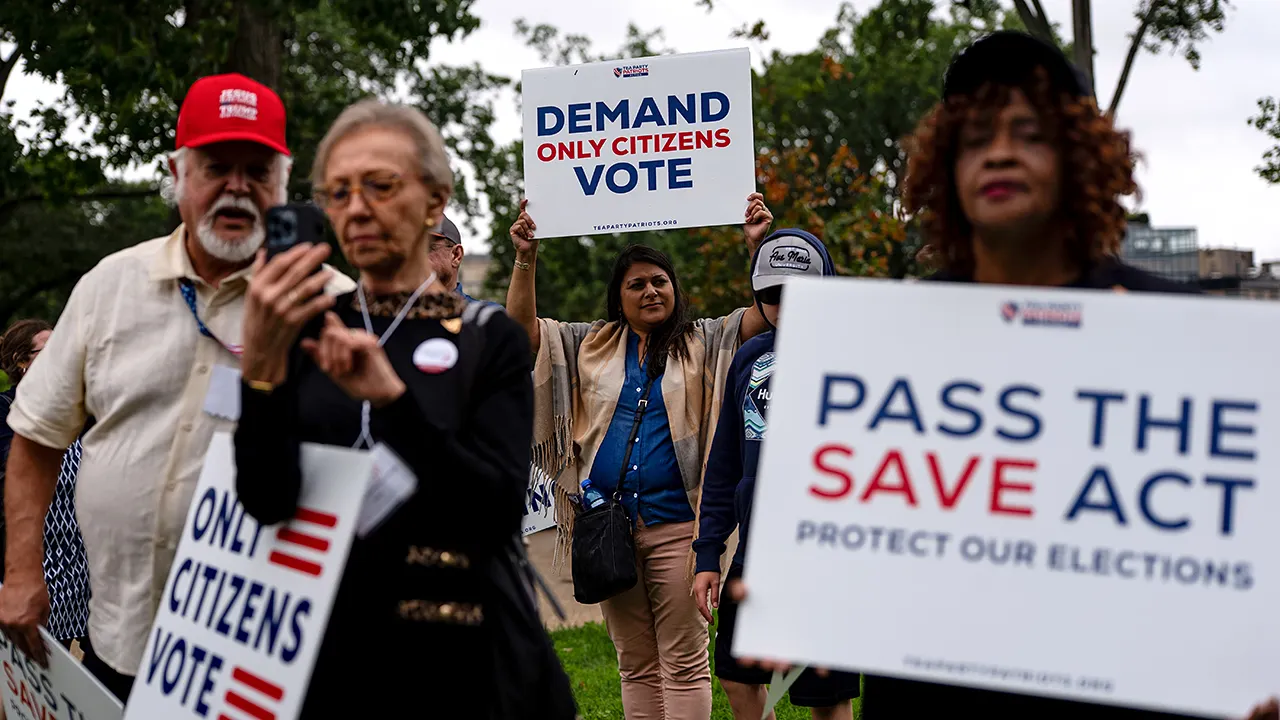
Congressional Republicans are rallying behind the SAVE America Act, which would require proof of citizenship to vote, but face significant hurdles in getting the legislation passed through the Senate despite its status as a cornerstone of President Donald Trump’s legislative agenda.
“We need to make it easy to vote and hard to cheat in America,” said Sen. Jon Husted, R-Ohio, echoing Republican support for the measure. Sen. Rick Scott of Florida emphasized the bill’s importance, noting Republicans “have to figure out how to get it passed.”
The challenge lies in the Senate’s procedural rules. Senate Majority Leader John Thune, R-S.D., has promised to bring the bill to the floor for “a full and robust debate,” but Republicans lack the 60 votes needed to overcome a Democratic filibuster. With only 53 Republican senators, the math simply doesn’t work.
Democrats have firmly positioned themselves against the legislation. Senate Minority Leader Chuck Schumer, D-N.Y., called it “one of the worst things we’ve seen in America in a very long time,” while Minority Whip Dick Durbin, D-Ill., claimed, “The real reason this president wants this bill to pass is to reduce the number of people voting in the November election.”
President Trump has emphasized the bill’s significance by warning he wouldn’t sign any other legislation into law—except perhaps a Department of Homeland Security funding measure—until Congress passes the SAVE America Act.
This impasse has led some Republicans to suggest dramatic procedural changes. Sen. Roger Marshall, R-Kan., declared he would “nuke the filibuster” to pass the bill, referring to eliminating the 60-vote threshold for legislation. Sen. Ron Johnson, R-Wis., framed the issue as preemptive, suggesting Republicans should eliminate the filibuster before Democrats potentially regain Senate control and do so themselves.
Other Republicans have advocated forcing Democrats to conduct a traditional “talking filibuster,” where opponents must continuously hold the floor. “They should have to go hold the floor like it used to be in the old days. They can go and talk as much as they want. But sooner or later they’re going to run out of time,” said Sen. Josh Hawley, R-Mo., invoking images of Jimmy Stewart’s character in “Mr. Smith Goes to Washington.”
However, many Republican senators reject this approach, concerned about an unlimited amendment process that could create what Sen. Thom Tillis, R-N.C., described as “a goat rodeo” lasting potentially “two or three weeks.” Tillis questioned the practical implementation: “I haven’t had anybody describe to me the project plan… and this is how we succeed at the end.”
Majority Leader Thune plans to allow extended debate—perhaps a week or more, potentially around the clock—but will maintain “ball control” by blocking amendments from both sides. He won’t immediately call for a 60-vote threshold to end debate but won’t permit the free-flowing amendment process that some conservatives want either.
The fundamental issue remains vote counts. “Many of us don’t believe that we should undo the filibuster because it holds the rights of the majority. And one day we’ll be back in the minority,” explained Sen. Shelley Moore Capito, R-W.Va., adding, “There’s not enough numbers to get it done.”
President Trump has begun applying pressure on Thune, though more gently than his criticism of former Majority Leader Mitch McConnell during his first term. “I think he’s a wonderful person. I do,” Trump said of Thune on Fox News Radio. “But it’s not that he doesn’t want to do it. He doesn’t think he can do it. And that’s bad.”
The Senate is scheduled to take a test vote Tuesday afternoon just to start debate on the bill, requiring only a simple majority. Vice President JD Vance may need to break a tie to launch this initial debate.
Despite the procedural maneuvering, the political reality remains stark: Without the votes to change Senate rules or overcome a Democratic filibuster, Republicans face the prospect of failing to deliver on a key Trump priority—potentially risking backlash from their base and the president himself.
Fact Checker
Verify the accuracy of this article using The Disinformation Commission analysis and real-time sources.

19 Comments
Production mix shifting toward Politics might help margins if metals stay firm.
If AISC keeps dropping, this becomes investable for me.
Good point. Watching costs and grades closely.
Uranium names keep pushing higher—supply still tight into 2026.
Good point. Watching costs and grades closely.
Good point. Watching costs and grades closely.
The cost guidance is better than expected. If they deliver, the stock could rerate.
Silver leverage is strong here; beta cuts both ways though.
Good point. Watching costs and grades closely.
Silver leverage is strong here; beta cuts both ways though.
Good point. Watching costs and grades closely.
Good point. Watching costs and grades closely.
Uranium names keep pushing higher—supply still tight into 2026.
I like the balance sheet here—less leverage than peers.
Good point. Watching costs and grades closely.
Good point. Watching costs and grades closely.
Exploration results look promising, but permitting will be the key risk.
Uranium names keep pushing higher—supply still tight into 2026.
Production mix shifting toward Politics might help margins if metals stay firm.