


Listen to the article
Georgia’s State Election Board has rejected a proposed rule that would have defined circumstances when hand-marked paper ballots could replace the state’s touchscreen voting machines, highlighting ongoing tensions over Georgia’s voting systems.
The proposal failed Wednesday on a 2-2 vote after board members debated whether such a rule would exceed their legal authority. Vice Chair Janice Johnston, who voted against the measure, acknowledged the issue should be handled by state legislators, saying, “This really is the duty and the job of the legislators.”
The rejected rule would have specified conditions under which the use of voting machines could be considered “impossible or impracticable,” expanding situations beyond current emergency provisions that allow for paper ballot backup systems.
Proponents argued that current touchscreen voting machines violate state law because voters cannot verify the QR codes that actually record their votes, and that the machines’ design compromises voter privacy. Jeanne Dufort, a county Democratic official who co-authored the bipartisan proposal, told the board, “You have both the duty and the responsibility for the conduct of legal elections in Georgia.”
The debate reflects a long-running controversy in Georgia, where voting machine critics have raised concerns since before the 2020 election. After that election, opposition intensified as conspiracy theories spread among supporters of former President Donald Trump who claimed the machines were used to manipulate results.
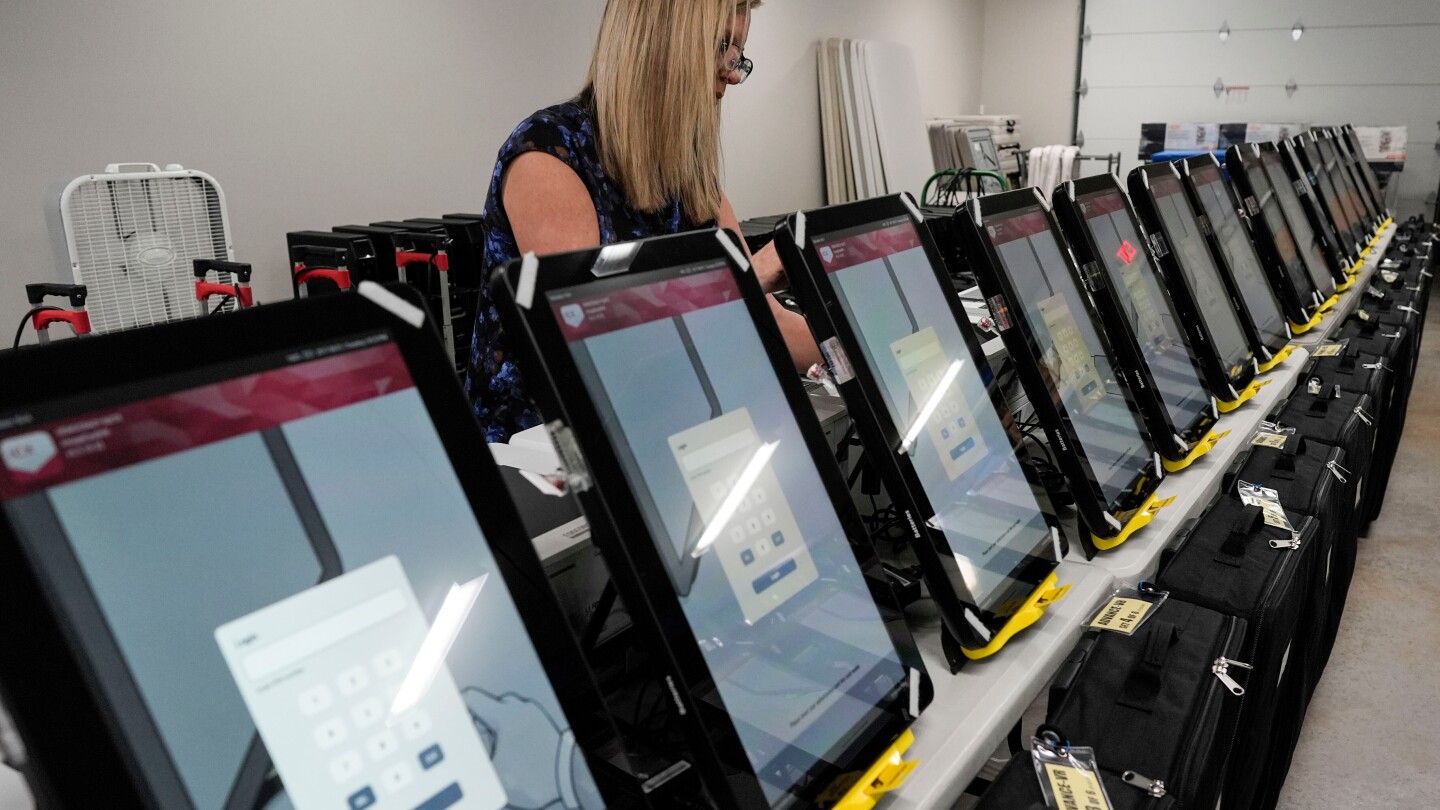
Georgia implemented its current voting system statewide ahead of the 2020 primaries. The system, manufactured by Dominion Voting Systems (recently acquired by Liberty Vote), features touchscreen machines that print ballots with both a human-readable list of selections and a machine-readable QR code used for the actual vote tabulation.
Critics have consistently argued that voters cannot verify their ballots are accurate because they cannot interpret the QR codes. They also contend the machines’ large screens compromise ballot secrecy and that the system contains unaddressed security vulnerabilities. Georgia election officials maintain the system is secure and produces reliable results.
Salleigh Grubbs, first vice chair of the Georgia Republican Party and the proposal’s other co-author, argued the board should act because legislators and Secretary of State Brad Raffensperger haven’t yet implemented a law passed to eliminate QR codes from ballots after July 1, 2026. “We are already voting on an illegal system,” Grubbs claimed.
Critics of the proposal, including key legislators and representatives from the state attorney general’s office, warned the board would exceed its authority by adopting the rule. They referenced a recent Georgia Supreme Court ruling that clarified the board can pass rules to implement and enforce election laws but cannot “go beyond, change or contradict” them.
Sara Tindall Ghazal, the board’s lone Democrat and only attorney, voted against the rule, cautioning, “We are putting ourselves at risk of getting swatted back under the very precedent that was created to constrain and orient this board.”
Some opponents expressed concern that the proposal could have facilitated a widespread shift to hand-marked paper ballots, bypassing state requirements for touchscreen voting machines. Janet Green, a DeKalb County poll worker, characterized the proposal as “a backdoor attempt to move Georgia to the routine use of hand-marked paper ballots,” a change many Republican activists have advocated for since 2020.
State Representative Victor Anderson, who serves as vice chair of a special study committee on elections, indicated legislators are already working to address voting machine concerns. “The proposed rule is trying to get ahead of that before we handle it through the proper sources,” he told The Associated Press.
Following the vote, board members committed to lobbying lawmakers to consider incorporating elements of the proposal into state law. “We will be in communication with the General Assembly to address the problem they created,” Johnston stated.
The debate highlights ongoing tensions over election administration in Georgia, a crucial battleground state that continues to grapple with election security concerns and partisan divisions over voting procedures ahead of the upcoming election cycle.
Fact Checker
Verify the accuracy of this article using The Disinformation Commission analysis and real-time sources.

30 Comments
Nice to see insider buying—usually a good signal in this space.
Good point. Watching costs and grades closely.
Uranium names keep pushing higher—supply still tight into 2026.
Good point. Watching costs and grades closely.
Exploration results look promising, but permitting will be the key risk.
Good point. Watching costs and grades closely.
Good point. Watching costs and grades closely.
I like the balance sheet here—less leverage than peers.
Good point. Watching costs and grades closely.
The cost guidance is better than expected. If they deliver, the stock could rerate.
Good point. Watching costs and grades closely.
Good point. Watching costs and grades closely.
If AISC keeps dropping, this becomes investable for me.
The cost guidance is better than expected. If they deliver, the stock could rerate.
Good point. Watching costs and grades closely.
Good point. Watching costs and grades closely.
The cost guidance is better than expected. If they deliver, the stock could rerate.
Good point. Watching costs and grades closely.
Good point. Watching costs and grades closely.
Exploration results look promising, but permitting will be the key risk.
Good point. Watching costs and grades closely.
I like the balance sheet here—less leverage than peers.
Good point. Watching costs and grades closely.
The cost guidance is better than expected. If they deliver, the stock could rerate.
Good point. Watching costs and grades closely.
I like the balance sheet here—less leverage than peers.
Nice to see insider buying—usually a good signal in this space.
Good point. Watching costs and grades closely.
Good point. Watching costs and grades closely.
I like the balance sheet here—less leverage than peers.