


Listen to the article
California Democrats Fear Election Quirk Could Hand Governorship to Republicans
LOS ANGELES — In an unprecedented move that has sparked internal party conflict, California Democratic Party Chair Rusty Hicks has urged trailing Democratic candidates in the governor’s race to withdraw, fearing the state’s unique primary system could inadvertently deliver the governorship to Republicans for the first time in 16 years.
“I recognize my suggestions are hard for many to contemplate and may be even viewed as overly harsh,” Hicks wrote in a statement Tuesday, expressing concern about California’s top-two primary system. Under this format, all candidates appear on a single ballot, with only the top two vote-getters advancing to the November general election regardless of party affiliation.
The chair’s intervention comes as polling suggests the crowded field of Democratic candidates could split their party’s vote so thoroughly that two Republicans—Riverside County Sheriff Chad Bianco and conservative commentator Steve Hilton, both Trump supporters—might claim both general election slots.
Such an outcome could have far-reaching consequences beyond California’s borders. Democrats fear that without a gubernatorial candidate at the top of the ticket, voter turnout could plummet in November, potentially hampering the party’s efforts to regain control of the U.S. House of Representatives.
Governor Gavin Newsom, who has not endorsed any candidate, acknowledged the legitimacy of Hicks’ concerns. “I’ll be candid with you. My first reaction is: I get why he sent it. There is some concern,” Newsom said.
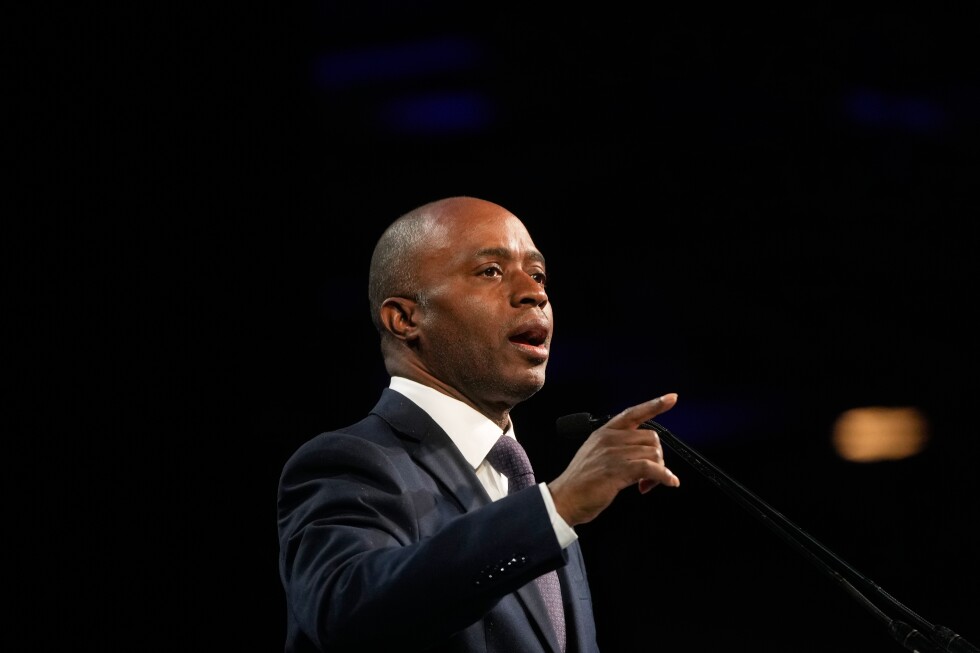
The unusual warning has met swift resistance from several candidates, particularly those from diverse backgrounds who interpreted the message as targeting them specifically. State Schools Superintendent Tony Thurmond, who is Black, responded defiantly: “The party is essentially telling every candidate of color to drop out. Aren’t we supposed to be the party who embraces democracy?” He vowed to remain in the race.
Former State Controller Betty Yee, the daughter of Chinese immigrants, did not directly address Hicks’ statement but proceeded to file her official candidacy paperwork Tuesday. San Jose Mayor Matt Mahan’s campaign responded that “voters choose the next governor, not political gatekeepers.”
The 2024 governor’s race represents the first time since California adopted the top-two primary system that there’s been no clear frontrunner, attracting numerous Democratic candidates. The field includes current and former members of Congress Katie Porter, Eric Swalwell, and Xavier Becerra (who later served in the Biden administration); billionaire Tom Steyer; former Los Angeles Mayor Antonio Villaraigosa; former State Assembly Majority Leader Ian Calderon; along with Thurmond, Yee, and Mahan.
Recent polling by the nonpartisan Public Policy Institute of California shows the field divided into two tiers, with Hilton, Porter, Bianco, Swalwell, and Steyer closely competing at the top, while other candidates trail significantly.
Democratic anxiety intensified after Silicon Valley entrepreneur and Republican Jon Slavet withdrew from the race, potentially allowing conservative support to consolidate behind Bianco and Hilton. Democratic strategist Paul Mitchell, who has conducted statistical simulations based on polling data, estimates the chance of an all-Republican ticket in November has now reached 25%.
“Republicans are consolidating their vote behind two candidates,” Mitchell explained. Slavet’s withdrawal “just helps clarify the concern Democrats have.”
The situation has also triggered infighting among Democrats. Villaraigosa’s campaign issued a statement calling on Becerra to drop out, suggesting this would reduce the chances of a Republican sweep. Both candidates are Latino and competing for support within that community.
Democratic strategist Drexel Heard II, former executive director of the Los Angeles County Democratic Party, supported Hicks’ intervention, stating that “any party’s role and mission has always been to shepherd the best candidates and then win the race.”
A Republican victory in California would represent a seismic political shift in a state where registered Democrats outnumber Republicans by nearly 2-to-1. Democrats also hold overwhelming control of the state legislature, where Republicans have been reduced to a largely symbolic minority.
As the June 4 primary approaches, Democrats face the difficult balancing act of preserving candidate diversity while preventing an unprecedented electoral setback in one of the nation’s most reliably blue states.
Fact Checker
Verify the accuracy of this article using The Disinformation Commission analysis and real-time sources.

18 Comments
Interesting to see the internal party dynamics at play here. It’s a tricky balance between respecting voter choice and trying to avoid an undesirable outcome. I’m curious to see how this unfolds and whether the Democratic candidates heed the party chair’s call to withdraw.
Yes, it’s a complex situation with no easy answers. The top-two primary system can certainly produce some unexpected results, so the party’s concerns are understandable.
This is a fascinating development in the California governor’s race. The party chair’s intervention raises some interesting questions about the role of party leadership and the dynamics of the top-two primary system. I’ll be following this closely to see how it plays out.
Yes, it will be interesting to see if the lagging Democratic candidates heed the party chair’s call or if they choose to stay in the race and let the voters decide.
The top-two primary system can certainly lead to some unexpected outcomes. While I sympathize with the Democratic party’s concerns, I’m not sure it’s their place to be urging candidates to withdraw. Voters should have the final say.
Agreed. The primary process should be about letting the voters choose, not party elites trying to manipulate the outcome.
This is a fascinating development in the California governor’s race. The party chair’s call for lagging Democratic candidates to withdraw highlights the tensions between respecting voter choice and trying to avoid an undesirable outcome. I’ll be following this closely to see how the candidates and voters respond.
Absolutely. The top-two primary system can certainly lead to some unexpected results, so the party’s concerns are understandable. But ultimately, the democratic process should be respected.
The California Democratic party’s dilemma highlights the tricky balance between respecting voter choice and trying to avoid an undesirable outcome. While I understand their concerns, I’m not sure it’s their place to be urging candidates to withdraw. Curious to see how this unfolds.
Agreed. The primary process should be about letting the voters choose, not party elites trying to manipulate the outcome. It will be interesting to see how the candidates respond.
The Democratic party’s dilemma in California raises some important questions about the role of party leadership and the dynamics of the top-two primary system. While I can empathize with their concerns, I’m not sure it’s their place to be urging candidates to withdraw. Voters should have the final say. Curious to see how this unfolds.
Agreed. The primary process should be about letting the voters choose, not party elites trying to manipulate the outcome. It will be interesting to see how the candidates respond to the party chair’s request.
This seems like a tough call for the Democratic party in California. On one hand, they want to respect the democratic process, but on the other, they’re worried about the potential for a GOP upset. It will be interesting to see how the candidates respond to the party chair’s request.
I can understand the party’s perspective, but ultimately the voters should decide. It will be up to the candidates to make their case to the electorate.
The party chair’s intervention in the California governor’s race raises some interesting questions about the role of party leadership and the dynamics of the top-two primary system. While I can understand the Democratic party’s concerns, I’m not sure it’s their place to be urging candidates to withdraw. Voters should have the final say.
Agreed. The primary process should be about letting the voters choose, not party elites trying to manipulate the outcome. It will be interesting to see how this plays out.
This is a complex issue with valid arguments on both sides. On one hand, the Democratic party’s concerns about a potential GOP upset are understandable. But on the other, the voters should have the final say. It will be interesting to see how this plays out and whether the lagging candidates heed the party chair’s call.
Exactly. The top-two primary system can certainly lead to some unexpected results, but ultimately the democratic process should be respected. Curious to see how the candidates respond.