


Listen to the article
President Trump’s Economic Claims Under Scrutiny: A Fact Check on Tariffs and Growth
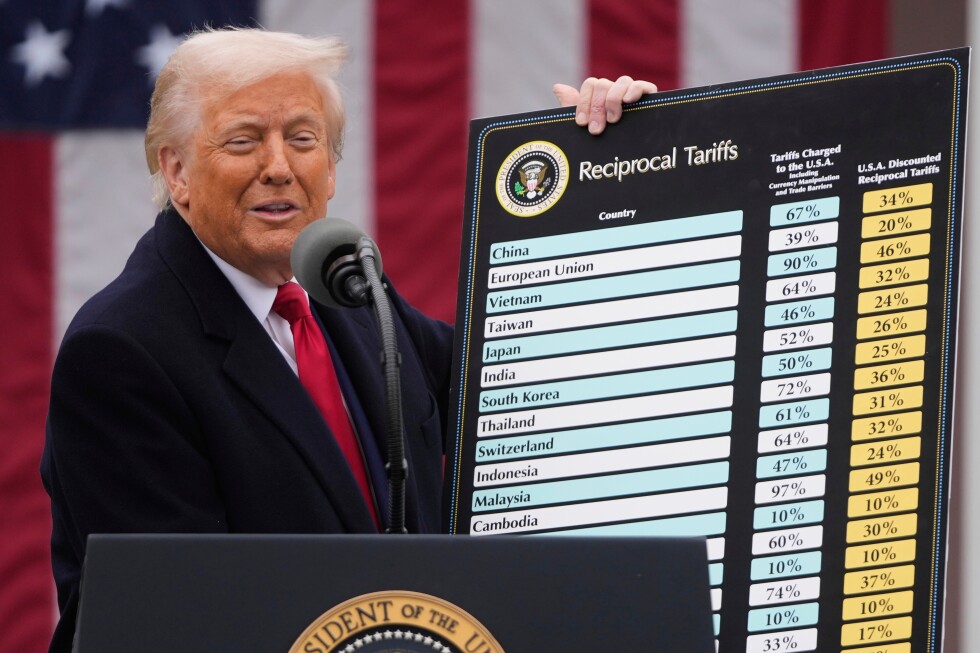
President Donald Trump has recently touted what he describes as an “American economic miracle” during the first year of his second term, attributing economic success primarily to his administration’s tariff policies. In an opinion piece published in The Wall Street Journal, Trump criticized economists and media outlets that predicted his tariffs would harm the economy. However, an analysis of his claims reveals significant discrepancies between the president’s assertions and economic reality.
Contrary to Trump’s characterization of inheriting a “DEAD” economy in January 2025, the United States was already performing strongly before his return to office. Under the Biden administration in 2024, U.S. gross domestic product grew by 2.8%, outpacing nearly all other wealthy nations except Spain, and maintained healthy expansion from 2021 through 2023.
Trump’s second term began with economic turbulence directly linked to his tariff threats. The first quarter of 2025 saw GDP shrink for the first time in three years, primarily due to a surge in imports as companies rushed to purchase foreign products before anticipated tariffs took effect. However, the economy rebounded impressively in subsequent quarters, with growth rates of 3.8% from April through June and 4.4% from July through September, partly driven by a drop in imports and strong consumer spending.
While Trump highlighted the U.S. stock market’s performance, noting 52 record highs in 2025, international context paints a different picture. The S&P 500 index climbed 17% last year—a solid performance but significantly behind several foreign markets, including South Korea (71%), Hong Kong (29%), Japan (26%), Germany (22%), and the United Kingdom (21%).
On inflation, the president’s claim of 1.4% annual core inflation over three months uses cherry-picked data affected by the government shutdown in October and November 2025, which disrupted data collection and led to artificial estimates. A more accurate measure shows annual core inflation for the final six months of 2025 at 2.6%, which represents little change from October 2024. Overall inflation remained at 3% in September 2025—exactly where it stood in January.
The administration’s retreat from some planned “Liberation Day” tariffs on products like coffee, beef, and kitchen cabinets following Democratic election victories focused on affordability concerns represents a tacit acknowledgment that tariffs were indeed affecting consumer prices. Harvard economist Alberto Cavallo, whose research Trump selectively cited, actually found that the president’s tariffs boosted overall inflation by approximately 0.75 percentage points.
Trump’s assertion that foreign producers bear “at least 80%” of tariff costs directly contradicts the Harvard Business School study he referenced. That research found U.S. consumers shouldered roughly 43% of tariff costs after seven months, with American firms absorbing most of the remainder. Cavallo noted that import prices hadn’t fallen significantly, indicating “foreign exporters did not reduce their pre-tariff prices enough to shoulder a large share of the burden.”
Regarding trade deficits, the president’s claim of slashing the monthly deficit by 77% involves selective data points—comparing a high January 2025 deficit with an unusually low October figure. The broader picture shows that from January through November 2025, the U.S. accumulated a trade deficit of nearly $840 billion, actually 4% higher than during the same period in 2024, largely due to the pre-tariff import surge in the first quarter.
Trump has successfully leveraged tariff threats to secure investment commitments from trading partners, including a $600 billion pledge from the European Union over four years. However, his claim of securing $18 trillion in commitments lacks substantiation. The White House has officially published a figure of $9.6 trillion, while researchers at the Peterson Institute for International Economics calculated pledges at approximately $5 trillion from various countries, raising questions about whether these commitments will fully materialize given their vague terms and the financial constraints of the countries involved.
While these investment figures far exceed historical foreign direct investment in the United States, which totaled $151 billion in 2024, economic experts remain cautious about how much of this promised capital will actually flow into American markets in the coming years.
Fact Checker
Verify the accuracy of this article using The Disinformation Commission analysis and real-time sources.

16 Comments
The GDP growth numbers under the previous administration seem more positive than the current rhetoric suggests. I’m curious to see how the data holds up under further scrutiny.
Yes, the data will be key here. It’s important to look at the full context and not just cherry-picked statistics.
The tensions between the administration’s rhetoric and the underlying economic data are quite striking. This analysis seems to provide a more balanced and fact-based perspective.
Agreed. It’s refreshing to see reporting that avoids partisan spin and focuses on the actual data and trends.
This is a complex issue with a lot of moving parts. I appreciate the fact-based approach taken in this analysis. It’s refreshing to see nuance in the reporting rather than partisan cheerleading.
I agree, nuance is so important when it comes to economic policy. Simplistic narratives often miss the bigger picture.
This is a timely and important fact check. It’s crucial that we scrutinize political claims, especially when they conflict with the available economic evidence.
Absolutely. Maintaining a healthy skepticism and relying on impartial analysis is key to understanding the true state of the economy.
This is a good reminder to be cautious about politicians’ claims, especially regarding the economy. It’s crucial to dig into the data and get a balanced perspective from multiple sources.
Absolutely. With so much political spin, it’s vital to rely on impartial analysis to understand the true state of the economy.
Interesting analysis. It’s important to look at the full economic picture beyond just one administration’s claims. Tariffs can have complex impacts, both positive and negative, that require nuanced examination.
I agree, the facts seem to tell a more nuanced story than the administration’s rhetoric. Economic performance is often influenced by many factors beyond just trade policies.
This is a good reminder that we shouldn’t take political claims at face value, especially when they conflict with economic data. I’m curious to see how this story develops.
Yes, it’s important to be discerning consumers of information, especially when it comes to complex economic issues.
The claim of an ‘economic miracle’ seems like a stretch based on the information provided. It will be interesting to see how this debate over the impact of tariffs evolves.
Absolutely. Rhetoric and reality don’t always align when it comes to the economy. Fact-checking is crucial.