


Listen to the article
Pennsylvania Democrats withdrew a resolution designating March as “National Women’s Month” after a Republican legislator proposed an amendment that would include a physiological definition of “woman” in the text, creating an unexpected moment of political theater in the state House.
The resolution, introduced by Democratic Representative Carol Hill-Evans of York, was intended to celebrate “the extraordinary accomplishments of women” that “too often go unacknowledged.” What was expected to be a routine symbolic vote instead became a brief but revealing legislative exchange.
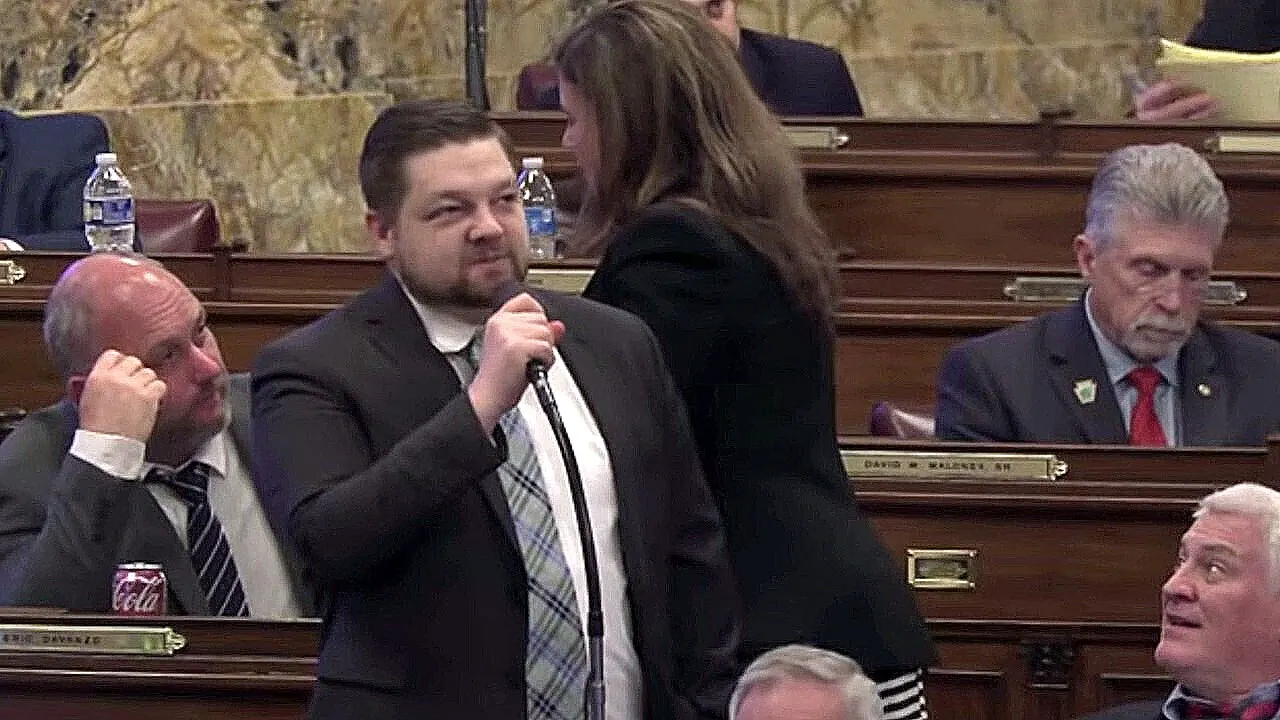
House Speaker Joanna McClinton, a Democrat from Southwest Philadelphia, was moving through a series of bills late in Tuesday’s session when Republican Representative Aaron Bernstine of Ellwood City offered his amendment.
“This amendment is very straightforward and clear,” Bernstine stated on the House floor. “It defines what a woman actually is—because we do know what that is.” Following his remarks, there was a brief pause in proceedings before Speaker McClinton announced, “The resolution is temporarily over,” prompting audible laughter throughout the chamber.
Rather than proceed with a vote that would potentially force lawmakers to take a position on defining “woman” in legislation, Democratic leadership opted to shelve the resolution and move on to other business. The chamber, which currently has a narrow 102-100 Democratic majority, quickly pivoted to consideration of “The Fairness Act” sponsored by State Representative Malcolm Kenyatta of North Philadelphia.
In an interview the following day, Bernstine defended his amendment as common sense, arguing that defining a woman as having XX chromosomes shouldn’t be controversial. “They pulled it because they were scared to define what a woman actually is,” he claimed, suggesting that Democrats were unwilling to engage with the biological definition his amendment would have formalized.
The Pennsylvania exchange mirrors similar moments that have occurred at the national level, including during Justice Ketanji Brown Jackson’s confirmation hearings when Senator Marsha Blackburn asked her to define “what is a woman”—a question that has become a recurring political flashpoint in debates surrounding gender identity and policy.
Jason Gottesman, spokesperson for the House Republican Caucus, criticized the Democrats’ decision, telling reporters that “if Democrats want to celebrate what they refuse to define, it is clear they do not take this issue seriously.”
The resolution technically remains “temporarily over,” meaning it could be resurrected for consideration at a later date. Bernstine suggested that Democrats may still have an opportunity to “step up and define what a woman is,” though he expressed skepticism about whether they would do so.
This legislative moment in Pennsylvania reflects the broader national debate over gender definitions that has increasingly become a partisan dividing line. What might have once been a straightforward ceremonial resolution recognizing Women’s History Month instead became caught in the crosscurrents of one of America’s most contentious cultural issues.
Speaker McClinton’s office did not respond to requests for comment on the withdrawn resolution or whether it might be brought back for consideration in a modified form. The incident highlights how even symbolic legislative measures can become theaters for larger political and ideological conflicts in today’s polarized environment.
Meanwhile, the legislature continued with its regular business, demonstrating how quickly such moments can both erupt and subside in the day-to-day operations of state government, even as they reflect deeper divisions in American political discourse.
Fact Checker
Verify the accuracy of this article using The Disinformation Commission analysis and real-time sources.

7 Comments
I’m curious to see how this plays out. Defining terms like ‘woman’ can get tricky, especially in the context of gender identity and biology. It will be interesting to watch if the Democrats try to reintroduce the resolution with different language.
You make a good point. Definitions can be a minefield in these sensitive political discussions. It will be telling to see if the two sides can find common ground or if this just leads to further polarization.
This seems like a complex issue without any easy answers. I can understand the Democrats wanting to celebrate women’s accomplishments, but the Republican amendment to define ‘woman’ also raises valid questions. It will be interesting to see how they navigate this going forward.
This seems like an unnecessary distraction from the intended purpose of the resolution – to celebrate women’s achievements. Trying to legislate the definition of ‘woman’ feels like a political ploy rather than a good faith effort to have a substantive discussion.
The definition of ‘woman’ is a thorny issue these days. I’m not surprised the Democrats withdrew the resolution rather than get drawn into a debate over it. These are sensitive topics where people have strong, differing views.
Exactly. It’s a politically charged topic without a clear consensus. Trying to legislate a definition of ‘woman’ is bound to be controversial and divisive. The Democrats probably made the pragmatic choice to avoid that fight for now.
Interesting political theater in Pennsylvania. It seems the Democrats withdrew their women’s month resolution rather than have a debate over the definition of ‘woman’. This touches on some complex social and scientific issues that are being heavily debated.