


Listen to the article
Democrats Spotlight Tariffs as Economic Attack Strategy for 2024 Midterms
Less than a week after the Supreme Court struck down President Donald Trump’s global tariffs, New York Governor Kathy Hochul toured a wine importing business to witness firsthand the financial toll these levies have imposed on small business owners.
“This is a heavy tax and you have to pay it up front,” explained Victor Schwartz, owner of VOS Selections, as he walked Hochul through his inventory of wines imported from 16 different countries.
The governor has made Trump’s tariff policy a centerpiece of her reelection campaign, pressing the administration to issue a $13.5 billion tariff refund to New Yorkers following the Supreme Court decision. Her campaign recently released an advertisement criticizing her Republican challenger, Bruce Blakeman, for supporting the tariffs and attending the White House event where Trump unveiled them.
“This is a lethal issue for Republicans this November,” Hochul stated in an interview. “You can be sure we’re going to make sure people know who did this to them.”
Hochul is not alone in this strategy. Democratic governors nationwide are making tariffs central to their electoral messaging, betting that in a campaign season dominated by immigration and the war in Iran, rising costs connected to tariffs will resonate strongly with voters feeling economic pressure.
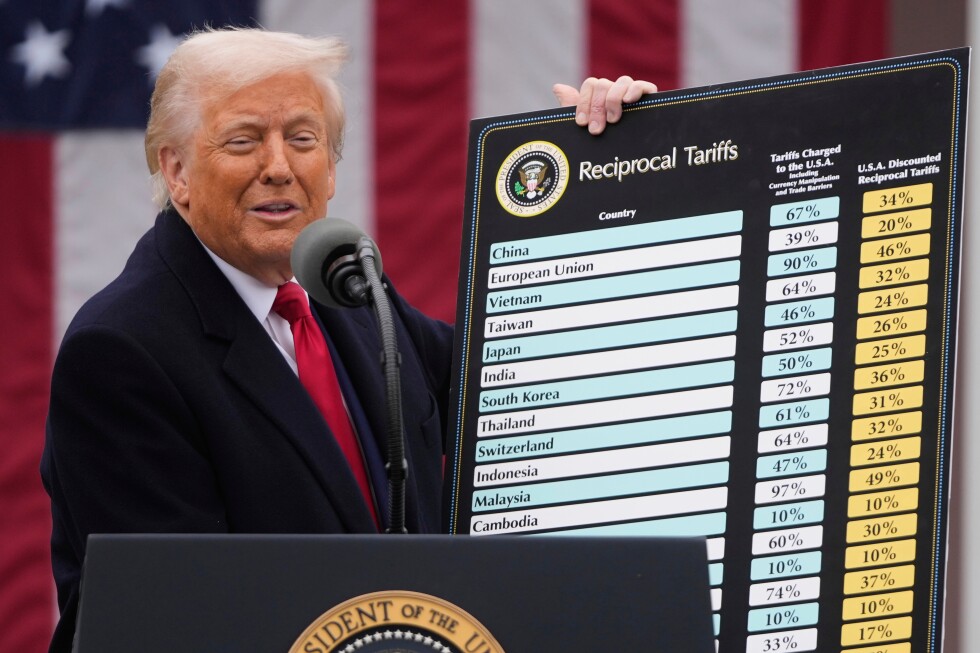
“That picture of Trump with the tariff board is going to be front and center in every single one of our campaigns,” said Kentucky Governor Andy Beshear, who currently chairs the Democratic Governors Association.
The White House has pushed back against this narrative. Spokesman Kush Desai argued that “what Democrats are really running against are President Trump’s Most-Favored-Nations deals to slash prescription drug prices by up to 90 percent, trillions in investments to bring manufacturing back to America, and new trade deals that level the playing field for American workers.”
Republicans face a challenging election cycle as they contend with widespread voter anxiety about inflation and price increases – issues Trump pledged to fix during his 2024 campaign. Historically, the president’s party typically loses ground during midterm elections, adding another obstacle for GOP candidates.
While much attention has focused on congressional races, with Democrats just a few seats shy of retaking the House majority, the party is also working to maintain governorships in battleground states like Arizona, Michigan, and Wisconsin while targeting Republican-held seats in Nevada, Georgia, and Iowa.
In Nevada, state Attorney General Aaron Ford sued the administration over its initial tariffs and is pursuing further legal action as Trump attempts to reimpose them. Ford, who is seeking the Democratic nomination to challenge Republican incumbent Governor Joe Lombardo, called the tariffs “illegal” and blamed them for restaurant closures and declining tourism in his state.
“Tariffs are at the very top of the conversation because Nevadans every single day are feeling the impacts,” Ford emphasized.
Arizona Governor Katie Hobbs, a Democrat seeking reelection in a state Trump won by more than 5 percentage points in 2024, is focusing her campaign on economic concerns. She has criticized Republican Representatives Andy Biggs and David Schweikert, both vying to challenge her, for “cheering on these reckless tariffs.” Both lawmakers opposed a recent measure to end the national emergency Trump declared to impose tariffs on Canada.
Republicans have attempted to redirect affordability concerns back to Democrats, especially in high-cost states with Democratic leadership. Blakeman countered Hochul’s criticism by stating she is “solely responsible for the affordability crisis in New York, with crushing electric bills, soaring insurance rates and the highest taxes in America.”
Despite the Supreme Court ruling against his administration’s approach, Trump hasn’t abandoned the tariff strategy. After calling the decision “unfortunate,” his administration is exploring alternative mechanisms to reinstate the levies. Trump has already announced a 10% tariff using a different legal framework – a move facing fresh legal challenges – and plans to raise tariffs further to 15%.
However, Trump’s promised manufacturing renaissance has not materialized. The first year of his second term saw the loss of 98,000 manufacturing jobs, and tariff revenue has done little to reduce the federal deficit, which continues to climb.
Public opinion suggests unease about Trump’s aggressive tariff implementation. An AP-NORC poll conducted in January found approximately six in ten American adults believed Trump went too far in imposing new tariffs and exercising presidential power.
Republican governors now find themselves in a delicate balancing act: acknowledging public concerns while avoiding criticism of Trump, who remains highly popular with the GOP base. This dilemma is exemplified by Governor Lombardo’s approach in Nevada, where he has urged Trump to lift specific tariffs on lithium while expressing “sincere appreciation for your efforts to return manufacturing jobs back to United States soil.”
As the midterm campaigns intensify, the economic impact of tariffs appears likely to remain a central point of contention between the parties, with Democrats hoping voters will hold Republicans accountable for rising prices at the ballot box.
Fact Checker
Verify the accuracy of this article using The Disinformation Commission analysis and real-time sources.

16 Comments
The Supreme Court striking down the tariffs presents an opportunity for Democrats to criticize the policy. It remains to be seen if this becomes a major campaign issue in the upcoming elections.
You make a good point. The timing of the court decision could give Democrats an opening to attack the tariff policy as ineffective or harmful to the economy.
The Democrats’ strategy of attacking Republicans over the tariffs seems like a reasonable political tactic, but it remains to be seen how effectively it will resonate with voters in key battleground states.
Agreed. The tariff issue may be just one factor among many that voters consider, so it will be important to monitor the broader economic landscape and its impact on voter sentiment.
The Democrats’ focus on the tariffs as an economic attack strategy seems like a calculated political move. It will be interesting to see if it gains traction with voters concerned about the impacts on local businesses.
Absolutely, this could be a savvy strategy if it taps into real economic anxieties in key swing states and districts. The politics of trade policy can be tricky, though.
Curious to see how effective the Democrats’ strategy will be in turning the tariff issue against Republicans. It seems like a plausible line of attack, but a lot can change between now and the elections.
That’s a fair assessment. Voter priorities can shift, so it will be important to monitor how this messaging resonates over the coming months.
It’s not surprising to see Democrats trying to leverage the tariff issue against Republicans, given the potential economic costs. But the ultimate impact on voter behavior remains to be seen.
That’s a fair point. Voters may have a range of economic concerns that factor into their decisions, so the tariff issue alone may not be a silver bullet for Democrats.
Interesting to see the Democrats trying to make the tariffs a central campaign issue. It’s a calculated risk, but could pay off if it taps into real economic anxieties among voters.
That’s a good point. The tariff issue may resonate more in some regions or industries than others, so the Democrats’ messaging will need to be tailored accordingly.
The Democrats’ strategy of using the tariffs as an economic attack against Republicans seems like a potentially effective political move, but a lot can change between now and the elections.
Absolutely. Voter priorities and economic conditions can shift, so it will be important to monitor how this issue plays out over the coming months.
Interesting to see how Democrats are trying to leverage the tariff issue against Republicans. Curious to see if it resonates with voters concerned about the economic impacts.
Agreed, it’s a savvy political move to highlight the tangible costs of the tariffs on local businesses. Will be interesting to see if it sways undecided voters.