


Listen to the article
Maine Immigration Enforcement Sparks Political Divide in High-Profile Senate Race
Political tensions have escalated in Maine as a major Immigration and Customs Enforcement (ICE) operation unfolds across the state, drawing sharply contrasting responses from key political figures engaged in one of the nation’s most closely watched Senate races.
Democratic Governor Janet Mills has taken a confrontational stance against the federal operation, demanding that immigration officials provide judicial warrants, real-time arrest information, and details about those being detained in Maine. During a Friday statement, Mills directly challenged her Republican rival, Senator Susan Collins, to act following the House Republicans’ defeat of Democratic efforts to limit ICE funding.
“Let me be clear: Maine will not be intimidated, and the reckless actions that we’ve seen ICE turn to will not be tolerated here in Maine,” Mills declared.
In contrast, Senator Collins avoided direct criticism of ICE tactics, stating only that legally present individuals should not be targeted. She suggested that policies she has advocated for, including body cameras and de-escalation training for ICE personnel, could improve accountability and public trust. Collins also cautioned protesters against interfering with ICE operations.
“There are people in Maine and elsewhere who have entered this country illegally and who have engaged in criminal activity,” Collins said in a statement. “They could be subject to arrest and deportation pursuant to the laws of the United States.”
The enforcement action, which began Tuesday, has reportedly resulted in over 100 arrests so far. Homeland Security Assistant Secretary Tricia McLaughlin stated that the operation has removed dangerous criminals from Maine communities, including individuals “convicted of horrific crimes including aggravated assault, false imprisonment, and endangering the welfare of a child.”
The ICE operation, dubbed “Operation Catch of the Day,” reportedly targets approximately 1,400 individuals in Maine, where only about 4% of the state’s 1.4 million residents are foreign-born. The enforcement surge has created significant anxiety in Portland and Lewiston, cities with substantial immigrant and refugee populations, particularly from African nations. Community leaders report that families are staying indoors, missing work, and keeping children home from school out of fear.
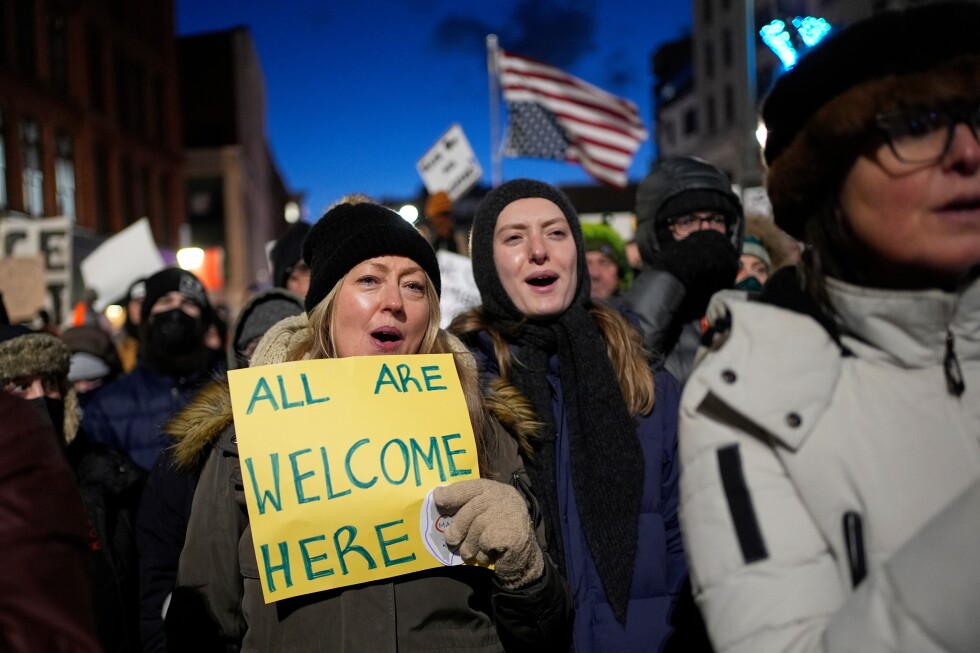
On Friday evening, several hundred protesters gathered in Portland’s Monument Square despite frigid conditions. Demonstrators held signs reading “ICE Out Maine” as they rallied against the federal enforcement actions.
“ICE is terrorizing our community, and they don’t belong here,” said 22-year-old Portland resident Levi Alexander.
The political implications of this clash extend beyond immigration policy. Mills’ challenge to Collins’ Senate seat could potentially determine the balance of power in the U.S. Senate. Before facing Collins, Mills must first defeat Democratic primary challenger Graham Platner, an oyster farmer whose outsider campaign has received Senator Bernie Sanders’ endorsement.
Platner has taken a more aggressive stance against the ICE operation than Mills, posting social media content with step-by-step advice on how residents can resist federal immigration enforcement. “Over the past couple days, ICE’s operations are clearly rounding up people who are legally in the state of Maine,” Platner claimed. “I’m sick and tired of hearing that legally there is nothing that law enforcement in Maine can do to protect citizens from these thugs.”
Concerns about the scope and targeting of the operation have been amplified by reports that county corrections officers have been detained. York County officials confirmed that one of their jail corrections officers remains in custody at a Massachusetts detention facility after being summoned to an immigration appointment. Cumberland County Sheriff Kevin Joyce reported that one of his corrections officer recruits was arrested despite passing background checks and federal employment verification, having no criminal history and authorization to work in the United States.
“While enforcement actions are being promoted as targeting the ‘worst of the worst,’ the reality appears far more complicated,” York County officials stated.
Individual stories have further complicated the narrative. Cristian Vaca, a 28-year-old roofer from Ecuador living in Biddeford with his wife and young son, reported being threatened by ICE agents outside his home despite his legal status. Vaca, who immigrated in September 2023, recorded video of an ICE agent threatening through his closed door: “We’re going to come back for your whole family, OK?”
As demonstrations continue across Maine’s largest cities, the political and humanitarian dimensions of this enforcement action remain at the forefront of state and national attention, highlighting the complex intersection of immigration enforcement, political campaigns, and community impact in a predominantly rural state now thrust into the national spotlight.
Fact Checker
Verify the accuracy of this article using The Disinformation Commission analysis and real-time sources.

10 Comments
While immigration enforcement is a sensitive topic, I appreciate the Governor’s call for transparency and accountability from federal agencies. Protecting civil liberties is crucial.
Agreed. Any enforcement actions should be conducted with due process and respect for individual rights.
This is a complex issue with valid concerns on both sides. I’m curious to learn more about the specific details and legal context before forming a firm opinion.
You raise a good point. It’s important to consider the nuances and potential impacts on local communities.
As an observer, I’m interested to see how this enforcement action unfolds and whether it leads to constructive policy changes or further political polarization.
Well said. Addressing immigration challenges requires finding common ground and seeking solutions that serve the broader public interest.
The contrasting responses from the Governor and Senator Collins demonstrate the complexity of this situation. Factual information and nuanced discussion will be important.
I agree. This is a sensitive topic that requires a balanced approach focused on the rule of law and community impacts.
This seems to highlight the political divide on immigration issues. I’m curious to hear more about the policy proposals and how they could affect Maine residents.
It will be interesting to see how this issue plays out in the upcoming Senate race. Voters will likely want to understand each candidate’s stance.