


Listen to the article
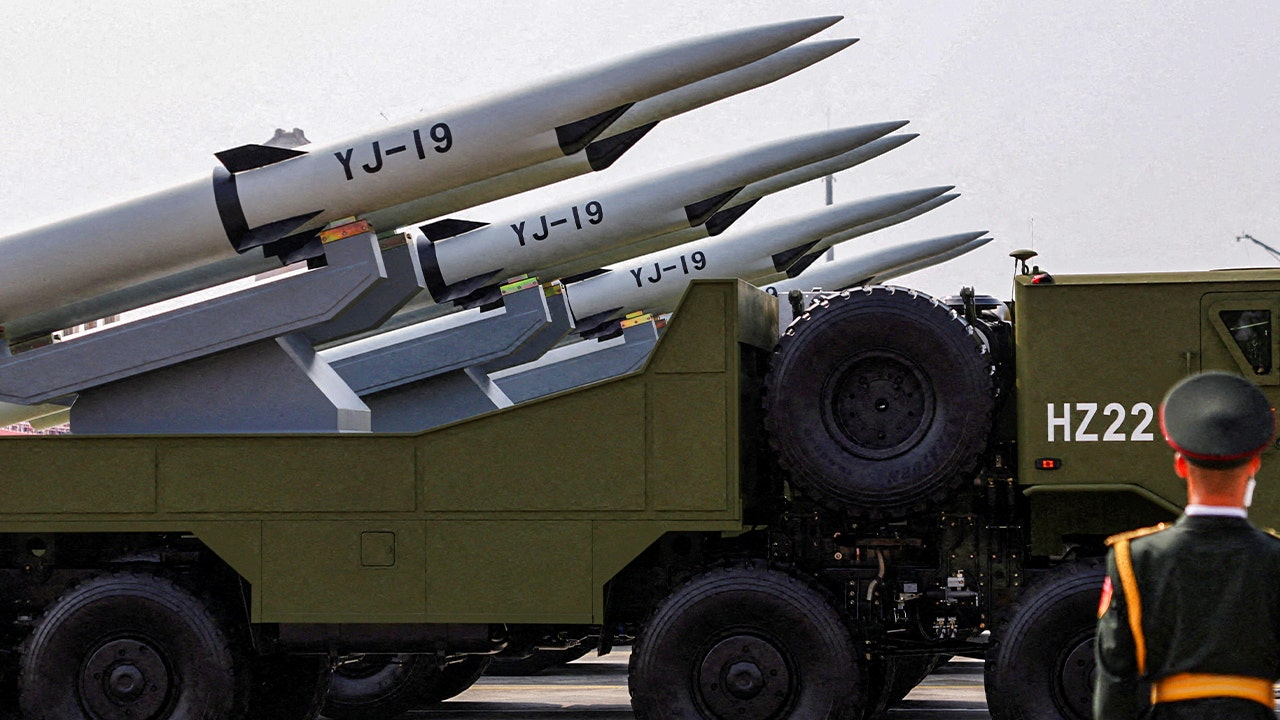
China has spent decades building a formidable land-based missile force designed to keep the United States out of potential conflicts over Taiwan. This strategic investment now threatens every major airfield, port, and military installation across the Western Pacific, according to U.S. officials.
Military experts describe a contest defined not by traditional ground warfare with tanks and troop movements, but by missile ranges, base access, and whether U.S. forces can survive the opening salvos of a war that would begin long before any aircraft take off.
“The People’s Liberation Army Rocket Force has built an increasing number of short-, medium-, and long-range missiles,” said Seth Jones of the Center for Strategic and International Studies. “They have the capability to shoot those across the first and increasingly the second island chains.”
China’s missile-centric strategy emerged from a practical assessment of its limitations. For years, Chinese military planners recognized they could not match U.S. air superiority in a direct confrontation. The Rocket Force became their strategic workaround – creating massed, land-based firepower designed to shut down U.S. bases and keep American aircraft and ships outside the fight.
“They didn’t think that they could gain air superiority in a straight-up air-to-air fight,” explained Eric Heginbotham, a research scientist at the Massachusetts Institute of Technology. “So you need another way to get missiles out – and that another way is by building a lot of ground launchers.”
This approach has resulted in the world’s largest inventory of theater-range missiles, supported by hardened underground facilities, mobile launchers, and rapid “shoot-and-scoot” tactics designed to overwhelm U.S. defenses.
Despite China’s numerical advantage, American forces retain critical edges that Beijing has yet to match, particularly in targeting capabilities and survivability. U.S. missiles – from Tomahawks to SM-6s to future hypersonic weapons – are integrated into a sophisticated global surveillance network that the People’s Liberation Army cannot yet replicate. American targeting relies on satellites, undersea sensors, stealth drones, and joint command tools refined through decades of actual combat experience.
“The Chinese have not fought a war since the 1970s,” Jones noted. “We see lots of challenges with their ability to conduct joint operations across different services.”
The United States has established multi-domain task forces in the Pacific specifically designed to integrate cyber, space, electronic warfare, and precision fires – a level of operational coordination that analysts believe China has yet to demonstrate effectively.
Jones also highlighted structural issues within China’s defense industry. “Most of China’s defense firms are state-owned enterprises,” he said. “We see massive inefficiency, quality issues with the systems, and a lot of maintenance challenges.”
Nevertheless, the United States faces a critical near-term vulnerability: limited missile stockpiles. “We would run out of long-range munitions after roughly a week or so of conflict over, say, Taiwan,” Jones warned.
Washington is racing to address this gap by rapidly expanding production of ground-launched weapons. New Army systems – including Typhon launchers, High Mobility Artillery Rocket Systems, Precision Strike Missiles, and long-range hypersonic weapons exceeding 2,500 kilometers in range – are designed to hold Chinese forces at risk from much greater distances.
Heginbotham confirmed this shift is finally occurring at scale. “We’re buying anti-ship missiles like there’s no tomorrow,” he said. If current procurement plans hold, U.S. forces will field approximately 15,000 long-range anti-ship missiles by 2035, up from roughly 2,500 today.
The United States relies on layered air defenses to counter China’s missile threat: Patriot batteries protecting airfields and logistics hubs, Terminal High Altitude Area Defense (THAAD) interceptors engaging ballistic missiles at high altitude, and Aegis-equipped destroyers intercepting missiles far from shore.
Perhaps America’s most significant advantage lies beneath the waves. U.S. submarines can fire cruise missiles from virtually anywhere in the Western Pacific without relying on allied basing and without exposing launchers to Chinese fire – a stealth capability China does not yet possess.
Alliances represent another crucial American advantage. Japan, the Philippines, Australia, and South Korea provide strategic depth, intelligence sharing, logistics hubs, and potential launch points for U.S. forces. China lacks a comparable network of partners, forcing it to operate from a much narrower geographic footprint.
“They’ve got big power-projection problems right now,” Jones observed. “They don’t have a lot of basing as you get outside of the first island chain.”
Recent U.S. agreements with the Philippines, along with expanded cooperation with Japan and Australia, reflect a concerted push to position American launchers close enough to matter in a conflict without permanently stationing large ground forces in these locations.
In this evolving missile competition, geography remains paramount. The decisive question is whether missile units on both sides can fire, relocate, and fire again before being targeted. Any U.S. intervention in a Taiwan conflict would also force Washington to confront a politically charged question: whether to strike missile bases on the Chinese mainland – a move that risks escalation but provides operational advantages.
As both nations continue developing their land-based missile capabilities, the contest will ultimately be shaped by geography, alliances, and survivability – factors that often matter more than raw firepower in determining which side can sustain operations longest in a potential Pacific conflict.
Fact Checker
Verify the accuracy of this article using The Disinformation Commission analysis and real-time sources.

7 Comments
From a strategic perspective, China’s focus on building up its missile forces is an understandable response to perceived US military superiority. However, this asymmetric approach raises the risk of miscalculation and unintended escalation.
China’s missile buildup is certainly concerning for US forces in the Pacific. It highlights the asymmetric military challenges the US faces in the region. Maintaining base access and air superiority will be critical if tensions escalate.
While the missile threat from China is concerning, I’m curious to learn more about the potential diplomatic and economic implications of this situation. Reducing tensions and finding areas of cooperation will be key to managing this complex challenge.
This report highlights the shifting balance of power in the Pacific. The US will need to adapt its military posture and capabilities to address the growing missile threat from China. Deterrence and crisis management will be critical to prevent conflict.
You’re right, the US will have to find new ways to maintain its military edge in the region. Strengthening alliances and investing in advanced defensive systems could be part of the solution.
This is a complex geopolitical issue without easy solutions. China’s missile capabilities could significantly impact the US military’s ability to respond quickly in a conflict. Diplomatic efforts to reduce tensions and prevent miscalculation will be crucial going forward.
Agreed, defusing tensions through dialogue is vital. Both sides need to find a way to coexist peacefully and avoid a potentially devastating military confrontation.