


Listen to the article
Voting Chaos in Texas Primary as Rule Change Leads to Widespread Confusion
A sudden change in primary voting rules across two Texas counties sparked mass confusion on Tuesday, resulting in a flurry of legal battles, a state Supreme Court intervention, and fears of voter disenfranchisement.
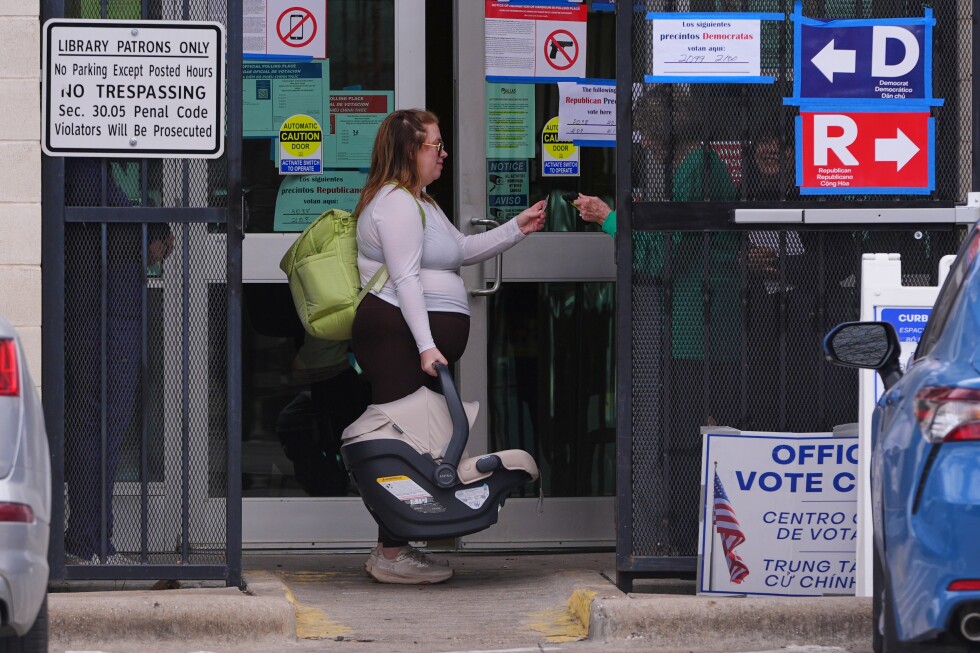
The disruption centered on Dallas and Williamson counties, where local Republican parties opted against the countywide voting system that had been in place for years. Under Texas law, both major parties must agree to countywide voting for it to remain in effect. Without this agreement, voters were restricted to casting ballots only at their assigned precincts.
The change had immediate consequences, particularly for the competitive Democratic primary race for U.S. Senate between Representative Jasmine Crockett and state lawmaker James Talarico. Crockett, whose base is in Dallas County, told supporters Tuesday night that the race couldn’t be resolved without complete results from her home county.
“I can tell you, people were disenfranchised,” Crockett said, characterizing the situation as an “effort to suppress the vote.”
As confusion mounted throughout Election Day, a Dallas County judge ordered polls to remain open two hours past the scheduled 7 p.m. closing time, citing “voter confusion so severe” that it crashed the county election office’s website. The ruling came after a petition from the local Democratic Party. Similarly, Democrats in Williamson County secured extended hours for two precincts.
The Texas Attorney General’s office quickly challenged these extensions, and the Texas Supreme Court intervened later that evening, issuing a stay on both decisions. The court ordered that ballots cast by voters who weren’t in line by the original 7 p.m. closing time be segregated, though it didn’t immediately rule on whether these votes would ultimately count.
Renea Hicks, an experienced Texas appellate attorney, noted the Supreme Court’s action was preliminary. “That doesn’t mean ‘throw them away.’ It doesn’t mean they won’t count,” Hicks explained. “We don’t know what it means.”
The logistical challenges were compounded by the fact that voting locations might also be specific to a voter’s party affiliation. Nic Solorzano, spokesperson for the Dallas County Elections Department, described the situation: “We’re seeing a lot of people that are going to their vote centers that they usually go to… and not realizing they can’t do that anymore. They have to go to their precinct-based location.”
Despite efforts to inform the public through signs, advertisements, text messages, and mailers, the sudden shift from a system that had been in place for nearly seven years left many voters confused. On Election Day, former poll workers were stationed outside voting locations with tablets to help redirect people to their correct precincts.
Brenda Allen, executive director of the Dallas Democratic Party, reported her offices were overwhelmed with hundreds of calls from voters of both parties trying to locate their precincts. The situation was further complicated by Texas’ mid-decade redistricting, which resulted in new precinct lines only being finalized in December, leaving minimal time to educate voters.
“Lots of reports of people being turned away, hundreds of people unable to vote. Both parties are affected by this,” Allen said. “It’s not great.”
The situation was similar in Williamson County, where the Democratic Party headquarters was flooded with calls from confused voters of both parties. Madison Dickinson, the local Democratic Party executive director, confirmed they were experiencing “significant problems with the precinct-level voting.”
While Republicans were less vocal about the changes online, the Dallas County Republican Party did post information to help voters locate their assigned polling places.
The Texas primary was one of three state contests kicking off the 2026 midterm election cycle on Tuesday, along with North Carolina and Arkansas. While voting in those states proceeded relatively smoothly, the Texas situation highlighted concerns about potential electoral disruptions that might emerge during the upcoming November elections.
For affected candidates like Crockett and Talarico, the uncertainty has left their races in limbo. Talarico told supporters that every vote must be counted, while his campaign expressed deep concern about voters being redirected from polling locations.
As legal challenges continue, the full impact of this electoral confusion remains to be seen, raising questions about how many voters were ultimately unable to cast their ballots and what recourse might be available to them.
Fact Checker
Verify the accuracy of this article using The Disinformation Commission analysis and real-time sources.

13 Comments
It’s troubling to hear about potential voter suppression tactics, even if unintentional. Free and fair elections are the foundation of our democracy. I hope the courts can provide a swift solution to restore faith in the process.
Agreed. Maintaining public trust in the integrity of elections should be the top priority for all elected officials and election administrators.
This situation highlights the importance of bipartisan cooperation and a shared commitment to fair, accessible elections. Hopefully the parties can find a way to work together and prevent similar issues from arising in the future.
Agreed. Voting rules should be set through a collaborative process, not unilateral decisions that create confusion and disruption.
Voting rule changes can have significant unintended consequences, as we’re seeing here. I hope election officials learn from this experience and work to prevent similar disruptions in the future.
Absolutely. Proactive planning and communication with the public are crucial when making changes to voting procedures.
This situation underscores the need for clear, consistent, and transparent voting rules that apply equally across all counties and districts. Anything less risks undermining the credibility of election outcomes.
Voter disenfranchisement is never acceptable, regardless of partisan affiliation. I hope the courts can quickly resolve this issue and ensure that all eligible voters in these counties can exercise their democratic rights.
Interesting development in the Texas primaries. Voting rule changes can certainly lead to confusion and potential disenfranchisement of voters. It’s important that election processes are clear and accessible to all eligible citizens.
Agreed. Transparency and consistency in voting rules are crucial for the integrity of our democratic process.
This situation highlights the importance of bipartisan cooperation on election policies. When the two major parties can’t agree on voting procedures, it creates uncertainty and disruption for voters. Hopefully the courts can provide clarity and ensure fair access to the polls.
Absolutely. Voters deserve a reliable, well-functioning electoral system that isn’t subject to partisan wrangling.
Voter disenfranchisement is always concerning, no matter which side it may benefit. I hope election officials can work quickly to resolve the issues in these Texas counties and prevent further confusion or barriers to voting.