


Listen to the article
U.S. Census Bureau’s 2030 Test Includes Citizenship Question, Raising Political Concerns
The U.S. Census Bureau has begun conducting a practice test for the 2030 census that includes a citizenship question, sparking concerns about a potential revival of Trump-era policies that previously failed to alter the constitutionally mandated population count.
The field test, currently underway in Huntsville, Alabama, and Spartanburg, South Carolina, has notably departed from traditional census preparation by utilizing questions from the American Community Survey (ACS) rather than from recent census forms. Among these questions is one asking, “Is this person a citizen of the United States?” – a query that hasn’t appeared on the decennial census for 75 years.
This development comes in the wake of instructions from President Trump last August directing the Commerce Department to begin work on a new census that would exclude immigrants living in the U.S. illegally from the official count. The move represents a significant potential shift in census methodology, which has long interpreted the Constitution’s 14th Amendment requirement to count “the whole number of persons in each state” as including all residents regardless of immigration status.
The Census Bureau has not responded to inquiries about why ACS questions are being used for the 2026 test rather than traditional census questions. This silence has fueled speculation about potential political motivations behind the methodological change.
Terri Ann Lowenthal, a former congressional staffer and census consultant, expressed alarm about the test’s reduced scope and altered methodology. “This full pivot from a real field test is alarming and deserves immediate congressional attention, in my view,” she stated, noting that ACS questions have never before been used for a census field test.
Initially planned for six locations, the test was recently scaled back to just two sites. The Trump administration eliminated four of the originally planned locations – Colorado Springs, Colorado; western North Carolina; western Texas; and tribal lands in Arizona. This reduction has raised additional questions about the administration’s approach to census preparation.
Mark Mather, an associate vice president at the nonpartisan Population Reference Bureau, highlighted methodological concerns with using the ACS questionnaire for census testing. “The ACS form wouldn’t provide a valid test of 2030 census operations,” Mather explained. “It’s a completely different animal.”
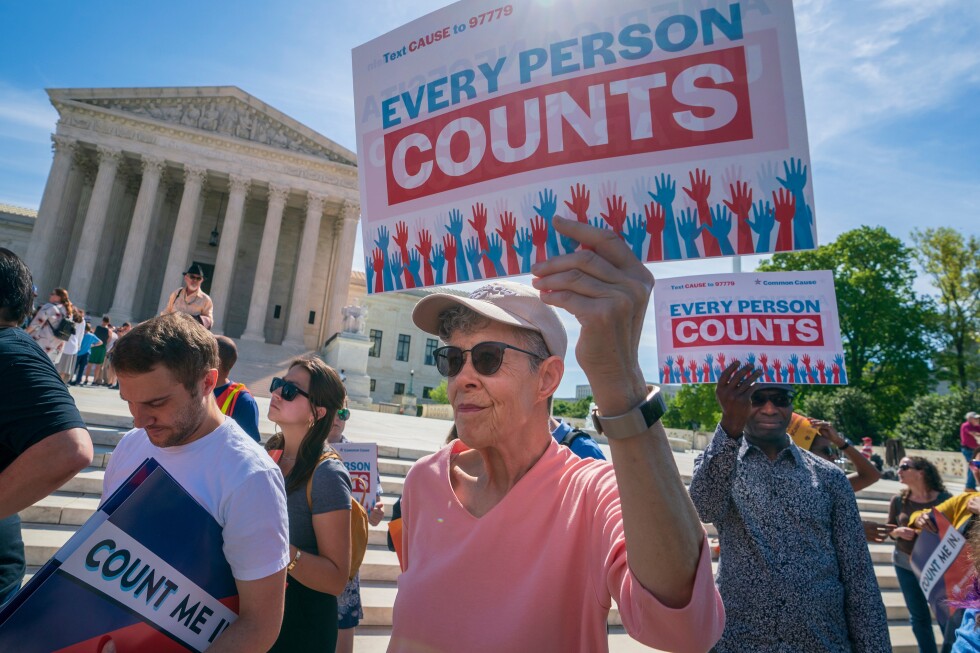
The current situation echoes Trump’s previous attempt during his first term to add a citizenship question to the 2020 census form – an effort ultimately blocked by the U.S. Supreme Court. Trump had also signed executive orders to exclude undocumented immigrants from apportionment figures and mandate citizenship data collection. These orders were rescinded when President Biden took office in January 2021, before the 2020 census figures were released.
The potential inclusion of a citizenship question carries significant political implications. Congressional representation and federal funding allocations worth hundreds of billions of dollars annually are determined by census population counts. Critics argue that asking about citizenship could discourage participation among immigrant communities, leading to undercounts in areas with large immigrant populations – typically urban areas that tend to vote Democratic.
Republican lawmakers have recently introduced legislation that would exclude certain non-citizens from the apportionment figures used to allocate congressional seats and Electoral College votes. Additionally, several Republican state attorneys general have filed federal lawsuits in Louisiana and Missouri seeking to add a citizenship question to the next census and exclude undocumented immigrants from the apportionment count.
The 2026 test also aims to evaluate new methodologies for improving accuracy in counting historically undercounted populations and to test the use of U.S. Postal Service workers for tasks previously performed by census takers.
As preparations for the 2030 census continue, the question of who gets counted – and how – remains a contentious political issue with far-reaching implications for political representation and the distribution of federal resources across the United States.
Fact Checker
Verify the accuracy of this article using The Disinformation Commission analysis and real-time sources.

27 Comments
If AISC keeps dropping, this becomes investable for me.
Good point. Watching costs and grades closely.
Silver leverage is strong here; beta cuts both ways though.
Nice to see insider buying—usually a good signal in this space.
Good point. Watching costs and grades closely.
Uranium names keep pushing higher—supply still tight into 2026.
Good point. Watching costs and grades closely.
Interesting update on Census Bureau plans to use survey with a citizenship question in its test for 2030, alarming experts. Curious how the grades will trend next quarter.
Good point. Watching costs and grades closely.
Silver leverage is strong here; beta cuts both ways though.
Good point. Watching costs and grades closely.
Good point. Watching costs and grades closely.
The cost guidance is better than expected. If they deliver, the stock could rerate.
Good point. Watching costs and grades closely.
Silver leverage is strong here; beta cuts both ways though.
Good point. Watching costs and grades closely.
Nice to see insider buying—usually a good signal in this space.
Good point. Watching costs and grades closely.
Uranium names keep pushing higher—supply still tight into 2026.
Good point. Watching costs and grades closely.
Good point. Watching costs and grades closely.
I like the balance sheet here—less leverage than peers.
Exploration results look promising, but permitting will be the key risk.
Good point. Watching costs and grades closely.
Good point. Watching costs and grades closely.
The cost guidance is better than expected. If they deliver, the stock could rerate.
Good point. Watching costs and grades closely.