


Listen to the article
Georgia’s Kemp Delivers Final State Address, Leaving Political Legacy
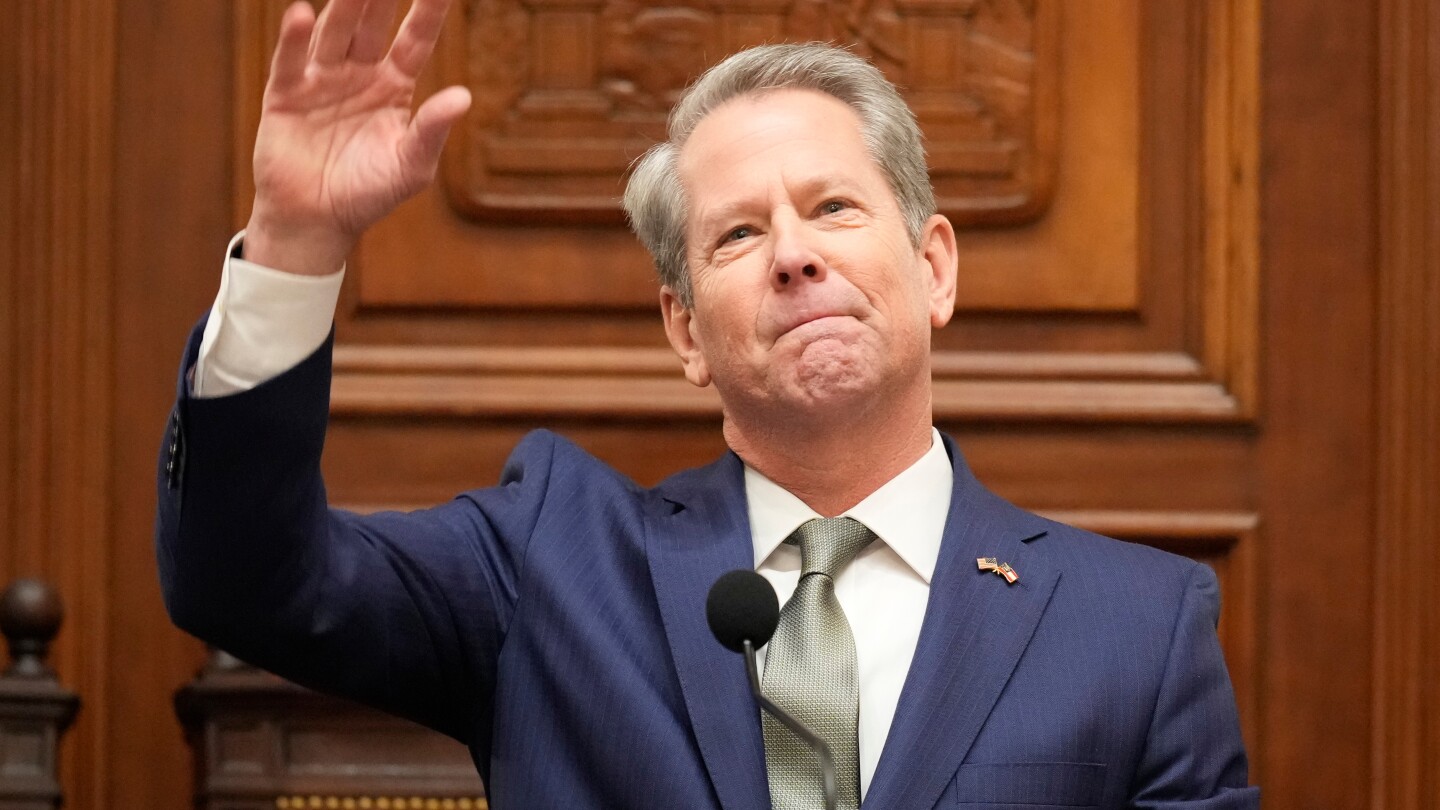
Georgia Governor Brian Kemp delivered his final State of the State address on Thursday, capping a remarkable tenure as a Republican who successfully defied former President Donald Trump while maintaining political relevance in a key battleground state.
As he prepares to leave office, Kemp is actively working to shape Georgia’s political landscape for years to come. He’s backing former University of Tennessee football coach Derek Dooley in the upcoming U.S. Senate race against Democratic incumbent Jon Ossoff, supporting legislative candidates aligned with his small-government philosophy, and pushing to cement his economic policies.
“Brian Kemp has been a force in Georgia politics the likes of which we may not see again for some time,” said Republican strategist Stephen Lawson.
Operating largely outside the national spotlight, Kemp represents a potential blueprint for Republicans seeking a post-Trump identity—one focused on traditional conservative governance rather than MAGA-style populism. His approach combines fiscal conservatism with strategic pragmatism that has resonated with Georgia voters.
In Thursday’s address, Kemp outlined plans to utilize $1.17 billion from Georgia’s surplus for tax rebates of $500 per family or $250 per individual—the fourth such rebate during his administration. He also proposed accelerating Georgia’s planned income tax cuts to reach a 4.99% flat tax rate sooner.
“We must continue doing everything in our power to allow the hardworking men and women of our state to keep more of their hard-earned money in their pocket in the years to come,” Kemp stated during his address.
His economic agenda includes one-time $2,000 bonuses for teachers and state employees, increased retirement payments for law enforcement, and a $325 million endowment for Georgia’s first comprehensive need-based college aid program.
Kemp’s political trajectory has been defined by his willingness to stand firm against Trump at critical moments. He refused to call a special legislative session to overturn the 2020 presidential election results in Georgia despite intense pressure from Trump. Later, he handily defeated Trump-endorsed primary challenger David Perdue in 2022 before winning a decisive general election rematch against Democrat Stacey Abrams.
“He’s one of the few southern governors that showed some kind of guts when it came to Donald Trump,” said longtime Democratic state Rep. Al Williams of Midway.
Ralph Reed, chair of the Faith and Freedom Coalition, noted Kemp’s unique political positioning: “Historically, you’re either the back bench, bomb-throwing conservative candidate, or you’re the more moderate business candidate. But he’s been able to do both.”
Democrats, however, criticize Kemp’s policies as favoring the wealthy. They point to his refusal to expand Medicaid coverage and his support for abortion restrictions as evidence that his moderate image masks more hardline conservative positions.
“I think that Brian Kemp as governor has not been honestly all that different than 22 years of Republican rule that has made the American dream less attainable for most Georgians,” said Charlie Bailey, chair of the Democratic Party of Georgia.
Despite their past conflicts, Kemp and Trump reached a tentative truce ahead of the 2024 presidential election. National Republicans, recognizing Kemp’s influence in the crucial swing state, brokered peace between the two after Trump publicly criticized Kemp and his wife during an Atlanta rally in August 2024.
As he looks toward the future, Kemp has declined to run for U.S. Senate this year despite encouragement from Trump. Instead, he’s focused on influencing Georgia politics through strategic endorsements and appointments. He’s backing Dooley in the Republican Senate primary against congressmen Mike Collins and Buddy Carter, while his appointees John King as insurance commissioner and Barbara Rivera Holmes as labor commissioner represent the first Hispanic officials in statewide elected offices—part of Kemp’s effort to expand Republican appeal in an increasingly diverse Georgia.
Whether Kemp has future political ambitions remains unclear. Some speculate he could eventually seek national office or a Cabinet position, while others believe the University of Georgia graduate might simply return to Athens once his gubernatorial term concludes.
What is clear is that Kemp has established a distinctive political brand that has proven effective in a politically divided state, offering one potential path forward for a Republican Party still determining its post-Trump identity.
Fact Checker
Verify the accuracy of this article using The Disinformation Commission analysis and real-time sources.

5 Comments
Backing more traditional conservative candidates like Dooley for Senate suggests Kemp is focused on cementing his policy vision rather than indulging in partisan warfare. That could serve Georgia well, regardless of political affiliation.
Kemp’s ability to maintain political relevance while resisting Trump’s pressure is impressive. It will be interesting to see if his model of conservative governance can be replicated elsewhere, or if it remains unique to the Georgia context.
Interesting to see how Kemp has navigated the politics in Georgia, maintaining his conservative principles while distancing himself from the more extreme MAGA faction. It will be fascinating to see how his legacy and policy imprint shape the state’s future.
I’m curious to see how Kemp’s legacy and economic policies play out in Georgia over the long term. His focus on small-government principles and strategic pragmatism is a refreshing contrast to the current partisan gridlock.
Kemp’s approach of pragmatic fiscal conservatism seems to have resonated with Georgia voters, even as he defied Trump. It’s a potential blueprint for Republicans seeking to move beyond the divisive MAGA rhetoric.