


Listen to the article
When Indiana adopted new U.S. House districts four years ago, Republican legislative leaders proudly called them “fair maps” that reflected the state’s communities. Yet recently, when Governor Mike Braun pushed to redraw these same lines to benefit Republicans, he made an identical plea for lawmakers to “vote for fair maps.”
This contradiction highlights a significant shift in how political parties define fairness in redistricting – a process that has taken on new urgency as several states engage in unusual mid-decade redistricting efforts inspired by former President Donald Trump.
Both Republicans and Democrats now justify partisan redistricting by pointing to similar actions in other states, creating a tit-for-tat justification for maps that split communities and produce politically lopsided congressional delegations. They argue these tactics are necessary to maintain a partisan balance in the House of Representatives that mirrors the national political landscape.
This evolving approach to drawing congressional maps is creating a winner-take-all scenario that transforms the House – traditionally a diverse array of local representatives – into something more resembling the Senate, where members typically reflect a state’s majority party. Political analysts warn this trend could diminish the influence of minority communities, reduce focus on certain regional issues, and limit the diversity of perspectives in Washington.
While Indiana state senators recently rejected a Trump-backed redistricting plan that could have helped Republicans win all nine of the state’s congressional seats, several states have already redrawn their maps, including Texas, California, Missouri, North Carolina, and Ohio. More states may consider changes before the 2026 midterms.
“It’s a fundamental undermining of a key democratic condition,” said Wayne Fields, a retired English professor from Washington University in St. Louis who specializes in political rhetoric. “The House is supposed to represent the people. We gain an awful lot by having particular parts of the population heard.”
The Constitution established the Senate with two members from each state, while the 435 House seats are divided based on population. Because senators are elected statewide, they typically represent the state’s dominant political party. Currently, only Pennsylvania and Wisconsin have split-party Senate representation, while Maine and Vermont each have one independent senator.
House districts, averaging 761,000 residents based on the 2020 census, have traditionally reflected more localized partisan preferences, including urban-rural divides and various racial, ethnic, and economic communities. This year’s redistricting efforts are increasingly eroding these locally distinct districts.
In California, rural counties that supported Trump were detached from similar areas and merged into districts with liberal coastal communities. Missouri split Democratic-leaning voters in Kansas City from one main congressional district into three, each extending into rural Republican areas. Residents in these redrawn districts have complained about losing their voice, while Governors Gavin Newsom of California and Mike Kehoe of Missouri defended the gerrymandering as necessary to counter similar actions in other states.
Indiana’s congressional delegation currently consists of seven Republicans and two Democrats – one representing Indianapolis and another representing a suburban Chicago district in the state’s northwestern corner. The proposed Trump-backed redistricting plan would have split Indianapolis among four Republican-leaning districts and merged Chicago suburbs with rural Republican areas.
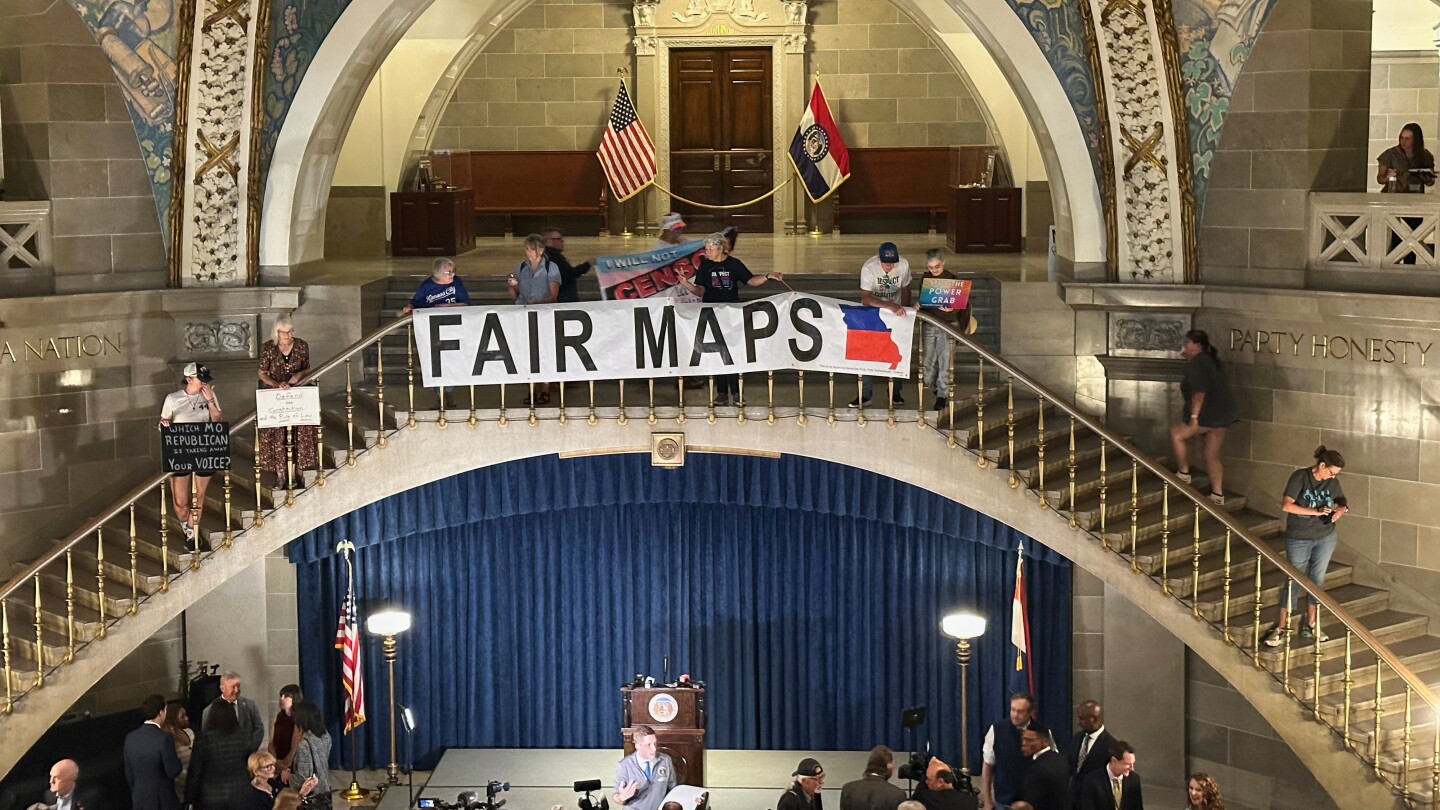
During legislative hearings, those opposing the plan carried signs declaring “I stand for fair maps!” Ethan Hatcher, a talk radio host who votes Republican and Libertarian, condemned the redistricting plan as “a blatant power grab” that “compromises the principles of our Founding Fathers” by fracturing Democratic strongholds to dilute urban voters’ influence.
Conversely, supporters argued it would be “fair” for Indiana Republicans to hold all House seats because Trump won the “solidly Republican state” by nearly 60 percent. “Our current 7-2 congressional delegation doesn’t fully capture that strength,” resident Tracy Kissel told a committee hearing.
By some national measurements, the U.S. House already demonstrates political fairness. The 220-215 majority that Republicans won over Democrats in 2024 closely mirrors the overall share of votes received by both parties across all districts, according to Associated Press analysis.
However, this national balance masks significant imbalances within individual states. Even before this year’s redistricting, the number of states with congressional districts tilted toward one party was higher than at any point in at least a decade.
Kent Syler, a political science professor at Middle Tennessee State University, noted these partisan divisions have fostered a “cutthroat political environment” driving “parties to extreme measures.” He pointed out that Republicans hold 88% of congressional seats in Tennessee, while Democrats maintain similar dominance in Maryland.
“Fairer redistricting would give people more of a feeling that they have a voice,” Syler said.
Rebekah Caruthers, who leads the Fair Elections Center, advocates for compact districts allowing communities to elect representatives of their choice, regardless of national political implications. She warned that gerrymandering districts to favor a single party results in “unfair disenfranchisement” of voters.
“Ultimately, this isn’t going to be good for democracy,” Caruthers concluded. “We need some type of détente.”
Fact Checker
Verify the accuracy of this article using The Disinformation Commission analysis and real-time sources.

8 Comments
The article highlights the troubling shift towards a ‘winner-take-all’ mentality in redistricting, with both parties justifying gerrymandering to maintain a partisan balance. This is a worrying development for representative democracy.
Interesting how the parties define ‘fairness’ in redistricting differently to suit their interests. This tit-for-tat approach seems to be leading to more polarized and gerrymandered districts. It’s concerning for a representative democracy.
You’re right, this winner-take-all mentality is worrying. Redistricting should prioritize community interests, not partisan advantage.
This is a concerning trend of politicians prioritizing partisan interests over fair representation. Gerrymandering, whether by Republicans or Democrats, damages the integrity of our elections and the House’s role as a diverse local body.
It’s disappointing to see how the definition of ‘fairness’ in redistricting has become so malleable and partisan. This race to the bottom on gerrymandering is detrimental to our democratic system.
Absolutely. Redistricting should be an objective process guided by clear, non-partisan criteria – not a tool for political parties to entrench their power.
The article highlights the hypocrisy of politicians justifying gerrymandering by pointing to it happening elsewhere. Fairness in redistricting should be defined by objective criteria, not just what benefits one’s own party.
I agree, the partisan back-and-forth over gerrymandering undermines faith in the democratic process. Voters deserve fairly drawn districts that reflect their communities, not political manipulation.