


Listen to the article
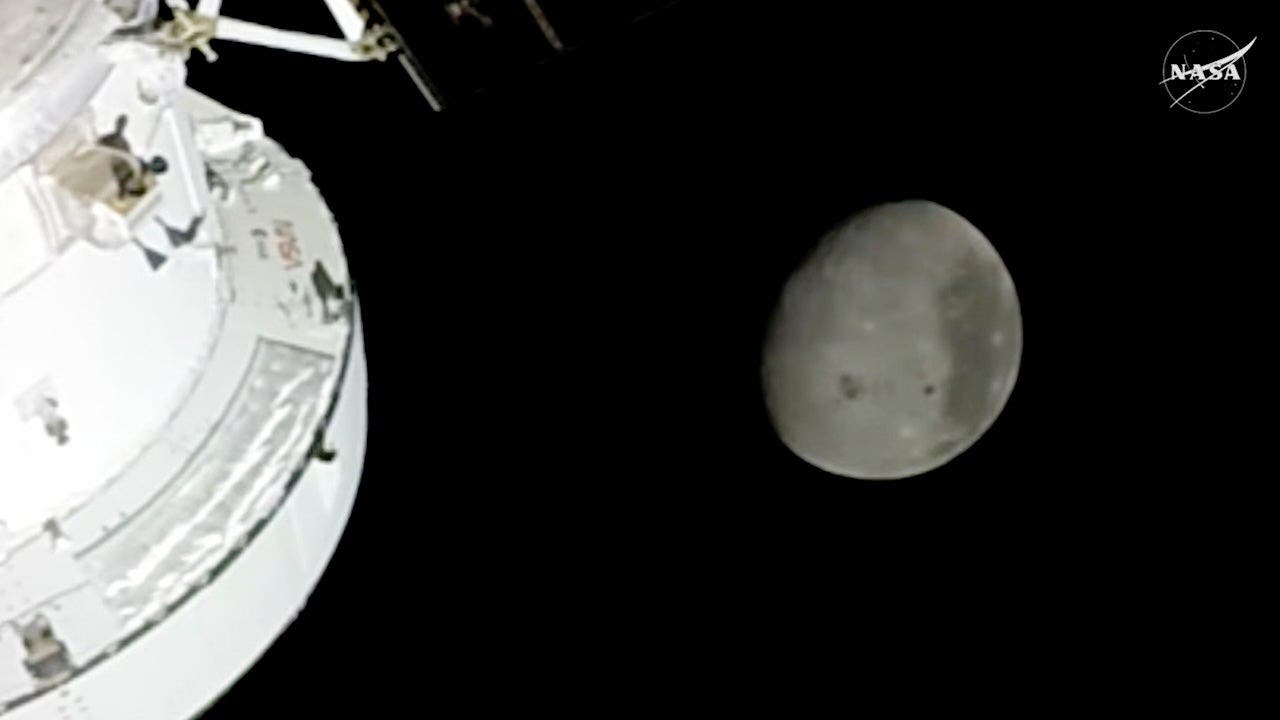
The Artemis II crew made history Monday as they journeyed around the far side of the moon, experiencing a 45-minute communications blackout that pilot Victor Glover met with both prayer and scientific focus.
During a video conference from Houston mission control, President Donald Trump asked the crew about their experience during the communications blackout. “I said a little prayer, but then I had to keep rolling,” Glover explained, noting that the crew immediately transitioned to conducting scientific observations of the lunar far side.
“That is actually the time when we were the farthest and the closest to the moon,” Glover continued. “We were really able to make some of our most detailed observations of the far side of the moon up close. And so we were busy up here working really hard.”
The conversation revealed fascinating differences between the moon’s familiar near side and its rarely seen far side. When Trump inquired about these distinctions, Canadian astronaut Jeremy Hansen explained how Earth’s gravitational influence has dramatically shaped the near side of the moon.
“The gravitational pull of the Earth has had a profound effect on the near side of the moon, changing all those dark mares, those dark patches of the moon you see from Earth,” Hansen said. “It’s very different on the far side. While you see some small patches of those mare and deep craters, it’s very much absent on that side.”
Hansen took a moment to thank the United States for its leadership in space exploration and for including Canada in the mission. “A nation that leads like that and creates and sets big goals for humanity, that brings other countries along with it, is truly incredible,” Hansen said, emphasizing that Canada was proud to contribute to the mutual goals of establishing a lunar presence and eventually reaching Mars.
Trump responded with appreciation for Hansen’s bravery, jokingly suggesting that even Canadian hockey legend Wayne Gretzky might hesitate to undertake such a mission.
Christina Koch, the first woman to travel to the moon and already a record holder for the longest single spaceflight by a woman (328 days), described the emotional impact of seeing Earth again after the communications blackout. “One of the biggest highlights was coming back from the far side of the moon and having the first glimpses of planet Earth again,” Koch said. “It really just reminds you what a special place we have and how important it is for our nation to work, to lead and not follow in exploring deep space.”
Mission commander Reid Wiseman shared details about unprecedented astronomical observations made possible by their unique vantage point. “We saw sights that no human has ever seen before, not even in Apollo,” Wiseman explained. The crew witnessed a solar corona during an eclipse and observed planets aligned beyond the moon—experiences unavailable to previous lunar missions.
Wiseman expressed enthusiasm about humanity’s future in space exploration: “All of us commented how excited we are to watch this nation, and this planet become a two-planet species.”
The Artemis II mission represents a critical step in NASA’s broader Artemis program, which aims to establish a sustainable human presence on the moon as preparation for eventual Mars missions. The crew, traveling in their Orion spacecraft nicknamed “Integrity,” has been conducting scientific observations throughout their journey, documenting phenomena never before seen by human eyes.
This mission marks humanity’s return to deep space after more than five decades since the Apollo program ended. As the crew continues their historic flight, they’re not only gathering scientific data but also demonstrating the technological capabilities that will enable future lunar landings and deeper space exploration.
The successful execution of this mission represents a significant achievement for international cooperation in space, with the United States leading while incorporating crucial contributions from partner nations like Canada.
Fact Checker
Verify the accuracy of this article using The Disinformation Commission analysis and real-time sources.

13 Comments
It’s great to see the astronauts embracing both scientific and spiritual approaches during their mission. Their ability to maintain focus and productivity during the communications blackout is truly inspiring.
The open dialogue between the astronauts and President Trump is a wonderful way to engage the public and build support for the Artemis program. Sharing these experiences helps people connect with the incredible work being done in space exploration.
The Artemis II mission is pushing the boundaries of space exploration. It’s inspiring to see astronauts not just relying on technology, but also turning to prayer during challenging moments. Their dedication and adaptability is admirable.
I agree, the ability to maintain focus and productivity during the communications blackout shows the astronauts’ professionalism and resilience.
The Artemis II mission is a significant step forward in our understanding of the moon and its formation. I’m looking forward to hearing more about the crew’s observations and discoveries as they continue their journey.
The differences between the near and far sides of the moon are fascinating. I’m curious to learn more about the geological features and formation processes that have shaped these distinct regions of the lunar surface.
The differences between the near and far sides of the moon are truly fascinating. I can’t wait to learn more about the geological processes that have shaped these distinct regions of the lunar surface.
The differences between the near and far sides of the moon are intriguing. I wonder what other insights the Artemis II crew was able to gain about the lunar surface and its formation during their mission.
The communications blackout must have been a challenging moment, but the astronauts’ ability to adapt and continue their scientific work is very impressive. This mission is a testament to the skill and resilience of the Artemis II crew.
Fascinating to hear the astronauts’ perspective on the far side of the moon. The communications blackout must have been an intense experience, but it’s great they were able to continue vital scientific observations during that time.
It’s great to see the open dialogue between the astronauts and President Trump. Sharing these experiences helps the public connect with and appreciate the incredible work being done in space exploration.
Absolutely, these types of interactions help build public support and excitement for the Artemis program.
The communications blackout must have been a nerve-wracking experience, but the astronauts’ ability to remain calm and focused is a testament to their training and professionalism. I’m in awe of their dedication and resilience.