


Listen to the article
Arizona’s GOP Faces Crossroads in Governor’s Race as Trump Influence Dominates
A sign reading “Let’s win not clash” greeted Arizona Republicans at a recent meeting where gubernatorial candidates sought support from the party’s core voters. The message highlights the frustration within a party that has seen its power erode over the past decade in a state increasingly competitive for Democrats.
Despite calls for unity, Arizona Republicans appear poised to once again nominate a candidate aligned with the party’s hard-right faction, a strategy that has failed to deliver statewide victories in recent elections.
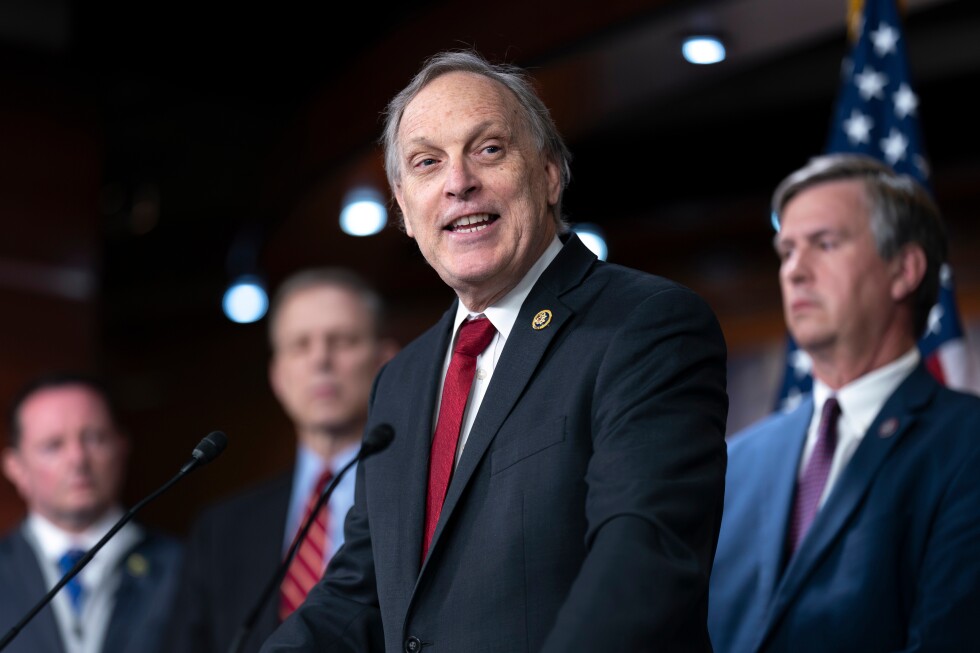
U.S. Rep. Andy Biggs has emerged as the frontrunner in the July primary, bolstered by endorsements from former President Donald Trump and Turning Point USA, an influential conservative youth organization. Biggs, who previously chaired the House Freedom Caucus and represents a solidly red district, faces U.S. Rep. David Schweikert, a fiscal conservative who has repeatedly defended his seat in a competitive, affluent purple district.
The winner will challenge Democratic Gov. Katie Hobbs, who defeated Trump-backed Kari Lake in 2020 and is now seeking a second term. The race recently narrowed when housing developer Karrin Taylor Robson, who represented the party’s traditional business-oriented wing, dropped out of the primary earlier this month.
Taylor Robson, who lost to Lake in the 2022 primary, had attempted to rebrand herself as a Trump-aligned culture warrior this time around. Despite securing Trump’s endorsement and prominently displaying it on her campaign materials, she failed to convince Republican primary voters like Anna Peto, a state party committeewoman from Pima County, who dismissed Taylor Robson’s candidacy as “fake.”
Arizona’s political landscape has shifted dramatically from its days as the home of conservative stalwarts like Barry Goldwater and John McCain. While Trump carried Arizona in 2016 and 2024 (losing narrowly in 2020), Republicans have failed to win U.S. Senate races since 2016 or the governor’s office since 2018.
Biggs is leaning heavily into his MAGA credentials. At a campaign event in Queen Creek last November, he promised to leverage the next round of redistricting to benefit Republicans and overhaul the state’s election system—a nod to his support for Trump’s efforts to overturn the 2020 election results, which remains a galvanizing issue for many Republican voters despite no evidence of widespread fraud.
“My goal is to mobilize everybody,” Biggs said in an interview, arguing he could better energize Republicans and right-leaning independents in a general election.
His endorsement from Turning Point USA carries significant weight with voters like Kendall Brittingham, a 32-year-old stay-at-home mother, who said the backing from the organization—now led by Erika Kirk following the assassination of her husband Charlie last year—holds even more sway than Trump’s endorsement.
Schweikert, meanwhile, is taking a different approach. Unlike most Republicans in the race, he doesn’t see Trump’s endorsement as essential to his campaign strategy. “Even some of the Biggs people, they’ll come up to me and say, ‘Uh, we know he can’t win the general election but he’s our friend,'” Schweikert said in an interview. “I think the activists are tired of losing.”
At a backyard gathering in Queen Creek, Schweikert emphasized his economic expertise and ability to balance a state budget. He argued that populist voters, many burdened by inflation, would benefit more from sound economic policies than ideological rhetoric.
Brian Symes, a mortgage broker familiar with both candidates, backs Schweikert as the only candidate who can unite the party. “I think it would be very tough for Andy to win,” Symes said.
Political consultant Paul Bentz sees little chance the party will change course. “The folks that have bemoaned the takeover of the party, the people who wish to go back to the more traditional Republican ways, aren’t the folks that show up at the precinct committee meetings, aren’t the folks that go knock on doors, and aren’t folks that have showed up at rallies,” Bentz explained.
As Arizona Republicans navigate this internal struggle between MAGA loyalty and electoral viability, the stakes remain high in a state that has become a crucial battleground in national politics. Whether the party can bridge its ideological divides may ultimately determine its ability to reclaim statewide power in November.
Fact Checker
Verify the accuracy of this article using The Disinformation Commission analysis and real-time sources.

10 Comments
This race highlights the broader battle within the GOP between the traditional fiscal conservatives and the Trump-aligned populists. The outcome could shape the party’s direction heading into the 2024 presidential election.
With Democrats holding the governor’s office, the Republican nominee will need to strike a careful balance to appeal to both the base and independent voters.
Regardless of the outcome, this race will provide valuable insights into the future direction of the Republican Party in a rapidly changing political landscape. Voters in Arizona will have a significant influence on shaping that path.
It will be worth watching how the candidates position themselves on issues like energy, the economy, and election integrity as they vie for the governorship.
As an energy and mining hub, Arizona’s economic interests could play a key role in this election. Voters will be looking for a governor who can balance environmental concerns with supporting the state’s vital resource industries.
The winner will need to navigate these complex issues and demonstrate a pragmatic, business-friendly approach that doesn’t alienate either side.
The Arizona gubernatorial race will be an interesting test of how much influence the MAGA wing of the GOP still holds. Voters will have a clear choice between a hardline Trump loyalist and a more moderate conservative.
It will be fascinating to see if the Republican base in Arizona still favors the MAGA approach or if they’re ready for a less divisive candidate.
This election will be a key test of Trump’s continued grip on the Republican Party. The winner could set the tone for the party’s approach to the 2024 presidential race and beyond.
With the state’s economic interests at stake, the candidates’ positions on mining, energy, and natural resources will be a crucial factor for many voters.