


Listen to the article
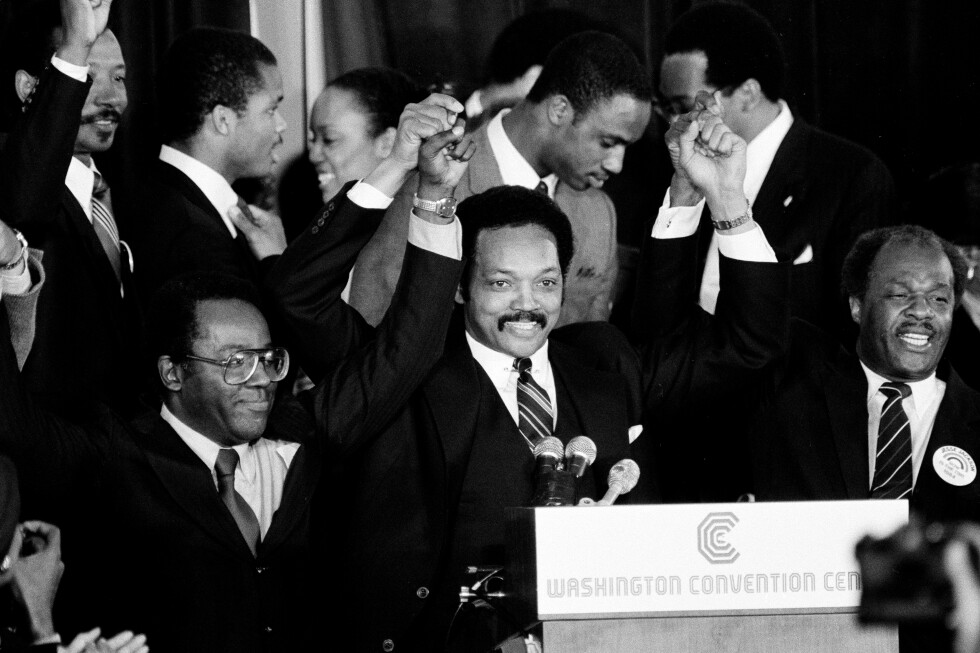
In a recently republished Associated Press profile from August 7, 1983, the Rev. Jesse Jackson emerges as a compelling figure preparing for what would become his historic 1984 presidential campaign. The original article, written by the late AP journalist Sharon Cohen, captures Jackson at age 41 as he stood at the crossroads of civil rights activism and national politics.
“I’m in the prophetic ministry,” Jackson told Cohen, comparing his calling to that of “ancient prophets” who “challenged the conduct of kings and queens.” Drawing parallels between himself and spiritual leaders like Jesus, Gandhi, and Martin Luther King Jr., Jackson described a profound sense of religious duty driving his activism: “There’s a push that comes from religious duty. Gandhi couldn’t stop. Martin couldn’t stop. Jesus couldn’t stop.”
Born in Greenville, South Carolina in 1941, Jackson rose through the civil rights movement after graduating from North Carolina A&T with a degree in sociology and economics. He joined King’s protests while attending Chicago Theological Seminary and was present when King was assassinated in Memphis in 1968. After King’s death, Jackson founded Operation PUSH (People United to Serve Humanity) in 1971, following his departure from the Southern Christian Leadership Conference.
Throughout the 1970s, Jackson’s advocacy evolved from direct civil rights activism to economic empowerment. His organization claimed to have secured over $1 billion in trade agreements with major corporations including Burger King, Coca-Cola, and Seven-Up to increase Black distributorships and advertising in Black-audience publications.
The profile reveals Jackson’s magnetic oratorical skills, showcasing his trademark rhythmic speaking style and gift for memorable phrases. “If you pickle your brains with liquor, you CAN’T hold out. If you shoot cocaine in your membrane, you CAN’T hold out,” he would tell church audiences, often moving them to respond with calls of “Preach, brother. Preach it.”
Jackson’s contemplation of a presidential run came at a time when Black political representation was still severely limited. “God did not limit genius to white males,” he stated. “He distributed it all over town.” Though he had never held elected office, polls at the time showed him more popular than some declared candidates.
However, the article doesn’t shy away from criticism of Jackson. Several unnamed national Black leaders described him as an opportunist who “exploits issues and seizes credit for the work of others.” Political strategist Don Rose, who worked with Jackson during the 1960s civil rights movement, offered pointed criticism: “The most pungent criticism is that he is constantly announcing campaigns and crusades that evaporate after the TV set is turned off.”
The profile also highlights controversies surrounding Jackson, including his embrace of PLO leader Yasser Arafat, which outraged American Jewish communities. Additionally, auditors from the Department of Education questioned PUSH-EXCEL’s use of approximately $736,000 in federal grants, with about $1 million in spending inadequately documented from approximately $6 million in total federal funding.
By 1983, Jackson had positioned himself as a voice on major national issues, bristling at critics who questioned his qualifications. “If on a given day Mr. Reagan can speak about agricultural policy and trade policy and international affairs and art and culture and science, who’s to suggest I should be less able to speak to a broad range of issues?” he challenged.
Georgia state Senator Julian Bond, reflecting on Jackson’s potential candidacy, noted its early impact: “He’s made the party more cognizant of black voters. It has made race — in a positive way — an agenda item in the campaign for the Democratic nomination.”
The following year, Jackson would indeed launch his presidential campaign, breaking new ground in American politics as the second African American (after Shirley Chisholm) to mount a nationwide campaign for the presidency.
Fact Checker
Verify the accuracy of this article using The Disinformation Commission analysis and real-time sources.

6 Comments
Fascinating look at Jesse Jackson’s path from civil rights activist to presidential candidate. His sense of religious duty and comparison to prophets like King is intriguing. Curious to learn more about how his 1984 campaign unfolded and its lasting impact.
The parallels he draws between himself and spiritual leaders like Jesus and Gandhi are quite bold. I wonder how his religious convictions shaped his approach to politics and policy positions.
Jackson seems to have been a captivating and principled figure, even if his presidential campaign didn’t succeed. It’s interesting to revisit this pivotal moment in American politics through the lens of this AP profile from the time.
I agree, the profile provides valuable historical context around Jackson’s rise and the challenges he faced. It’s a reminder of the complex interplay between civil rights, religion, and electoral politics.
This is a fascinating look back at a key moment in US political history. Jackson’s invocation of religious duty and prophetic mission is intriguing, though I wonder how that resonated with voters at the time. Curious to learn more about the legacy of his 1984 campaign.
The comparison to King and other revered civil rights leaders sets up high expectations. It will be interesting to see how Jackson’s own campaign and legacy are viewed in retrospect, both in terms of its successes and shortcomings.