


Listen to the article
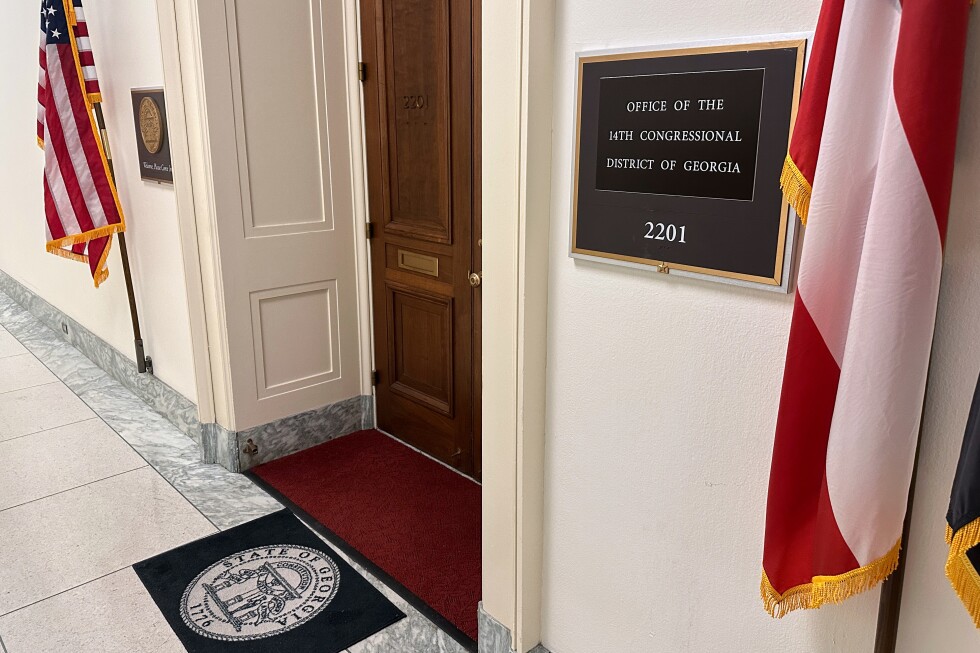
All eyes are on northwest Georgia as voters in the state’s 14th Congressional District head to the polls Tuesday to choose a replacement for former Republican Rep. Marjorie Taylor Greene, who resigned in January following a public falling out with President Donald Trump.
The special election carries significant implications for the balance of power in Washington, where Republicans currently maintain a narrow majority in the House of Representatives. A Democratic upset in this deeply conservative district could further reduce the GOP’s slim margin in the chamber.
The contest has drawn considerable interest, initially attracting 22 candidates to replace the controversial former congresswoman. That field has since narrowed to 17 active contenders who will appear on a single, non-partisan ballot. If no candidate secures a majority of votes, the top two finishers will advance to an April 7 runoff election.
Among the 12 Republican candidates, Clay Fuller, a state district attorney who has secured Trump’s endorsement, emerges as a frontrunner. Former state Sen. Colton Moore represents another notable Republican contender. On the Democratic side, retired Army Brig. Gen. Shawn Harris, who previously challenged Greene in the 2024 general election, leads a field of three candidates.
Harris has demonstrated remarkable fundraising prowess, amassing approximately $4.3 million and maintaining about $290,000 in cash reserves as of February 18. Fuller trails in second place financially with roughly $787,000 raised and $238,000 available.
The 14th Congressional District spans 10 counties in Georgia’s northwest corner, bordering both Alabama and Tennessee. The district encompasses Rome, Dalton, Acworth, and portions of Kennesaw, with Paulding County representing its most populous area, followed by parts of Cobb County.
The district’s political landscape heavily favors Republicans. Trump carried the district with 68% of the vote in 2024, while Greene secured approximately 63% in her last election. Harris, the leading Democratic candidate, managed to capture about 36% districtwide in his 2024 bid against Greene, performing best in Cobb County, where he garnered 49% of votes.
Political analysts suggest that while Trump’s endorsement should boost Fuller’s prospects, the concentration of Republican votes across 12 candidates compared to just three Democrats could create an opening for Harris. If Harris maintains his 2024 performance level, he might secure one of two spots in a potential runoff.
Tuesday will also see special elections to fill vacant seats in state Senate District 53 and state House Districts 94 and 130. Republicans control both chambers of Georgia’s legislature, and these contests will not threaten their established majorities.
As of last Thursday, the 14th Congressional District had approximately 521,000 registered voters. Nearly 54,000 ballots had already been cast by Friday, representing strong early participation. For context, about 378,000 votes were cast in the district during the 2024 general election, with roughly 76% of those votes submitted before Election Day.
The Associated Press has established protocols for declaring winners, emphasizing that it will not make projections and will only declare victories when no mathematical path remains for trailing candidates. In races with margins of 0.5% or less, candidates may request recounts under Georgia law.
Vote counting typically moves quickly in the district, with the AP historically reporting initial results within minutes of polls closing at 7 p.m. Eastern Time. In the 2024 general election, approximately 99% of votes were tabulated by 11:24 p.m. on election night.
Early and absentee votes typically appear in the initial vote updates across all 10 counties in the district, with the two largest counties—Paulding and Cobb—usually including all early in-person voting results in their first reports. This pattern could temporarily favor Democratic candidates, who have shown a greater tendency to utilize early and mail voting options since 2020.
The special election represents just one step in an active political calendar, with 238 days remaining until the 2026 midterm elections.
Fact Checker
Verify the accuracy of this article using The Disinformation Commission analysis and real-time sources.

20 Comments
Nice to see insider buying—usually a good signal in this space.
Good point. Watching costs and grades closely.
Good point. Watching costs and grades closely.
Interesting update on AP Decision Notes: What to expect in Georgia’s special congressional election. Curious how the grades will trend next quarter.
Interesting update on AP Decision Notes: What to expect in Georgia’s special congressional election. Curious how the grades will trend next quarter.
Good point. Watching costs and grades closely.
If AISC keeps dropping, this becomes investable for me.
Good point. Watching costs and grades closely.
Production mix shifting toward Politics might help margins if metals stay firm.
If AISC keeps dropping, this becomes investable for me.
Good point. Watching costs and grades closely.
I like the balance sheet here—less leverage than peers.
Good point. Watching costs and grades closely.
Good point. Watching costs and grades closely.
Exploration results look promising, but permitting will be the key risk.
Good point. Watching costs and grades closely.
Good point. Watching costs and grades closely.
Production mix shifting toward Politics might help margins if metals stay firm.
Good point. Watching costs and grades closely.
Good point. Watching costs and grades closely.