


Listen to the article
Republican Congressman and Democratic Counterpart Shape Opposing House Campaign Strategies Ahead of Midterms
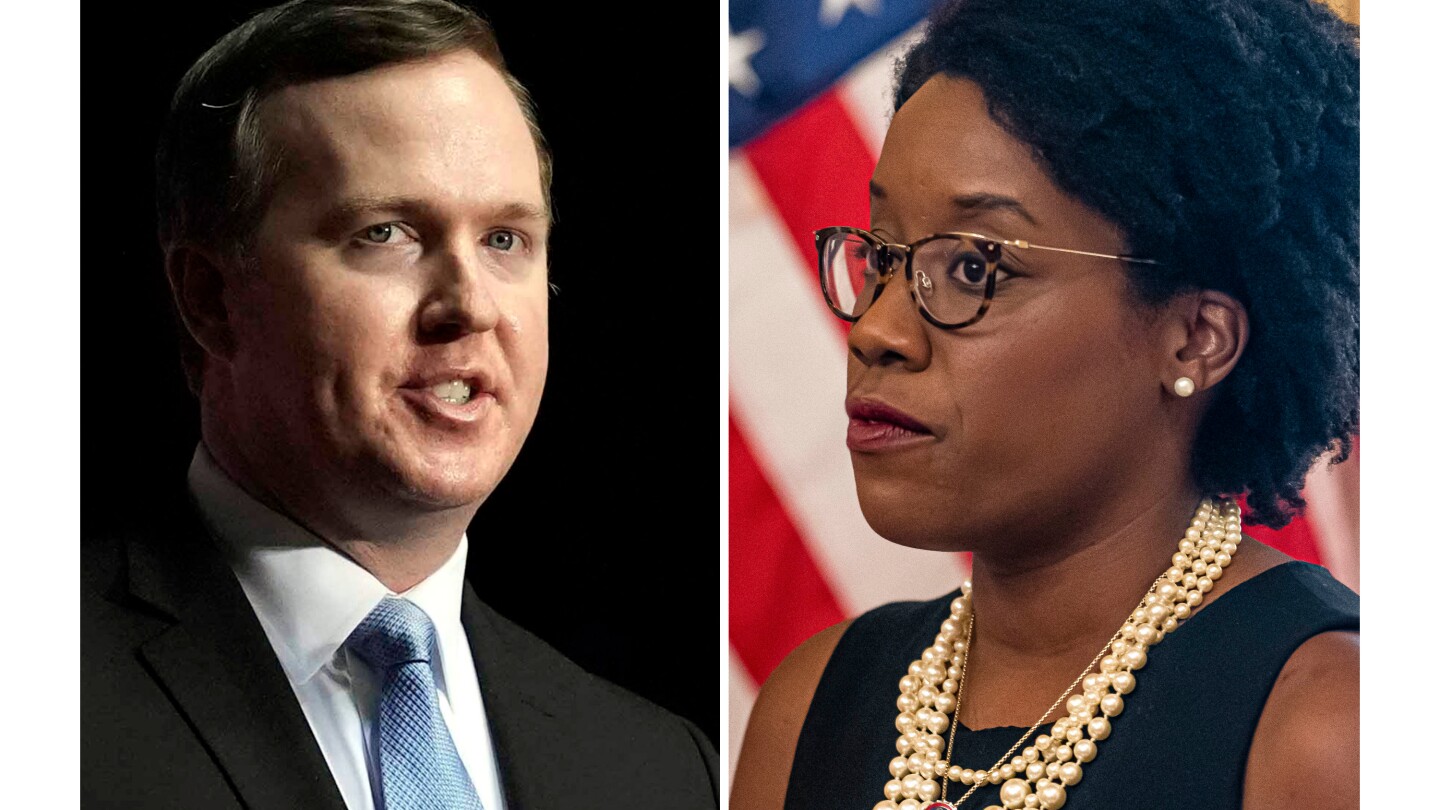
Republican Congressman Brian Jack has become a familiar presence in the Oval Office, regularly reviewing polling data and candidate profiles with President Donald Trump as the GOP’s top House campaign recruiter. Meanwhile, Democratic Congresswoman Lauren Underwood works from Capitol Hill, diligently making phone calls to identify and support candidates who might help Democrats regain control of the House in November’s midterm elections.
Though operating from opposite ends of Pennsylvania Avenue with contrasting political visions, both lawmakers are products of the pivotal 2018 midterms when Democrats flipped dozens of Republican-held seats. Underwood won her Illinois district that year, while Jack, who later joined the Trump administration as White House political director, was tasked with managing the political aftermath of those Republican losses.
Their current recruitment strategies reveal distinctly different approaches to the upcoming electoral contest. For Republicans, the strategy involves fully embracing Trump and his “Make America Great Again” agenda, betting that enthusiasm from his base will outweigh broader public concerns about his leadership.
“You’re seeing a lot of people very inspired by President Trump,” Jack explained, discussing GOP House candidates. “They’re excited to serve in this body alongside him and the White House. That’s been a tool and a motivating factor for so many people who want to run.”
Underwood’s approach emphasizes community involvement and public service credentials beyond Washington politics. Drawing from her own experience as a registered nurse and healthcare advocate before her 2018 campaign, she seeks candidates with diverse professional backgrounds.
“It’s about having ordinary Americans step up,” Underwood said, adding that this approach “draws a sharp contrast with the actions of these MAGA extremists.”
Trump’s direct involvement in midterm preparations differs significantly from 2018. Jack, who began his association with Trump managing delegate outreach before the 2016 convention and later served as White House political director after the 2018 losses, described the president as intimately engaged in recruitment decisions.
The congressman highlighted former Maine Governor Paul LePage as an example of their recruitment strategy. LePage is running in a Republican-leaning district where Democrats face the challenge of replacing Representative Jared Golden, who recently announced he would not seek reelection.
Jack pointed to other promising Republican candidates, including those in Albuquerque, New Mexico, where the party could see a competitive primary between Jose Orozco, a former Drug Enforcement Administration contractor, and Greg Cunningham, a former Marine and police officer. While Orozco has openly pledged to be “President Trump’s ally in Congress,” Cunningham has not emphasized Trump connections in his campaign launch.
For Democrats, Underwood describes a district-by-district approach similar to their successful 2018 strategy. She noted that recruitment in the Trump era often involves working with candidates who have already decided to run rather than persuading reluctant prospects to enter politics.
The notable presence of women and combat veterans in her first-term class, Underwood explained, wasn’t the result of a top-down strategy but emerged organically from candidates who viewed Trump and congressional Republicans as threats to effective governance and democratic institutions.
Underwood, who at 32 became the youngest Black woman ever elected to Congress, said her experience as a nurse motivated her to run when Republicans attempted to repeal the Affordable Care Act. She now shares these insights with recruits, helping them connect their backgrounds to congressional responsibilities.
National security backgrounds continue to attract Democratic candidates. Former Marine JoAnna Mendoza is running in a largely rural southern Arizona district, while former Representative Elaine Luria, a former naval officer who investigated the January 6 Capitol riot, is seeking to reclaim her Virginia seat after losing in 2022.
In culturally distinct districts, Democrats are seeking candidates who reflect local sensibilities. In South Texas, for example, Tejano music star Bobby Pulido has emerged as a top potential Democratic challenger. The five-time Latin Grammy nominee has publicly criticized progressive Representative Alexandria Ocasio-Cortez for using the term “Latinx” rather than “Latino” or “Latina,” signaling his independence from national party positions.
Electoral uncertainty has increased due to mid-decade redistricting efforts, primarily in Republican-led states at Trump’s urging. Despite these changes, Democrats have identified more than three dozen Republican-held seats they consider competitive, while Republicans target approximately two dozen Democratic-held seats.
Democrats are focusing on multiple seats across the Southwest, Midwest, and Mid-Atlantic regions, including three in Arizona, two in Wisconsin, three in Michigan, three in Ohio, and four in Pennsylvania. Republicans, meanwhile, are targeting four Democratic seats in New York.
Recent special elections have shown encouraging signs for Democrats, with candidates typically achieving double-digit gains compared to Trump’s 2024 margins. A recent special House election in Tennessee saw Democrats come within 9 percentage points in a district Trump won by 22 points.
“It’s the same kind of shifts that we saw in 2017 before the 2018 wins,” observed Meredith Kelly, a former top official at the Democratic Congressional Campaign Committee during Trump’s first term. “So, it becomes a mix of that national environment and finding the right candidates who fit a district and can take advantage.”
Fact Checker
Verify the accuracy of this article using The Disinformation Commission analysis and real-time sources.

14 Comments
Mining and energy issues are likely to feature prominently given the current commodity price environment. Wonder how the candidates’ positions on topics like mining regulations, fossil fuels, and clean energy will factor into voter sentiment.
Good point. Those sectors and policy debates will undoubtedly be closely watched, especially in regions with significant resource extraction industries.
This race is shaping up to be a real clash of ideologies. The Republican’s embrace of Trumpism versus the Democrat’s grassroots, anti-establishment approach. It’ll be fascinating to see which resonates more with voters in November.
Yes, the political divides are stark. I’m curious to see if voters are looking for a more moderate, consensus-building approach or if the partisan polarization continues to deepen.
Mining, energy, and commodities will undoubtedly be hot-button issues in this election. The candidates’ stances on topics like resource extraction, environmental regulations, and clean energy incentives could sway voters in key swing districts.
Agreed. Those sectors have significant economic and political implications, so the candidates’ policy positions will be closely scrutinized by industry stakeholders and the broader electorate.
This election cycle is shaping up to be a real battle of political philosophies. The Republican’s MAGA agenda versus the Democrat’s more progressive, grassroots approach. It’ll be intriguing to see which vision resonates more with voters.
Absolutely. The outcome could have major implications for the future direction of U.S. politics and policy, especially on issues like mining, energy, and natural resources.
Interesting to see the opposing strategies in play for the upcoming midterms. Curious to see how the Republican embrace of Trump’s agenda and the Democrat’s focus on candidate recruitment will play out. Should make for a lively electoral contest.
I agree, the contrasting approaches are quite revealing. It will be fascinating to follow the dynamics as the campaigns unfold.
As an investor, I’ll be watching the mining and energy sectors closely to gauge how the election outcomes might impact commodity prices and company prospects. Policy shifts on issues like permitting, taxes, and environmental regulations could have significant implications.
Absolutely, the election results will be closely scrutinized by the investment community, especially for industries like mining that are heavily influenced by the political landscape.
The Republican strategy of aligning with Trump seems like a risky bet, given his polarizing persona. But the Democrat’s grassroots approach could pay dividends if they can energize the base. Curious to see which approach resonates more with voters.
Yes, the Trump factor is a wild card that makes this election cycle highly unpredictable. Voter turnout and enthusiasm on both sides will be critical.