


Listen to the article
U.S. Deploys Advanced Aircraft Carrier to Caribbean Amid Escalating Anti-Drug Operations
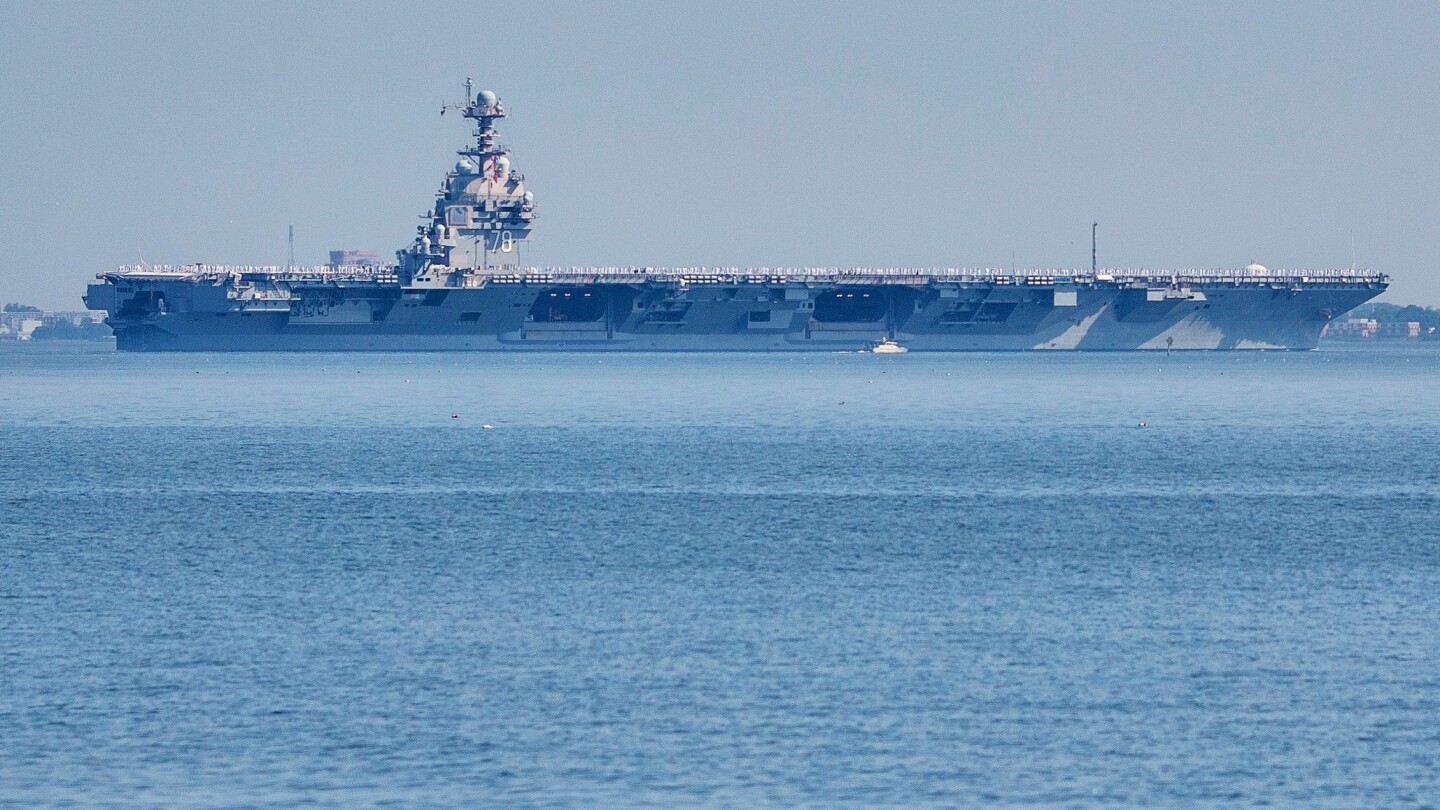
The USS Gerald R. Ford, America’s most advanced aircraft carrier, arrived in the Caribbean Sea on Sunday, significantly escalating U.S. military presence in a region where the Trump administration has intensified its anti-narcotics campaign in recent months. The deployment raises questions about the administration’s ultimate intentions toward Venezuela and its contested president, Nicolás Maduro.
The carrier’s arrival, announced in a U.S. military news release, comes amid a series of aggressive actions in what the administration describes as a counterdrug operation. Since early September, U.S. strikes have reportedly killed at least 80 people in 20 separate attacks on small boats allegedly transporting drugs in the Caribbean and eastern Pacific Ocean.
Defense Secretary Pete Hegseth has dubbed the mission “Operation Southern Spear,” which now constitutes the largest buildup of U.S. military power in Latin America in decades. The deployment brings the total American troop presence to approximately 12,000 personnel aboard nearly a dozen Navy vessels.
According to Navy officials, the Ford’s carrier strike group, which includes fighter jet squadrons and guided-missile destroyers, transited the Anegada Passage near the British Virgin Islands on Sunday morning. Rear Admiral Paul Lanzilotta, commander of the strike group, stated that the deployment will strengthen American forces in the region to “protect our nation’s security and prosperity against narco-terrorism in the Western Hemisphere.”
The Trump administration has consistently framed this military buildup as focused on disrupting drug trafficking networks. However, critics note that the government has provided little evidence supporting its characterization of those killed in boat strikes as “narcoterrorists.” President Trump has indicated that operations may expand beyond maritime strikes, saying the U.S. would “stop the drugs coming in by land.”
Military analysts point out that aircraft carriers have traditionally been used by the United States to project power and deter aggression, as their warplanes can strike targets deep within enemy territory. Some experts suggest that while the Ford may not be ideally suited for anti-cartel operations, it serves as a powerful intimidation tool that could pressure Maduro’s regime.
Secretary of State Marco Rubio has emphasized that the United States does not recognize Maduro as Venezuela’s legitimate leader, following what many international observers described as a fraudulent election last year. Rubio has characterized Venezuela’s government as a “transshipment organization” that actively collaborates with drug traffickers.
For his part, Maduro—who faces narcoterrorism charges in the United States—has accused the U.S. of “fabricating” a pretext for war against his government. Venezuelan authorities recently announced a “massive” mobilization of troops and civilians to defend against potential U.S. military action.
President Trump has justified the naval strikes by claiming the United States is in “armed conflict” with drug cartels and alleging the targeted boats are operated by “foreign terror organizations.” This characterization has faced significant skepticism and pushback from regional leaders, the United Nations human rights chief, and U.S. lawmakers from both parties who have demanded more transparency regarding the targets and legal justification for the operations.
Despite concerns about potential military escalation, Senate Republicans recently voted down legislation that would have required congressional authorization before any attack against Venezuela.
“This is the anchor of what it means to have U.S. military power once again in Latin America,” said Elizabeth Dickinson, senior analyst for the Andes region at the International Crisis Group. “And it has raised a lot of anxieties in Venezuela but also throughout the region. I think everyone is watching this with sort of bated breath to see just how willing the U.S. is to really use military force.”
The deployment of the USS Gerald R. Ford represents a dramatic shift in U.S. strategy toward the region, with potential implications that extend far beyond drug interdiction efforts. As tensions continue to mount, regional observers remain concerned about whether the situation could evolve from maritime drug enforcement into a broader military confrontation with Venezuela.
Fact Checker
Verify the accuracy of this article using The Disinformation Commission analysis and real-time sources.

9 Comments
Interesting developments in the Caribbean. The U.S. military buildup in the region raises questions about the administration’s true intentions beyond just anti-drug operations. This could have broader geopolitical implications we’ll need to watch closely.
I wonder what the strategic rationale is for sending such a powerful naval asset like the Gerald R. Ford to the Caribbean at this time. Is it solely about drug interdiction, or could there be other geostrategic objectives at play? This bears close observation.
This is a significant ramp-up of U.S. military activity in the Caribbean. I wonder if there are any concerns about the potential for miscalculation or unintended escalation, given the geopolitical tensions in the region.
Good point. With the heightened tensions, any missteps or miscommunications could quickly spiral out of control. Careful diplomacy and conflict de-escalation will be crucial going forward.
Wow, the U.S. is really flexing its military muscle in the Caribbean. 12,000 personnel and a dozen Navy vessels is a major force projection. I’m curious to see how Venezuela and other regional actors respond to this show of force.
While the official reason given is anti-drug operations, the scale of this military buildup in Latin America is quite unusual. I hope the administration is being transparent about its full intentions and not escalating tensions unnecessarily.
The arrival of the USS Gerald R. Ford in the Caribbean is a strong signal of U.S. resolve, but I hope this doesn’t lead to further militarization or conflict in the region. Diplomatic solutions should be the priority.
I agree. Increased military posturing often begets more of the same. Hopefully the administration can find ways to de-escalate tensions through constructive dialogue and engagement with all relevant stakeholders.
The deployment of the USS Gerald R. Ford, America’s most advanced aircraft carrier, to the Caribbean is a significant escalation of U.S. military presence in the region. It will be important to monitor how this impacts regional dynamics and Venezuela’s situation.