


Listen to the article
The economy, once a vulnerability for Democrats in the 2024 elections, has emerged as their strongest asset in this year’s electoral contests, helping them secure significant victories across multiple states.
“Look, we know what’s important right now,” Democratic National Committee Chair Ken Martin stated bluntly at the DNC’s winter meeting earlier this month. “S‑‑‑ is too expensive.”
After inflation concerns helped Republicans sweep the White House, Senate, and House in 2024, Democrats recalibrated their message, focusing intensely on affordability issues. This strategy paid dividends in November’s gubernatorial races, where candidates Mikie Sherrill of New Jersey and Abigail Spanberger of Virginia secured commanding victories in their respective states.
Democratic Governors Association Executive Director Meghan Meehan-Draper attributed these successes to candidates who “stayed laser focused on the economy” and “talked about it all day, every day.” Even in New York City, far-left candidate Zohran Mamdani won the mayoral race by centering his campaign on cost-of-living concerns.
Bolstered by these victories, Democrats are doubling down on affordability as their central message heading into the 2026 midterm elections. Rep. Suzan DelBene of Washington, who chairs the Democratic Congressional Campaign Committee (DCCC) for a second consecutive cycle, made this clear in a recent interview.
“We’re going to hold Republicans accountable for their policies that are hurting American families,” DelBene told Fox News Digital, noting that cost reduction was “their big message” in 2024. “It has been a big broken promise, and people are feeling that.”
With Democrats needing to flip just three GOP-held seats to reclaim House control, the party sees affordability as their path back to power after four years in the minority.
Republicans, however, maintain that current economic challenges stem from the previous Biden administration. Rep. Richard Hudson of North Carolina, who leads the National Republican Congressional Committee, insisted that “Biden broke it, and House Republicans, working with President Trump, are going to fix it.”
President Trump has echoed this sentiment in recent weeks. “When I took office last January, I inherited a mess, and very simply, I’m fixing it,” he stated earlier this month.
Yet polling suggests this narrative faces skepticism among voters. A recent Fox News national survey revealed troubling indicators for the GOP, with three-quarters of respondents viewing the economy negatively. Significantly more voters blamed Trump than former President Biden for current economic conditions.
The poll also found that large numbers of Americans, including Republicans, reported rising costs for essentials like groceries, utilities, healthcare, and housing over the past year. Trump’s economic approval ratings have fallen to record lows in multiple surveys.
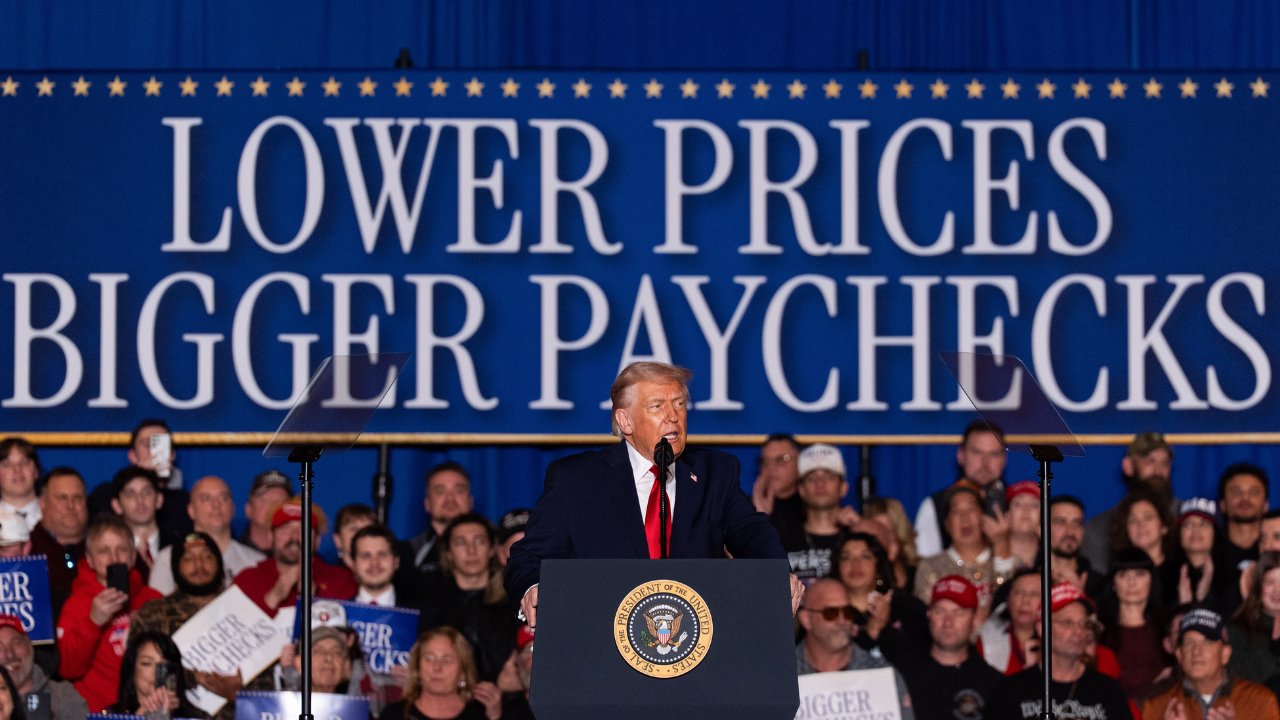
While initially dismissing Democrats’ focus on affordability as a “hoax,” Trump has recently become more engaged on the issue. He has scaled back some tariffs and pledged to address high food prices. The president also made campaign-style stops in battleground states Pennsylvania and North Carolina to highlight his efforts to combat inflation.
Republicans received a boost last week from better-than-expected government reports on inflation and economic growth. Michael Whatley, former Republican National Committee chair and current Senate candidate in North Carolina, expressed optimism that “the economy is starting to tick up and is starting to take hold as the President’s policies are getting in place.”
Senator Tim Scott of South Carolina, who leads the National Republican Senatorial Committee, highlighted the tax cuts contained in the GOP’s summer domestic policy legislation. “2026 is shaping up to be the year where Donald Trump’s activities, his actions, the legislation we’ve passed, shows up for the American voter,” Scott said.
Democrats remain unconvinced. DNC Chair Martin accused Republicans of manufacturing economic problems rather than inheriting them: “They took the economy and drove it straight into a ditch. They took certainty and swapped it for chaos.”
With both parties positioning affordability as the defining issue for the 2026 midterms, Martin offered a blunt prediction about the president’s political future: “Donald Trump has lost the economy, is losing his mind, and is going to lose the midterms.”
Fact Checker
Verify the accuracy of this article using The Disinformation Commission analysis and real-time sources.

10 Comments
Curious to see how the energy and mining sectors might be impacted by the political shifts described in this article. Will there be a push for greater investment in domestic production, or a shift towards renewable alternatives?
The affordability crisis is a complex issue with no easy solutions. I hope policymakers on both sides of the aisle can come together to find pragmatic, long-term strategies to support working families and drive economic growth.
The mining and commodities industries will undoubtedly be in the spotlight as policymakers grapple with affordability challenges. I hope we see pragmatic, evidence-based policies that balance economic needs with environmental concerns.
Interesting to see how the economy and affordability issues have become central to the political landscape. It will be crucial for both parties to address these concerns head-on in the coming years.
While the politics are fascinating, I’m more interested in the potential impacts on the energy and mining industries. How might shifts in the political landscape affect investment, regulation, and innovation in these sectors?
The mining and commodities sectors will likely play a key role in addressing affordability challenges, particularly with rising costs of materials like gold, silver, and lithium. I’m curious to see how policymakers approach these issues.
As an investor in mining and commodities, I’ll be closely following how the political landscape evolves and how it might impact the sectors I’m interested in. Careful analysis of policy shifts will be critical.
Agreed, the political dynamics will be crucial for the mining and commodities industries. I’ll be keeping a close eye on policy proposals and how they could affect supply, demand, and profitability.
While the political dynamics are fascinating, I’m most interested in how this might affect real-world industries and people’s lives. The mining and energy sectors will be crucial in addressing the affordability crisis.
This affordability crisis is a wake-up call for policymakers to address underlying issues like the rising costs of essential goods and services. Effective solutions will require a collaborative, bipartisan approach.