


Listen to the article
In a year marked by political posturing ahead of the crucial presidential election, President Donald Trump has consistently touted his administration’s achievements while disparaging the record of his predecessor, Joe Biden. However, fact-checkers and political analysts have increasingly noted that many of these claims rely on misleading information or outright falsehoods.
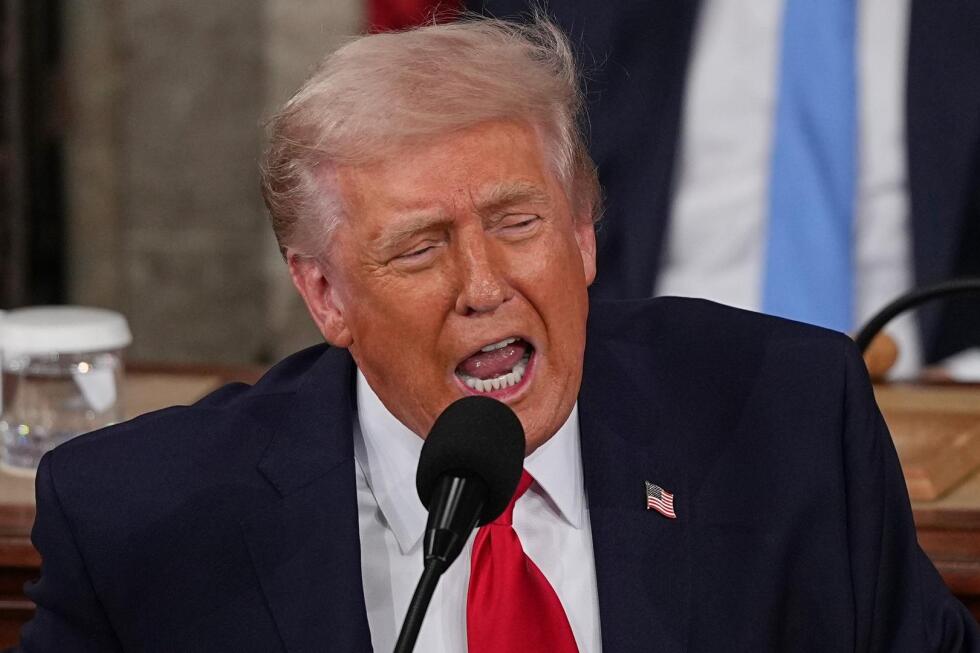
This pattern was on full display during Trump’s recent State of the Union address, where the president once again presented a selective view of his administration’s accomplishments, often stretching the truth or omitting critical context.
The Associated Press, which has been tracking presidential statements throughout Trump’s term, documented numerous instances where the president’s claims diverged significantly from factual reality. These mischaracterizations covered a range of issues from economic performance to immigration policy and international relations.
In particular, Trump’s assertions about economic growth have frequently overstated his administration’s impact. While the U.S. economy has shown resilience in certain sectors, economists point out that many positive trends began during the previous administration and have continued, albeit with some modifications due to Trump’s policies such as tax cuts and deregulation efforts.
The president has also repeatedly exaggerated improvements in trade relationships and manufacturing job growth. Although there have been some notable developments in these areas, data from the Bureau of Labor Statistics and trade analysts suggest a more nuanced picture than the one presented in Trump’s speeches.
Immigration remains another contentious topic where the president’s rhetoric often contradicts documented facts. Trump’s claims about border security and undocumented immigration frequently include statistics that government agencies themselves cannot verify or directly contradict official data from Customs and Border Protection and other relevant departments.
Political communication experts note that this approach is not unique to Trump but represents a particularly aggressive version of a common political strategy: emphasizing favorable data while minimizing or ignoring contradictory evidence. What distinguishes the current administration, according to these experts, is the frequency and boldness of claims that can be readily disproven with publicly available information.
The impact of this communication style extends beyond mere political posturing. Market analysts have observed that certain industries and stock prices sometimes fluctuate in response to presidential statements, particularly those related to trade policy, tariffs, and international relations. This creates a challenging environment for investors trying to make decisions based on factual economic indicators.
For voters attempting to assess the administration’s actual performance, the task has become increasingly difficult, requiring cross-referencing presidential statements with information from government agencies, economic reports, and independent analysis.
Media watchdogs and fact-checking organizations have ramped up their efforts to provide context for presidential claims, though these corrections often receive less attention than the original statements. This information asymmetry concerns political scientists who study democratic discourse and voter decision-making.
As the election season intensifies, political observers expect this pattern to continue, with claims and counterclaims dominating the campaign landscape. The challenge for voters will be distinguishing between legitimate policy differences and factual misrepresentations.
The phenomenon also highlights broader questions about accountability in political communication and the role of traditional and social media in either amplifying or challenging inaccurate statements from political leaders.
For the remainder of the campaign season, analysts recommend that voters consult multiple sources when evaluating political claims, particularly those related to complex policy areas where simplified narratives often fail to capture important nuances and trade-offs.
Fact Checker
Verify the accuracy of this article using The Disinformation Commission analysis and real-time sources.

13 Comments
While economic progress is positive, it’s concerning to see misleading claims being made. Transparency and accountability should be the priority for elected officials.
Absolutely. Voters deserve the truth, not selective information designed to bolster a particular narrative.
The article raises valid concerns about misleading claims. It’s a good reminder to critically examine statements from all political figures, regardless of party affiliation.
This is a timely and important article. Ensuring the accuracy of political claims is vital for a well-informed electorate. I hope this encourages more rigorous fact-checking across the board.
The article raises valid points about the need to scrutinize political rhetoric and ensure it aligns with the facts. I appreciate the balanced and evidence-based approach.
This is an important reminder that we should be critical consumers of information, especially when it comes to claims made by political leaders. Fact-checking is essential for a healthy democracy.
Well said. Maintaining a skeptical yet open-minded attitude is crucial when evaluating the statements of those in power.
Interesting analysis. It’s important to scrutinize claims made by political leaders and ensure they align with the facts. While economic progress is positive, we should be cautious about oversimplifying the factors involved.
Agreed. Nuance and context are crucial when evaluating a leader’s record. Fact-checking is essential for an informed electorate.
Fact-checking is crucial, but it can be challenging to cut through the partisan noise. I appreciate the effort to provide a nuanced, evidence-based analysis in this piece.
Agreed. Maintaining impartiality and focusing on the facts is the best way to cut through the political spin.
This highlights the need for balanced and objective reporting, especially during election cycles. Voters deserve to have access to reliable information to make informed decisions.
Well said. Cutting through political rhetoric and getting to the core facts is key for a healthy democracy.