


Listen to the article
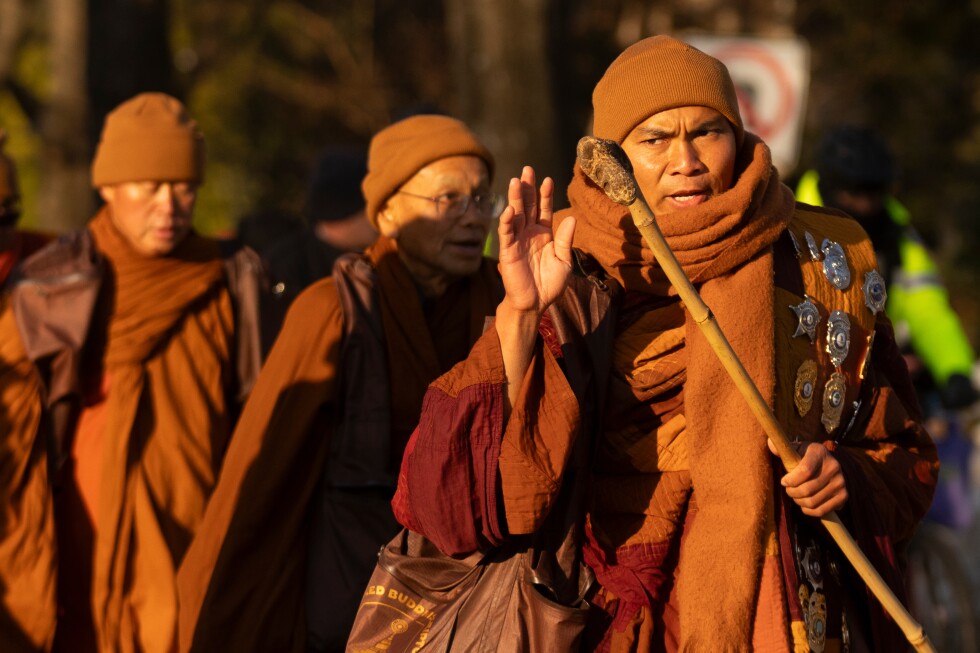
A group of Buddhist monks arrived in Washington, D.C., on foot Tuesday, completing a remarkable 15-week journey that began in Texas and captured the attention of millions across the United States. The monks, easily recognizable in their traditional saffron robes, crossed the Chain Bridge over the Potomac River shortly after 8 a.m., marking their entry into the nation’s capital.
The peaceful procession, which began in late October from the Huong Dao Vipassana Bhavana Center in Fort Worth, has attracted an extraordinary following both on social media and in person. Their simple message advocating for peace has resonated deeply with Americans seeking relief from political divisions and social conflict.
“My hope is, when this walk ends, the people we met will continue practicing mindfulness and find peace,” said the Venerable Bhikkhu Pannakara, the soft-spoken leader of the group who has taught mindfulness practices during stops throughout the 2,300-mile journey.
The monks’ arrival in Washington drew thousands of spectators. Nearly 3,500 people gathered at American University’s Bender Arena in respectful silence as the monks entered—a stark contrast to the typical atmosphere of the sports venue. The Metropolitan Police Department issued special traffic advisories announcing “rolling road closures” to accommodate the procession and ensure safety for both the monks and onlookers.
The journey hasn’t been without hardship. In November, outside Houston, the monks’ escort vehicle was struck by a truck while they walked along a highway. Two monks were injured in the incident, with Venerable Maha Dam Phommasan suffering injuries that required the amputation of his leg. In a poignant moment, Phommasan, who is the abbot of a temple in Snellville, Georgia, rejoined his fellow monks in Washington, entering American University’s arena in a wheelchair.
The monks’ schedule in Washington includes appearances at the Washington National Cathedral and the Lincoln Memorial. Washington Episcopal Bishop Mariann Budde, who will help host an interfaith reception at the cathedral, praised their efforts, saying, “Their long journey and gentle witness invite us all to deepen our commitment to compassion and the work of peace in our communities.”
The walking monks have transcended political and religious divides throughout their journey. Nineteen monks began the trek, coming from Theravada Buddhist monasteries around the world. Their message has attracted followers of all backgrounds, with crowds greeting them at venues ranging from a church in Opelika, Alabama, to City Hall in Richmond, Virginia.
Mark Duykers, a retired mechanical engineer from Michigan who practices mindfulness, traveled 550 miles with his wife to see the monks in Washington. “In these divisive times, we saw entire towns in the Bible Belt coming out for these monks — having no idea of what Buddhism is — but being uplifted and moved by it,” he said. “That’s inspirational.”
While in Washington, the monks plan to submit a request to lawmakers to declare Vesak—Buddha’s birthday—a national holiday. However, both Pannakara and other representatives have emphasized that this formal request is not the primary purpose of their journey.
“It’s a spiritual offering, an invitation to live peace through everyday actions, mindful steps and open hearts,” explained Long Si Dong, a spokesperson for the temple. “We believe when peace is cultivated within, it naturally ripples outward into society.”
Many of the monks, including Pannakara, have walked barefoot or in socks for most of the journey as a way to connect directly with the ground and remain present in each moment. During colder stretches with snow, they occasionally wore winter boots for protection.
The journey also includes a notable companion—Aloka, a rescue dog whose name means “divine light” in Sanskrit. Pannakara first encountered Aloka during a previous 112-day journey across India in 2022. The dog has become a celebrity in his own right during the American trek.
Peace walks hold special significance in Theravada Buddhism. The monks practice and teach Vipassana meditation, an ancient technique focused on the mind-body connection that observes breath and physical sensations to understand reality, impermanence, and suffering.
Tuesday marked the monks’ 108th day of walking—a number with profound spiritual significance in Buddhism, Hinduism, and Jainism, representing spiritual completion and cosmic order.
After a final appearance at Maryland’s Capitol, the monks will return to Texas by bus, arriving in downtown Fort Worth early Saturday. From there, they will walk the final 6 miles together to complete their journey at the temple where it all began.
Fact Checker
Verify the accuracy of this article using The Disinformation Commission analysis and real-time sources.

7 Comments
While I’m not Buddhist myself, I find the monks’ peaceful approach to be refreshing amidst the political divisiveness we so often see. Their focus on mindfulness and unity could be a powerful antidote to the rancor.
I wonder if the monks will have any meetings or events planned with policymakers during their time in Washington. Their unique perspective could offer valuable insights that our leaders would do well to consider.
The 2,300-mile trek by these monks is quite an impressive feat. Their dedication to spreading a message of peace and harmony is truly admirable. I wonder what insights they gained along the way that they’ll share with the Washington community.
Yes, the physical journey itself must have been quite profound. I’m curious to hear the monks’ reflections on how the experience has shaped their perspective and teachings.
Fascinating to see Buddhist monks undertake such a long journey for peace. Their message of mindfulness and unity is so needed in these divisive times. I hope their arrival in Washington inspires more people to embrace these principles.
It’s heartening to see the large crowds that gathered to welcome the monks. Their message of compassion and non-violence seems to be resonating with many Americans who are seeking an alternative to the status quo.
Agreed. The monks’ arrival in Washington at this particular moment could provide an important counterpoint to the partisan gridlock that often dominates the political discourse.