


Listen to the article
Three U.S. soldiers were killed and five others seriously wounded during American military operations against Iran, the U.S. military announced Sunday. These casualties mark the first American deaths in a major offensive that President Donald Trump has warned could result in further losses.
The deceased were Army soldiers from a logistics and supply unit deployed to Kuwait, according to an anonymous source familiar with the situation. In addition to the eight serious casualties, several others sustained minor shrapnel injuries and concussions but will return to duty, according to U.S. Central Command.
“We pray for the full recovery of the wounded and send our immense love and eternal gratitude to the families of the fallen,” Trump said in a video statement posted to his Truth Social platform on Sunday. “And sadly, there will likely be more before it ends. That’s the way it is. Likely be more, but we’ll do everything possible where that won’t be the case.”
In the six-minute video, Trump described the fallen soldiers as “true American patriots who have made the ultimate sacrifice for our nation.” He pledged that the United States would avenge their deaths while continuing what he called a “righteous mission.”
Speaking to the Daily Mail on Sunday, Trump acknowledged that casualties were expected in the conflict. “You know, we expect that to happen, unfortunately,” he told the newspaper. “Could happen continuous — it could happen again.” He also indicated his belief that the conflict could last for “about four weeks or so.”
The president had previously prepared the public for potential casualties in a Saturday address, stating, “The lives of courageous American heroes may be lost, and we may have casualties. That often happens in war. But we’re doing this not for now. We’re doing this for the future.”
U.S. Central Command has described the current situation as “fluid” and is withholding the identities of the service members killed until 24 hours after their families have been notified, following standard military protocol.
The casualties come amid escalating tensions in the Middle East following joint U.S.-Israeli strikes that killed Iran’s supreme leader Ayatollah Ali Khamenei and other Iranian leaders. In response, Iran has launched counterattacks against U.S. military bases in Bahrain and the United Arab Emirates.
Iranian officials claimed to have struck the USS Abraham Lincoln aircraft carrier with ballistic missiles, but the U.S. military denied this assertion, stating on social media that the “missiles launched didn’t even come close.” Iran’s Revolutionary Guard has threatened to launch its “most intense offensive operation” ever against American and Israeli military installations.
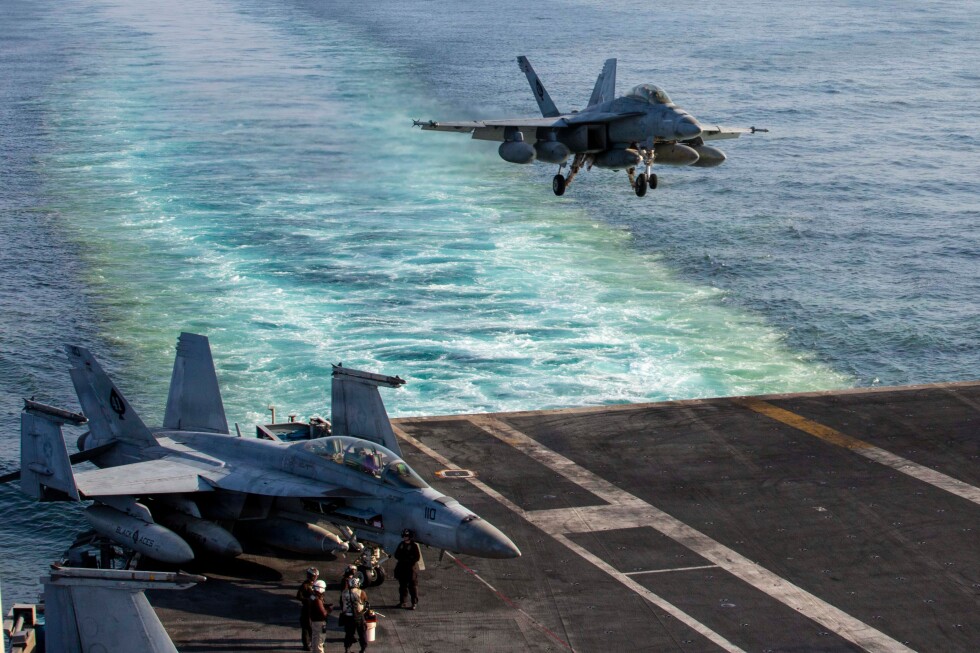
Prior to the current operations, Trump had significantly increased the American military presence in the Middle East. The USS Abraham Lincoln carrier strike group, accompanied by three guided-missile destroyers, was deployed to the region in late January. This deployment was later reinforced by the world’s largest aircraft carrier, the USS Gerald R. Ford, along with four additional destroyers redirected from the Caribbean Sea.
The Ford had previously participated in the U.S. operation in Venezuela that captured leader Nicolás Maduro, who was subsequently brought to New York to face drug trafficking charges. That January operation resulted in seven U.S. troops suffering gunshot wounds and shrapnel injuries, though no American lives were lost.
One of those injured in the Venezuela operation, Army Chief Warrant Officer 5 Eric Slover, received the Medal of Honor during Trump’s State of the Union address last week. Trump recognized Slover for piloting the lead CH-47 Chinook helicopter that descended on the “heavily protected military fortress” where Maduro was staying.
Since beginning his second term, Trump has authorized several military operations, including strikes against Islamic State group members in Syria following an ambush that killed two U.S. troops and an American civilian interpreter in December. U.S. forces have also conducted operations against IS elements in Nigeria, with Trump citing the Nigerian government’s alleged failure to prevent the targeting of Christians.
Fact Checker
Verify the accuracy of this article using The Disinformation Commission analysis and real-time sources.

10 Comments
The death of any soldier is heartbreaking. I appreciate the sacrifices these troops made to serve our country. At the same time, I’m concerned about the potential for this conflict to spiral out of control and lead to even greater loss of life on both sides.
I hope the administration is exploring all possible diplomatic solutions to de-escalate tensions and find a peaceful resolution. Maintaining open communication channels with Iran could be crucial to preventing further escalation.
This is a tragic loss of life. My heart goes out to the families of the fallen soldiers. I hope the wounded make a full recovery soon. Conflicts like this serve as a somber reminder of the high price that is often paid for military action.
While I understand the need to respond to threats, I hope the administration will carefully weigh the costs and benefits of further escalation. Diplomacy should always be the first option to avoid more senseless loss of life.
My deepest condolences go out to the families and loved ones of the fallen soldiers. Their service and sacrifice deserve our utmost respect and gratitude. However, I worry that continued military action could lead to a dangerous cycle of retaliation and further bloodshed.
I would encourage the administration to prioritize diplomatic efforts to find a peaceful solution and avoid escalating the conflict. The lives of more brave soldiers should not be put at risk if there are viable alternatives to military force.
This is a tragic day for our country. I’m saddened to hear of the loss of these American lives and the injuries sustained by our troops. My thoughts are with their families during this difficult time.
While I understand the need to respond to threats, I hope the administration will carefully consider the long-term implications of continued military action. De-escalation and diplomacy should be the top priorities to prevent further loss of life.
The deaths of these soldiers are a solemn reminder of the high price that is sometimes paid in service to our country. My heart goes out to their loved ones. I hope the wounded make a full recovery and that the administration can find a way to resolve this conflict without further bloodshed.
Diplomatic solutions should always be the first course of action, even in the face of aggression. I hope the administration is exploring all avenues to de-escalate tensions and find a peaceful resolution to this crisis.