


Listen to the article
University of New England President Addresses Pier Project Controversy Amid Growing Community Tension
The president of the University of New England has acknowledged communication failures while expressing concern over what he describes as misinformation fueling opposition to the university’s proposed Saco River pier project.
In an email sent Wednesday, President James Herbert said public discussion about the project has been marred by anonymous attacks and inaccurate information circulating through social media channels and email campaigns.
“These communications do little to advance a constructive conversation and instead contribute to confusion, distrust, and an inaccurate understanding of the project,” Herbert wrote. “In some cases, that seems to be the intent.”
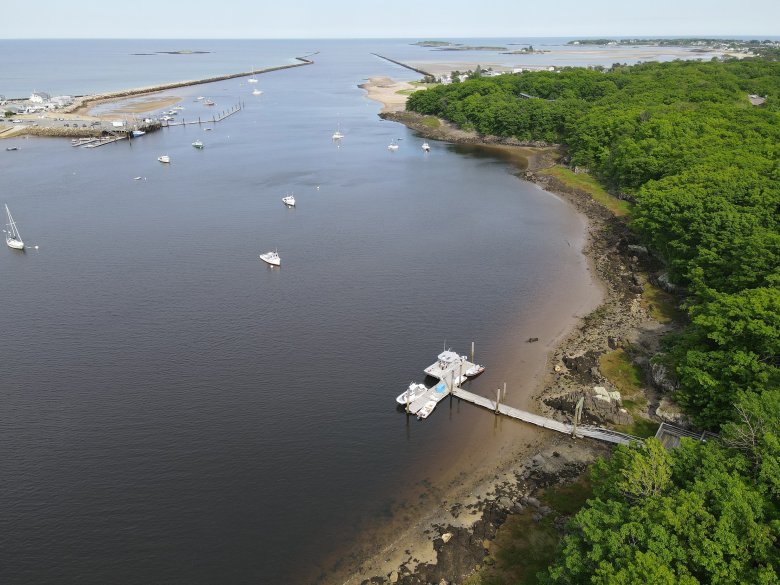
The controversial pier, which would be constructed adjacent to UNE’s Marine Biology Center, has faced significant pushback from Biddeford residents over the past year. Community concerns have grown to such an extent that city officials intervened last November, halting the permitting process and reactivating the dormant Institutional Zone Review Committee to assess the situation.
This committee, composed of Herbert, City Councilors Marc Lessard and Patricia Boston, and three Biddeford residents, is tasked with reviewing UNE proposals from the past decade. The group held its first public comment session on March 2, during which residents voiced numerous concerns about the proposed waterfront development.
Commercial fisherman Shawn Tibbetts, who maintains a mooring on the Saco River, expressed frustration over what he perceives as incomplete communication from the university. “I’ve dealt with the pier issue for a while now, and a lot of things haven’t been addressed for me personally,” he stated during the public session.
John Schafer, a Biddeford resident and former chair of the Biddeford Harbor Commission, raised specific concerns about the pier’s impact on existing moorings. “The location of this pier is going to be very displacing,” Schafer said Thursday, adding that he resigned from his harbor commission position to speak more freely about the project.
Schafer has accused the university of providing inaccurate information regarding the number of moorings that would be displaced and failing to properly acknowledge a 250-foot buffer zone that prohibits development along the river. He claims this buffer zone was overlooked during the zoning process for the pier project.
While the Saco River Corridor Commission previously approved the pier project, the city of Biddeford recently petitioned the Maine Superior Court to invalidate that approval, specifically citing the 2001 creation of the development buffer zone.
“I asked the SRCC director, ‘What about the buffer?’ and they said, ‘Well, we made a mistake, but the approval still holds,'” Schafer recalled.
Herbert defended the university’s site selection process, stating that Maine engineers and environmental specialists evaluated multiple potential locations before identifying one that balanced safety, environmental concerns, and operational requirements. “Over time, the design has been refined to reduce its footprint and address concerns raised during the review process,” the president noted.
Despite the ongoing tensions, Schafer emphasized that opposition to the current proposal isn’t rooted in anti-university sentiment. “I’m a supporter of UNE,” he clarified. “I want the university to have a pier, just not in this location.”
The controversy highlights the delicate balance between institutional growth and community concerns in coastal Maine, where waterfront access and development remain contentious issues. The university’s pier would enable year-round marine research, potentially enhancing UNE’s already substantial environmental science programs, but local residents worry about the precedent it might set for development along the historically preserved riverfront.
Biddeford Mayor Liam LaFountain declined to comment extensively on the situation, citing the city’s pending court review of the pier approval, but expressed appreciation for resident feedback throughout the process.
Herbert acknowledged in an email to the Press Herald that while many residents have offered constructive comments about the project, the university needs to improve its efforts to address rumors and misinformation surrounding the proposal, admitting the institution has “fallen short” in its communication approach.
As the legal challenge proceeds and community discussions continue, the future of the UNE pier project remains uncertain, with both sides committed to their respective positions on this significant waterfront development.
Fact Checker
Verify the accuracy of this article using The Disinformation Commission analysis and real-time sources.

10 Comments
This sounds like a complex situation with valid concerns on both sides. I hope the university and local officials can work together constructively to find a solution that balances the project’s merits with the community’s needs.
Me too. Compromise and mutual understanding will be key to resolving this issue in a way that works for everyone involved.
This highlights the challenge of balancing development projects with local community interests. It’s crucial that all stakeholders work together in good faith to find a mutually agreeable outcome.
Absolutely. Open and transparent dialogue, not one-sided messaging, will be essential to navigating this sensitive issue.
The university president’s acknowledgment of communication failures is a positive step, but the real test will be how they engage the community moving forward. Transparent, inclusive dialogue is essential here.
Agreed. The university needs to demonstrate a genuine commitment to addressing community concerns, not just defending their own position.
Interesting to see the university president addressing the misinformation surrounding this pier project. Transparent communication will be key to addressing community concerns and finding a constructive solution.
Agreed. Tackling misinformation head-on is important, but the university will also need to genuinely engage with the community to understand their valid concerns.
The university’s acknowledgment of communication failures is a good first step. Rebuilding trust with the community through a collaborative process will be vital moving forward.
Agreed. Addressing misinformation and being open to community feedback are important for the university to demonstrate its commitment to a fair and inclusive decision-making process.