


Listen to the article
UNESCO Urges Digital Literacy to Combat Climate Change Misinformation
UNESCO officials have called for increased capacity building among journalists, civil society organizations, and community leaders to address the growing problem of climate change misinformation in the digital age.
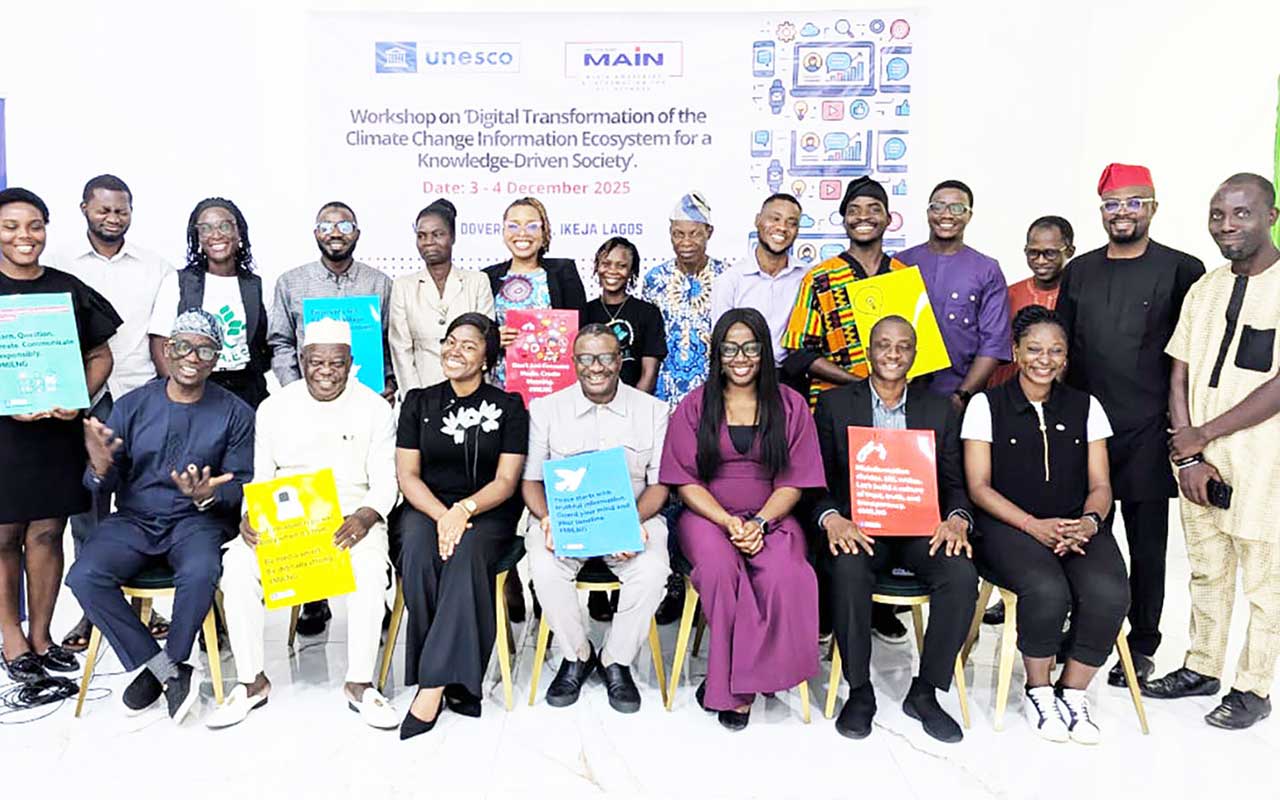
The appeal came during a two-day workshop in Lagos focused on the “Digital transformation of the climate change information ecosystem for a knowledge-driven Society.” The event was jointly organized by UNESCO and the Media Awareness and Information for All Network (MAIN).
Jean-Paul Ngome Abiaga, Head of Office and Representative at UNESCO’s Abuja office, highlighted the dual challenge facing society: the escalating threat of climate change alongside widespread misinformation about environmental issues.
“Digital platforms connect us in unprecedented ways, allowing knowledge to travel across borders and communities in seconds. Yet this same digital space has also become fertile ground for confusion, conspiracy theories, manipulated content, and myths that undermine public understanding of climate change,” said Abiaga, whose remarks were delivered by Yachat Nuhu, the officer in charge of communication and information.
Abiaga emphasized that climate-related misinformation has serious consequences across Africa, fueling denial, delaying policy action, eroding trust in scientific evidence, and increasing community vulnerabilities. “In many cases, misinformation spreads faster than corrective facts,” he noted.
The workshop covered a range of topics including UNESCO’s role in promoting climate action, the relationship between climate change and public health, common myths and misinformation about climate change, and the potential of artificial intelligence in addressing environmental challenges.
Professor Jide Jimoh, Chairman of MAIN, explained that the workshop aimed to bridge the gap between scientific understanding of climate change and community perceptions shaped by cultural beliefs. He noted that in many communities, deeply rooted cultural beliefs often attribute extreme weather events to spiritual forces or ancestral displeasure rather than human-induced climate disruption.
“This disconnect between scientific evidence and traditional worldviews has fostered misgivings about climate change claims, with many not recognizing its tangible impacts on their health, food security, and livelihoods,” Jimoh said.
Oluseyi Soremekun, National Information Officer of the UN Information Centre, addressed how climate change myths undermine public trust in scientific consensus and create confusion among policymakers and citizens. “When individuals believe inaccurate information, they are less likely to support climate-friendly initiatives or adopt sustainable practices,” he explained.
Soremekun advocated for clear communication of scientific facts, proper contextualization of data, and highlighting the overwhelming consensus among climate scientists as strategies to combat misinformation.
The health dimension of climate change was addressed by Dr. Olumayomikun Soremekun, a public health consultant, who explained how rising temperatures could increase heat-related illnesses, worsen air quality, alter infectious disease patterns, threaten food and water security, and impact mental health. He specifically mentioned increased risks of conditions like malaria fever, dengue fever, and cholera.
Dr. Goke Rauf, Rector of DS Adegbenro ICT Polytechnic in Ogun State, emphasized the critical importance of leveraging digital technologies such as artificial intelligence, Internet of Things, and big data to accelerate climate action through improved efficiency, emissions reduction, and enhanced adaptation measures.
Samuel Babatunde, Executive Director of SBZ Development Ltd, stressed the importance of climate education as a foundation for community resilience. “As education increases, climate change resilience gets stronger. Climate literacy leads to climate action which will lead to resilient outcomes such as stronger food systems, reduced emissions, lower displacement, and green economic growth,” he said.
UNESCO reiterated its commitment to bridging the information gap by empowering citizens and institutions to navigate the digital landscape responsibly. “Media and Information Literacy is not just a skillset; it is a cornerstone of democratic participation, community resilience, and sustainable development,” Abiaga concluded.
The workshop represents part of growing efforts across Africa to combat climate misinformation while building resilience through education, digital literacy, and community engagement.
Fact Checker
Verify the accuracy of this article using The Disinformation Commission analysis and real-time sources.

25 Comments
Interesting update on UN Urges Journalists and Civil Society to Combat Climate Change Misinformation. Curious how the grades will trend next quarter.
The cost guidance is better than expected. If they deliver, the stock could rerate.
Good point. Watching costs and grades closely.
Good point. Watching costs and grades closely.
Nice to see insider buying—usually a good signal in this space.
Exploration results look promising, but permitting will be the key risk.
Uranium names keep pushing higher—supply still tight into 2026.
Good point. Watching costs and grades closely.
Good point. Watching costs and grades closely.
Interesting update on UN Urges Journalists and Civil Society to Combat Climate Change Misinformation. Curious how the grades will trend next quarter.
Good point. Watching costs and grades closely.
The cost guidance is better than expected. If they deliver, the stock could rerate.
Good point. Watching costs and grades closely.
Exploration results look promising, but permitting will be the key risk.
Uranium names keep pushing higher—supply still tight into 2026.
The cost guidance is better than expected. If they deliver, the stock could rerate.
Good point. Watching costs and grades closely.
Production mix shifting toward News might help margins if metals stay firm.
If AISC keeps dropping, this becomes investable for me.
Good point. Watching costs and grades closely.
Exploration results look promising, but permitting will be the key risk.
Good point. Watching costs and grades closely.
Uranium names keep pushing higher—supply still tight into 2026.
Good point. Watching costs and grades closely.
I like the balance sheet here—less leverage than peers.