


Listen to the article
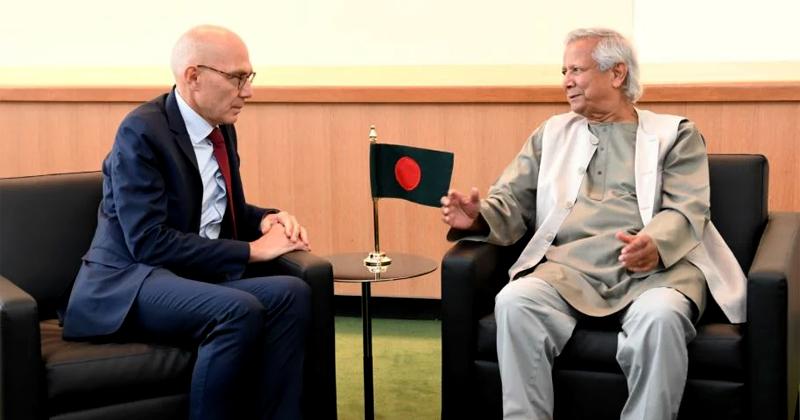
UN human rights chief Volker Türk has pledged his office’s support to help Bangladesh counter a wave of misinformation threatening to undermine the country’s upcoming February 12 elections, following concerns raised by Chief Adviser Professor Muhammad Yunus.
During a telephone conversation on Tuesday, Professor Yunus highlighted the severity of the problem. “There has been a flood of misinformation surrounding the elections. It is coming from both foreign media and local sources,” he said, according to a statement from the Chief Adviser’s Press Wing.
“They have flooded social media with fake news, rumors and speculation. We are concerned about the impact this may have on the elections,” Yunus added, underscoring the potential threat to electoral integrity.
In response, High Commissioner Türk acknowledged the gravity of the situation, offering the resources of the UN human rights office to address what he characterized as a “growing misinformation challenge.”
“There is a lot of misinformation. We will do whatever is needed,” Türk assured, committing to close collaboration with Bangladesh’s authorities to tackle the problem.
The conversation extended beyond electoral concerns to encompass broader governance issues, including institutional reforms, the upcoming referendum, and the ongoing work of the Enforced Disappearance Commission. The formation of the National Human Rights Commission (NHRC) was also a key topic, with Türk emphasizing the need for “a truly independent” commission to effectively address human rights concerns, particularly enforced disappearances.
Professor Yunus provided assurances that progress was already underway, noting that the NHRC ordinance has been promulgated and that a new commission would be established before the February elections. “We will do it before we leave,” he affirmed, underscoring the interim government’s commitment to institutional reform.
The Chief Adviser also revealed that he had shared the final report of the Enforced Disappearance Commission with the UN High Commissioner. He described it as a “crucial document” that would contribute significantly to accountability and justice for victims of enforced disappearances during what he termed the “autocratic regime” that governed Bangladesh from 2009 to 2024.
The issue of enforced disappearances has been a persistent human rights concern in Bangladesh, with international organizations documenting hundreds of cases over the past decade. The commission’s work represents a critical step toward addressing these abuses and providing closure for affected families.
Türk commended Professor Yunus for his leadership over the past 18 months, highlighting the UN’s support for the Disappearance Commission’s work and reiterating his office’s commitment to continuing this assistance.
Bangladesh’s interim government, led by Nobel laureate Yunus, came to power in August 2023 following the resignation of long-serving Prime Minister Sheikh Hasina amid mass protests. The administration has been tasked with implementing crucial reforms and preparing the country for free and fair elections.
The upcoming February 12 elections represent a pivotal moment for Bangladesh’s democratic trajectory after years of political polarization and allegations of authoritarianism. In this context, the threat posed by misinformation campaigns takes on added significance, with potential to destabilize the electoral process and undermine public confidence.
SDG Coordinator and Senior Secretary Lamiya Morshed was also present during the conversation between Yunus and Türk, reflecting the whole-of-government approach being taken toward these critical human rights and electoral issues.
Fact Checker
Verify the accuracy of this article using The Disinformation Commission analysis and real-time sources.

22 Comments
The flood of fake news and speculation surrounding Bangladesh’s upcoming elections is concerning. I hope the UN’s support can help the authorities there stem the tide of misinformation and restore public trust.
Me too. Maintaining credible and transparent elections is crucial for Bangladesh’s democracy to thrive.
Misinformation is a growing threat to democracy globally. I’m glad to see the UN stepping in to assist Bangladesh in combating this challenge ahead of their elections. Collaborative efforts like this are essential.
Agreed. The UN’s involvement demonstrates the seriousness of the issue and the need for a coordinated international response.
The UN’s pledge to support Bangladesh in combating election misinformation is a welcome development. Restoring public trust in the electoral process is critical, and international cooperation will be key to overcoming this global challenge.
Agreed. Upholding the integrity of elections is fundamental to a healthy democracy, and the UN’s involvement signals the seriousness of the issue.
Interesting to see the UN getting involved to address the misinformation challenge in Bangladesh. It highlights the global nature of this issue and the need for international cooperation to tackle it effectively.
Absolutely. Misinformation knows no borders, so a coordinated, multi-stakeholder approach is required to protect the integrity of elections worldwide.
Addressing election misinformation is a complex challenge, but the UN’s involvement is a positive step. I hope their collaboration with Bangladeshi authorities can help stem the tide of fake news and speculation and ensure a fair and credible electoral process.
Absolutely. Proactive and coordinated efforts are essential to protect the democratic process from the corrosive effects of misinformation.
Combating misinformation is critical to upholding electoral integrity. The UN’s support in this effort is welcome, as social media has become a breeding ground for fake news and rumors that can distort the democratic process.
Agreed. Transparency and fact-checking will be key to countering misinformation and ensuring a fair and credible election in Bangladesh.
The scale of misinformation surrounding Bangladesh’s elections is alarming. I hope the UN’s support can help the authorities there develop effective counter-measures and restore public confidence in the electoral process.
Me too. Restoring trust in democratic institutions is essential, especially when they are under attack from coordinated disinformation campaigns.
Kudos to the UN for pledging support to Bangladesh in combating election misinformation. This is a global challenge that requires global cooperation. I hope their involvement can make a meaningful difference in safeguarding the integrity of the upcoming vote.
Agreed. The UN’s expertise and resources could be invaluable in helping Bangladesh develop a comprehensive strategy to counter the misinformation threat.
Maintaining the integrity of elections is crucial for democracy. I’m glad to see the UN taking this issue seriously and offering assistance to Bangladesh. Misinformation is a global challenge that requires a global response.
Exactly. The UN’s involvement underscores the importance of international cooperation in safeguarding the democratic process, even in national elections.
Election misinformation is a complex problem without easy solutions. But I’m encouraged to see the UN offering its resources and expertise to help Bangladesh address this critical challenge. Ongoing vigilance will be required.
Absolutely. Tackling misinformation requires a multi-pronged approach involving technology platforms, media outlets, and government authorities working together.
It’s concerning to hear about the scale of misinformation surrounding Bangladesh’s upcoming elections. The UN’s pledge of support is a positive step, but the real test will be in the effective implementation of counter-measures.
Good point. The proof will be in how well the UN and Bangladeshi authorities can coordinate and execute their plan to combat the misinformation threat.