


Listen to the article
UN Chief Calls for Urgent Climate Action, Warning Planet is “On the Brink”
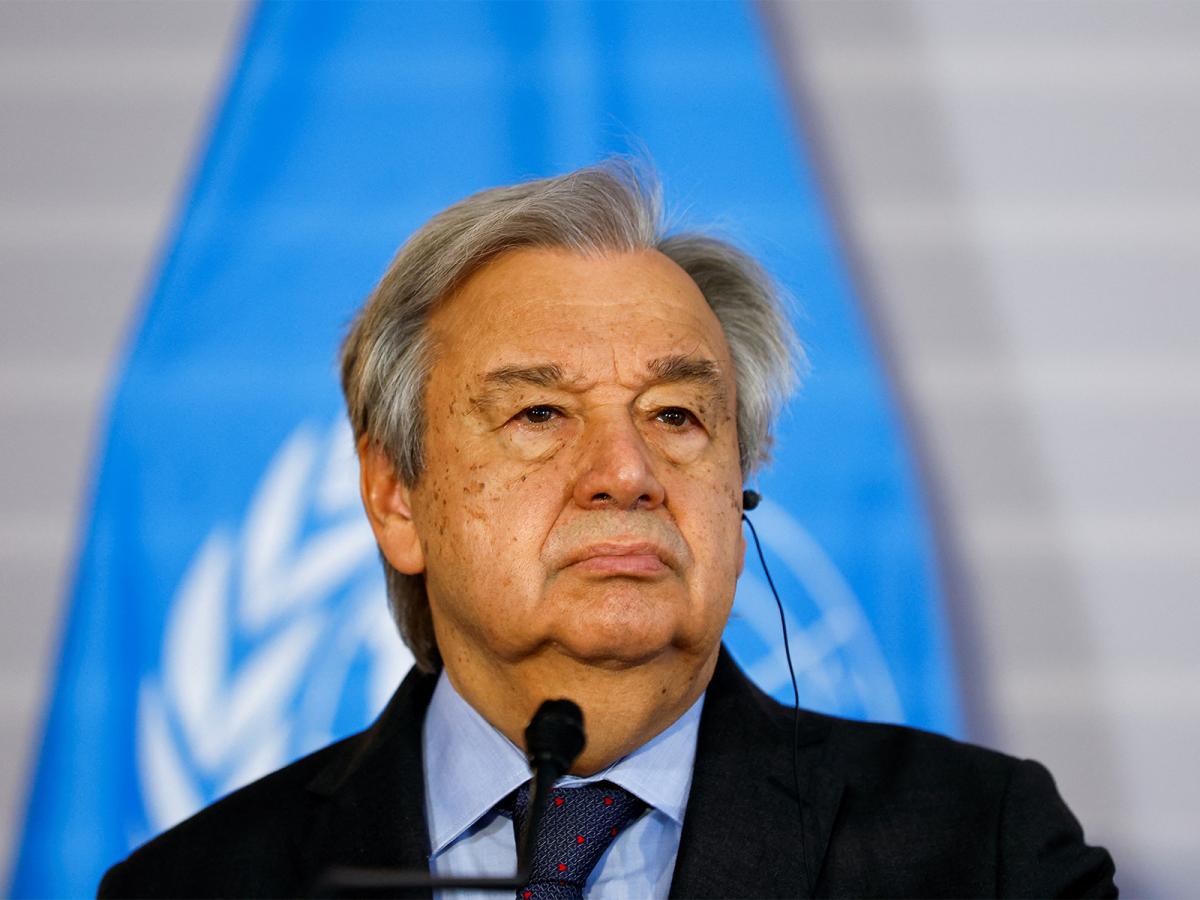
United Nations Secretary-General Antonio Guterres issued a stark warning Wednesday that “global warming is pushing our planet to the brink” and called for immediate international action to expand early-warning systems and fulfill climate finance commitments.
Speaking at an event marking the World Meteorological Organization’s 75th anniversary in Geneva, Guterres emphasized the critical importance of early warning systems in mitigating climate disasters. The UN chief’s comments come at a politically charged moment, just weeks after former U.S. President Donald Trump dismissed climate change as “the greatest con job ever” during his address to the UN General Assembly.
“Every one of the last 10 years has been the hottest in history,” Guterres stated, highlighting that “no country is safe from fires, floods, storms and heatwaves.” He stressed that early warning systems are not abstract concepts but practical tools that save lives by enabling farmers to protect crops and livestock, allowing families to evacuate safely, and shielding entire communities from devastation.
The Secretary-General acknowledged progress made by the World Meteorological Organization, noting that over 60 percent of countries now report having multi-hazard early-warning systems in place. Least developed countries have nearly doubled their capacity since official reporting began, while observation networks and forecast capabilities continue to strengthen.
Despite these advances, Guterres outlined three areas requiring urgent global attention. First, he called on governments to integrate early-warning systems across policies, institutions, and budgets. This includes bringing meteorological and hydrological services into national disaster risk reduction frameworks, supported by appropriate legislation.
Second, he emphasized the need for increased financing to ensure warning systems reach every community worldwide. Referring to the Financing for Development Conference held in Sevilla in June, Guterres reiterated the consensus to “unlock more finance for developing countries” and reform global financial institutions to better serve developing nations.
Third, and perhaps most crucially, the UN chief stressed the need to address climate disasters at their source: “a rapidly heating planet.” He reminded attendees of the UN’s Early Warnings for All initiative, launched in 2022, which aims to ensure universal access to alert systems by 2027.
Looking ahead to November’s UN Climate Conference (COP30) in Brazil, Guterres urged countries to deliver ambitious national climate action plans aligned with limiting global temperature rise to 1.5 degrees Celsius. The summit, scheduled for November 10-21 in the Amazon city of Belem, will be a critical opportunity for world leaders to agree on a plan to mobilize $1.3 trillion annually in climate finance for developing countries by 2035.
“Developed countries must honour their commitment to double finance for adaptation to at least $40 billion this year, and rapidly deploy proven tools to unlock billions more in concessional finance,” Guterres insisted.
The Secretary-General highlighted the economic viability of renewable energy, noting that “almost all new power capacity came from renewables” last year, with investment continuing to surge. “Renewables are the cheapest, fastest and smartest source of new power. They represent the only credible path to end the relentless destruction of our climate,” he said.
Guterres also addressed the growing challenge of climate misinformation, emphasizing that “scientists and researchers should never fear telling the truth.” He referenced the recently launched Global Initiative for Information Integrity on Climate Change, through which governments and organizations are collaborating to fund research and promote information integrity on climate issues.
This focus on combating misinformation stands in stark contrast to Trump’s UNGA address, in which he called the carbon footprint concept “a hoax made up by people with evil intentions” and described renewables as “a joke” that “don’t work” and are “too expensive.”
In a social media post following the event, Guterres praised the WMO as “a barometer of truth” and “a quiet force & credible source of data & information behind every climate-smart decision we make,” calling for continued unity in using science to deliver the urgent climate action needed.
Fact Checker
Verify the accuracy of this article using The Disinformation Commission analysis and real-time sources.
