


Listen to the article
White House Launches Controversial “Media Bias Tracker” Amid Growing Press Tensions
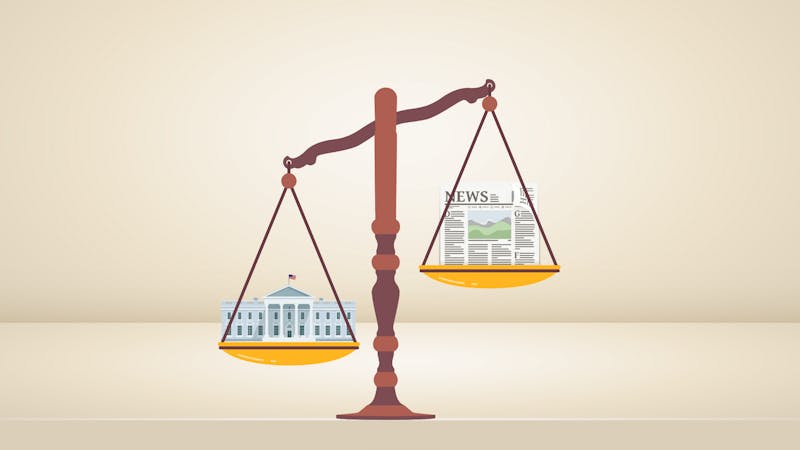
The White House has unveiled a new “Media Bias Tracker” on its official website, drawing sharp criticism from press freedom advocates who view it as an alarming escalation in President Trump’s contentious relationship with the media.
The online database, advertised as a transparency tool, features what critics describe as government-sanctioned targeting of journalists and news organizations that challenge administration narratives. The tracker includes a rotating “Media Offender of the Week,” an “Offender Hall of Shame,” and a leaderboard tallying alleged offenses by various news outlets.
Each flagged story is cataloged with the publication name, reporter, summary of the supposed offense, and a category label such as “bias,” “false claim,” “left-wing lunacy,” or “misrepresentation.” When users click on any category, they’re presented with “The Truth” – the administration’s own counter-narrative without independent fact-checking or external verification.
Press freedom experts warn the tracker creates a chilling effect on journalism. By publicly labeling certain reporting as “lies” while presenting unverified government claims as fact, critics argue the administration is attempting to position itself as the sole arbiter of truth – a concerning development in a democratic society where press freedoms are constitutionally protected.
“This is not media accountability. This is government-run intimidation,” said one press freedom advocate who requested anonymity for fear of being added to the tracker. “It blurs the line between legitimate media criticism and state-driven intimidation.”
The tracker emerges amid a pattern of confrontational interactions between Trump and journalists. In recent months, the president has publicly berated several reporters during official White House events. On November 14, when Bloomberg News journalist Catherine Lucey attempted to ask about Jeffrey Epstein-related documents, Trump reportedly responded, “Quiet piggy.”
Just days later, Trump called ABC’s Mary Bruce “insubordinate” and “a terrible reporter” after she questioned Saudi Crown Prince Mohammed bin Salman about the killing of Washington Post columnist Jamal Khashoggi during an Oval Office meeting. On December 8, when ABC’s Rachel Scott inquired about releasing full video of a controversial Venezuelan military strike, Trump called her “the most obnoxious reporter in the whole place.”
The president’s criticism has extended beyond traditional journalists to entertainers who critique his administration. In September, ABC temporarily suspended Jimmy Kimmel’s late-night show following pressure after a monologue about conservative activist Charlie Kirk’s assassination – a move Trump celebrated on social media, writing: “Great News for America. Congratulations to ABC for finally having the courage to do what had to be done.”
Media scholars note that similar tactics have preceded more severe press restrictions in countries with deteriorating democratic norms. In Russia, Vladimir Putin’s government has imprisoned 27 journalists on criminal charges since its 2022 Ukraine invasion, with nine charged with spreading “fake news.” The Kremlin has banned 24 media outlets and blocked over 25,000 websites for war reporting.
In Hungary, Prime Minister Viktor Orbán has introduced legislation allowing government monitoring and penalization of media outlets deemed threats to “national sovereignty” – including cutting funding and monitoring bank accounts of targeted organizations.
While the White House Media Bias Tracker lacks the legal enforcement mechanisms of these international examples, press freedom advocates suggest it employs similar delegitimization tactics: branding journalists as offenders, elevating government narratives as unquestionable truth, and encouraging public reporting of critical voices.
“A democracy that cannot tolerate scrutiny or humor is not a confident democracy,” noted one media ethics professor. “When even mild questioning is framed as a personal attack, it signals leadership that views criticism as a threat rather than as part of constructive discourse.”
White House officials defend the tracker as promoting transparency and accountability in media coverage, but critics maintain it represents an unprecedented government effort to control information by discrediting those who report it.
Fact Checker
Verify the accuracy of this article using The Disinformation Commission analysis and real-time sources.

22 Comments
Interesting update on Trump’s View on Truth: The Criminalization of Criticism. Curious how the grades will trend next quarter.
Good point. Watching costs and grades closely.
Silver leverage is strong here; beta cuts both ways though.
The cost guidance is better than expected. If they deliver, the stock could rerate.
Good point. Watching costs and grades closely.
Exploration results look promising, but permitting will be the key risk.
Good point. Watching costs and grades closely.
Production mix shifting toward News might help margins if metals stay firm.
Good point. Watching costs and grades closely.
Silver leverage is strong here; beta cuts both ways though.
Interesting update on Trump’s View on Truth: The Criminalization of Criticism. Curious how the grades will trend next quarter.
Silver leverage is strong here; beta cuts both ways though.
The cost guidance is better than expected. If they deliver, the stock could rerate.
Good point. Watching costs and grades closely.
Good point. Watching costs and grades closely.
Interesting update on Trump’s View on Truth: The Criminalization of Criticism. Curious how the grades will trend next quarter.
Good point. Watching costs and grades closely.
Silver leverage is strong here; beta cuts both ways though.
Good point. Watching costs and grades closely.
If AISC keeps dropping, this becomes investable for me.
Good point. Watching costs and grades closely.
I like the balance sheet here—less leverage than peers.