


Listen to the article
Government Acknowledges Challenges in Regulating Misleading Travel Content by Influencers
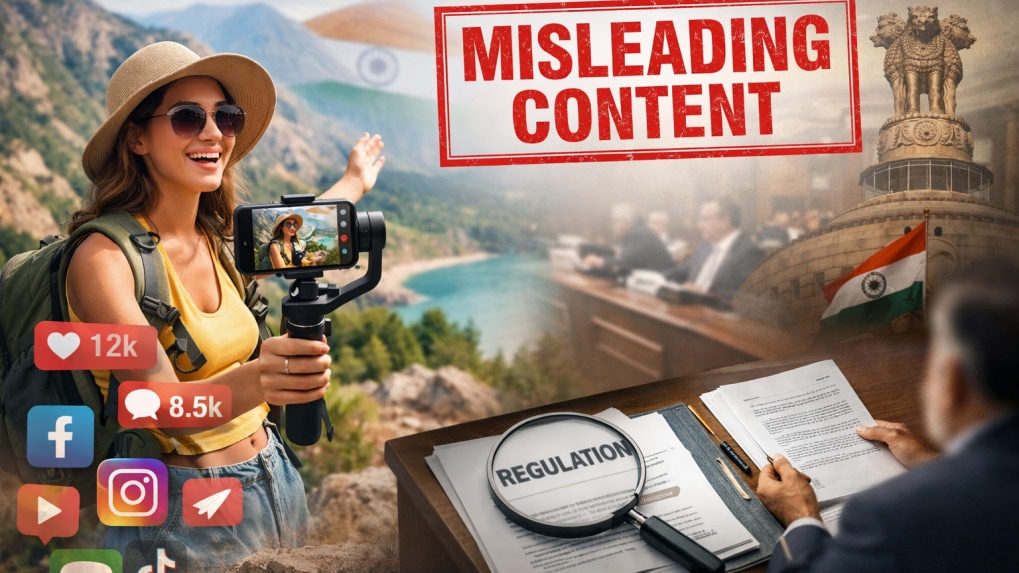
The Union Ministry of Tourism has recognized growing concerns regarding misleading travel content shared by social media influencers but admitted that direct regulation of such material presents significant challenges due to the vast scale of digital platforms.
In a recent response to questions raised in the Rajya Sabha, the Ministry stated that while it has noted the proliferation of influencer-driven tourism content across social and digital media, monitoring or regulating individual creators is not feasible given the sheer volume of users and platforms involved.
The statement comes amid intensifying scrutiny of influencers who have been accused of disseminating misinformation about travel safety, environmental impact, and access to restricted locations. Such content has reportedly led to overcrowding and ecological damage in several sensitive areas across the country.
Rajya Sabha MP Dr. Ashok Kumar Mittal raised the question, seeking information on the government’s plans to address misleading travel promotions, verify the authenticity and safety of influencer content, and counter unethical tourism promotion online. Dr. Mittal also questioned why no certification or code of conduct has yet been proposed for content creators who significantly influence public travel behavior.
The Ministry clarified that it currently lacks a dedicated mechanism to verify influencer-led travel promotions, noting that such content is user-generated and distributed independently on private digital platforms. Officials also indicated that the government does not actively monitor influencer activity, highlighting the limitations of oversight in an ecosystem characterized by decentralized content creation.
Policy experts have pointed out that the absence of a formal regulatory framework has become increasingly problematic as influencer narratives progressively shape travel decisions, sometimes encouraging risky behavior or travel to environmentally fragile zones. Viral videos showcasing remote or restricted destinations have been criticized for minimizing legal restrictions or safety concerns, prompting calls for greater accountability from both creators and platforms.
While the Ministry has not proposed a certification system or code of conduct specifically for travel influencers, it emphasized that its role is primarily limited to promoting verified and responsible tourism information through official channels. The government currently relies on the Incredible India Digital Platform (IIDP) and its official social media accounts to disseminate accurate travel advisories, destination information, and policy updates.
The Ministry’s response suggests that responsibility for regulating misleading tourism content currently lies more with the digital platforms themselves rather than with sector-specific government departments. However, industry observers note that as influencer marketing continues to drive tourism demand, the issue is likely to receive increased policy attention in the near future.
Tourism industry analysts point out that the sector has experienced significant transformation in recent years, with social media becoming a primary source of travel inspiration for many Indians. This shift has created a complex ecosystem where content creators wield substantial influence over travel patterns, sometimes directing large numbers of visitors to locations unprepared for sudden tourism surges.
As misinformation on social media faces broader regulatory scrutiny across various sectors, tourism content may emerge as a particular area of concern, especially where public safety and environmental sustainability are at stake. The government’s acknowledgment of the problem, even while highlighting regulatory constraints, signals that influencer-driven tourism has firmly established itself on the policy agenda.
The situation highlights the growing tension between digital freedom and responsible content creation in an era where a single viral post can transform a pristine location into an overnight tourism hotspot, often with significant ecological and cultural consequences.
Fact Checker
Verify the accuracy of this article using The Disinformation Commission analysis and real-time sources.

28 Comments
If AISC keeps dropping, this becomes investable for me.
Good point. Watching costs and grades closely.
The cost guidance is better than expected. If they deliver, the stock could rerate.
Interesting update on Tourism Ministry Warns of Influencer Misinformation, Rejects Direct Monitoring. Curious how the grades will trend next quarter.
Good point. Watching costs and grades closely.
Good point. Watching costs and grades closely.
Uranium names keep pushing higher—supply still tight into 2026.
Good point. Watching costs and grades closely.
Good point. Watching costs and grades closely.
Production mix shifting toward News might help margins if metals stay firm.
Good point. Watching costs and grades closely.
Production mix shifting toward News might help margins if metals stay firm.
Good point. Watching costs and grades closely.
Silver leverage is strong here; beta cuts both ways though.
Good point. Watching costs and grades closely.
If AISC keeps dropping, this becomes investable for me.
Production mix shifting toward News might help margins if metals stay firm.
Good point. Watching costs and grades closely.
Uranium names keep pushing higher—supply still tight into 2026.
I like the balance sheet here—less leverage than peers.
Good point. Watching costs and grades closely.
Good point. Watching costs and grades closely.
Production mix shifting toward News might help margins if metals stay firm.
Good point. Watching costs and grades closely.
If AISC keeps dropping, this becomes investable for me.
Good point. Watching costs and grades closely.
Good point. Watching costs and grades closely.
Exploration results look promising, but permitting will be the key risk.