


Listen to the article
Climate Educator Counters Joe Rogan’s Misleading Climate Change Claims
A TikTok educator is gaining attention for systematically debunking misleading climate change information shared on one of the world’s most popular podcasts. Patrick Lavery, who posts educational content under the handle @attlas_pat, recently addressed incomplete claims made by Joe Rogan about Earth’s historical temperature patterns.
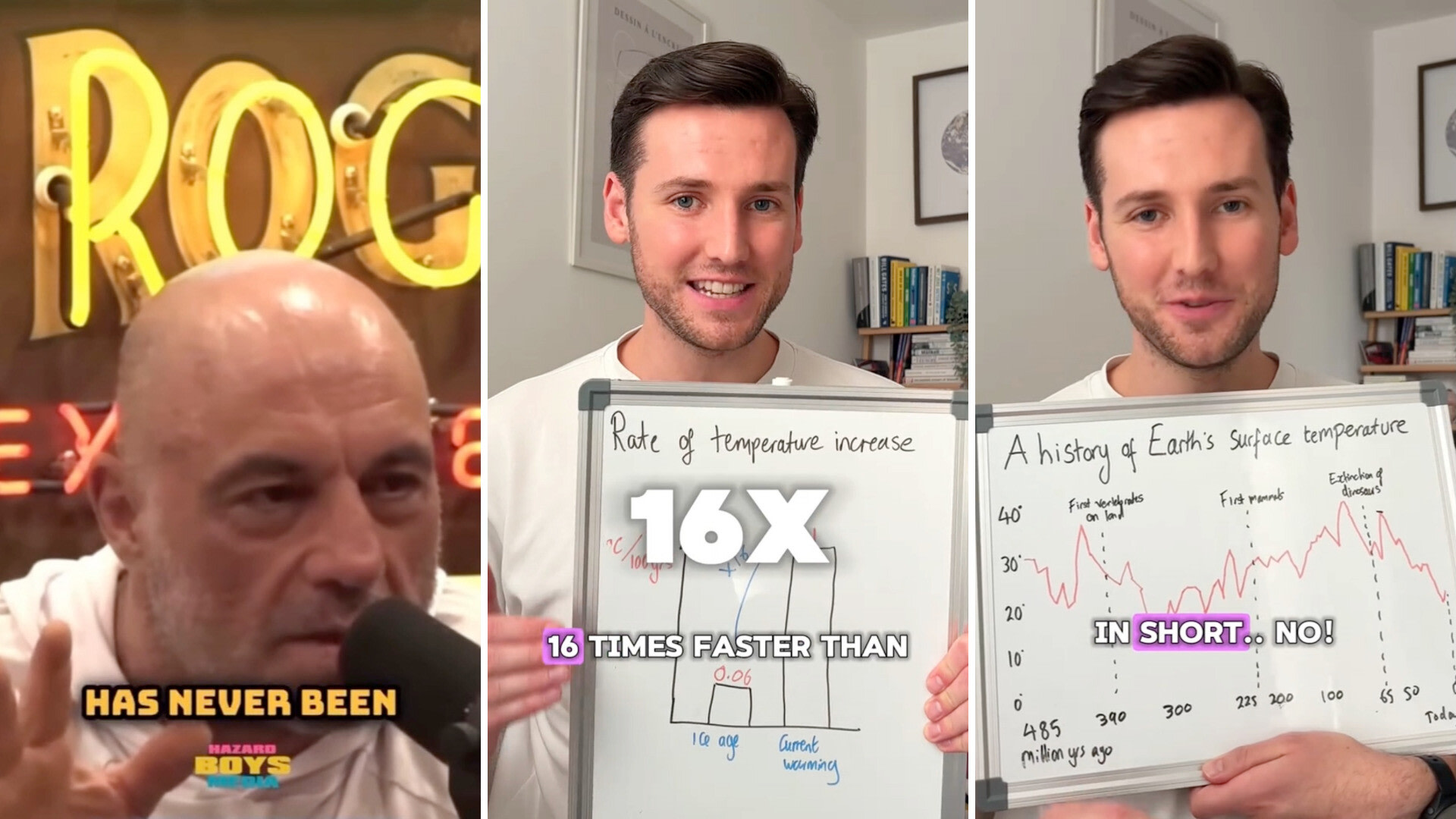
In his viral video, Lavery examines a chart titled “The history of Earth’s surface temperature” that Rogan referenced during a podcast episode. The chart itself contains factually accurate information, showing that Earth experienced significantly higher temperatures in the distant past—particularly during the period around the dinosaur extinction—and has undergone a general cooling trend over the last 50 million years.
“This is one of the more insidious forms of misinformation because what Joe Rogan says isn’t technically incorrect, he just doesn’t capture the full picture,” Lavery explained in his post.
Drawing from sources including The Wall Street Journal and “An Introduction to Modern Climate Change” by climate scientist Andrew Dessler, Lavery contextualizes the information that Rogan’s segment omitted. He notes that approximately 55 million years ago, the Arctic region supported alligators and forests in temperatures roughly 15 degrees Fahrenheit warmer than today.
While these facts align with Rogan’s commentary, Lavery emphasizes the critical distinction between past and present climate change: the unprecedented rate of warming humanity is currently experiencing.
According to Lavery’s explanation, historical warming periods occurred at approximately 0.06 degrees Celsius (0.11 degrees Fahrenheit) per century. In stark contrast, today’s warming rate has accelerated to about one degree Celsius (1.8 degrees Fahrenheit) per century—16 times faster than previous natural climate shifts.
This dramatic acceleration has profound implications that Rogan’s discussion failed to address. If current warming trends continue, the consequences would extend far beyond more intense heat waves. Rapid sea level rise would threaten coastal populations worldwide, while ecosystems and agricultural systems would face unprecedented pressure to adapt.
“Even if people wanted to live in a hotter world, humanity wouldn’t be able to adapt fast enough,” Lavery argues. The cascading effects would include more frequent crop failures, accelerated biodiversity loss, and coastal flooding at scales that would overwhelm human adaptation capabilities.
Climate communication experts note that this type of selective presentation of scientific information—sharing accurate but incomplete data—represents a particularly challenging form of misinformation to counter. Unlike outright falsehoods, which can be directly refuted, contextual omissions require more nuanced responses.
Rogan’s podcast reaches an estimated audience of over 11 million listeners per episode, making it one of the most influential media platforms globally. When topics like climate science are presented without proper context on such platforms, the potential for public misunderstanding increases significantly.
Lavery’s educational efforts represent part of a broader movement of science communicators using social media platforms to provide accessible climate science information. By breaking down complex climate concepts into digestible content, these educators aim to help audiences better understand both the scientific consensus and the urgency surrounding climate action.
As online discussions about climate change continue to shape public understanding, the role of educators like Lavery highlights the ongoing tension between simplified media narratives and the nuanced reality of climate science in public discourse.
Fact Checker
Verify the accuracy of this article using The Disinformation Commission analysis and real-time sources.

18 Comments
The example of the climate change chart illustrates how context and framing can significantly impact the interpretation of data. Vigilance is required to avoid falling victim to selective or incomplete information.
Agreed. Thorough analysis and cross-checking of sources are necessary to ensure we have a comprehensive understanding of complex issues like climate change.
Interesting that subtle misinformation can be more dangerous than blatant falsehoods. Fact-checking is crucial, even for seemingly innocuous data visualizations.
You make a good point. Presenting factual data without proper context can lead to misleading conclusions.
This study serves as a sobering reminder that misinformation can take subtle and insidious forms. Maintaining a critical eye and verifying claims, even from reputable sources, is essential.
Agreed. The prevalence of subtle misinformation underscores the need for greater media literacy education and a renewed commitment to fact-based discourse.
The findings emphasize the importance of being an active, discerning consumer of information, rather than passively accepting claims at face value. Fact-checking and seeking out diverse perspectives are key.
You’re right. Developing the ability to identify biases, cherry-picked data, and incomplete narratives is crucial in navigating the modern information landscape.
It’s concerning how easily misinformation can spread, especially through influential platforms like podcasts. Rigorous verification of claims is essential to combat this issue.
Agreed. Fact-checking and providing proper context are vital to ensuring the public has accurate information.
It’s troubling to see how even subtle misinformation can gain traction and influence public discourse. Diligent fact-checking and context-setting are crucial remedies.
Absolutely. Addressing this issue requires a multi-pronged approach of education, accountability, and a commitment to truth from all stakeholders.
This highlights the importance of critical thinking and media literacy. Even reputable sources can inadvertently propagate misinformation without proper scrutiny.
You’re right. Consumers need to be discerning and verify claims, rather than blindly accepting information at face value.
This study highlights the need for greater media literacy and critical thinking skills. Subtle misinformation can be particularly insidious and difficult to detect.
You make a valid point. Developing the ability to identify and counter misleading narratives, even when they appear factual, is an essential life skill in the digital age.
This is a concerning trend that underscores the need for improved media literacy and fact-checking skills among the general public. Subtle misinformation can be particularly insidious.
Absolutely. Cultivating a culture of critical thinking and healthy skepticism is essential to combat the spread of misleading information, even from seemingly credible sources.