


Listen to the article
AI Companies Battle for Mindshare in Super Bowl Ad Blitz
Sunday’s Super Bowl transformed into what industry experts are now calling the “AI Bowl,” as artificial intelligence companies dominated commercial breaks in a manner reminiscent of the 2022 Crypto Bowl and the 2000 Dot Com Bowl. According to tracking firm iSpot, fifteen of the 66 advertisements aired during the game were either promoting AI companies or were created using AI technology.
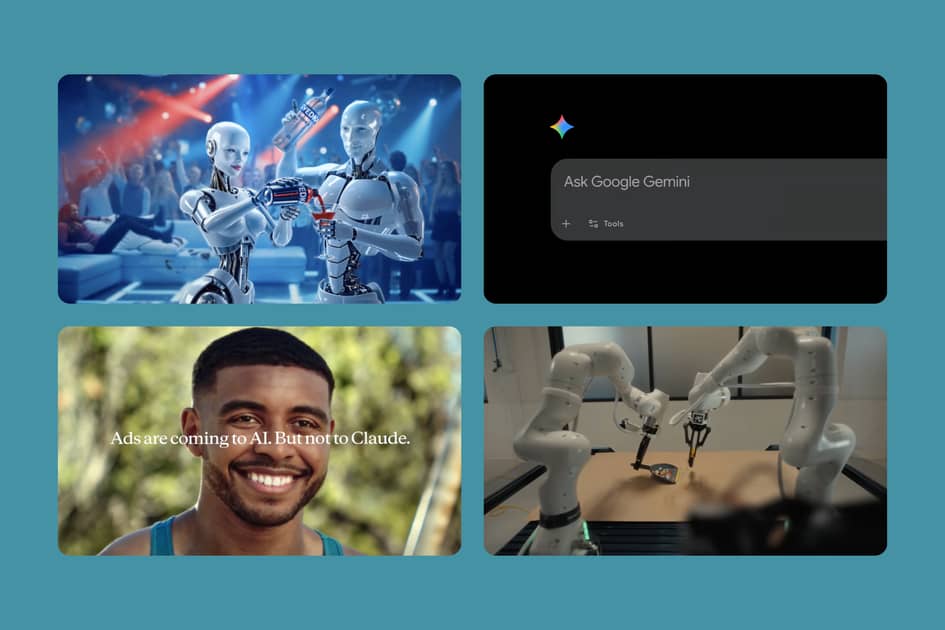
The flood of AI-focused advertisements showcased a wide range of messaging strategies. Amazon’s spot for Alexa+ featured Chris Hemsworth contemplating his potential doom at the hands of the digital assistant, playing into widespread fears about AI overreach. Other companies positioned their AI tools as enablers of new possibilities, with OpenAI, Google Gemini, Ring, and a Meta-Oakley collaboration highlighting capabilities that extend human potential. Meanwhile, Microsoft Copilot, Genspark, Wix, and Base44 emphasized AI’s role in reducing workloads, while Anthropic and AI.com addressed future developments in AI advertising and autonomous AI systems.
The diverse approaches underscore a fundamental challenge for the AI industry: differentiation in an increasingly crowded marketplace.
“It becomes a classic marketing problem of differentiation,” explained Derek Rucker, marketing professor at Northwestern University’s Kellogg School of Management. “Which product do I use and why? I think it’s natural to see these AI firms move to the Super Bowl.”
Industry experts suggest these companies have reached a critical juncture in their growth trajectory. Allen Adamson, co-founder of brand consultancy Metaforce, noted: “Those companies are on the end of their growth curve. They need to generate revenue. Everyone understands that AI has a lot of potential, but now it’s time to see, to start seeing what that potential is beyond company evaluation and investor valuation levels.”
Despite the significant advertising investment, consumer reception was decidedly mixed. Meltwater’s analysis revealed that nearly 50% of mentions about AI commercials were negative – substantially more critical than the overall sentiment toward Super Bowl advertisements. Some viewers criticized the ads as “emblematic of declining creative effort,” suggesting ongoing public skepticism toward artificial intelligence. However, discussion about AI advertisements constituted just 6% of total ad mentions and 4% of total engagement, indicating relatively limited conversation despite the high volume of spots.
The saturation of AI messaging may have worked against the advertisers. “When you start seeing more ads for that category, that fatigue that consumers are reporting – ‘Do we have to see another one?’ – what they’re saying is, ‘I’ve got enough information about that category; I really don’t want more,'” Rucker explained. “That’s usually a loss for the number of players in the category.”
Perhaps the most noteworthy development was the emergence of direct competition between AI platforms. Anthropic launched a pointed campaign for its Claude platform with four spots created by agency Mother that mocked advertising on AI platforms – a thinly veiled attack on OpenAI, which is currently testing advertisements on its ChatGPT service. One advertisement boldly stated, “Ads are coming to AI. But not to Claude,” while another declared, “There is a time and place for ads. Your conversations with AI should not be one of them.”
OpenAI executives quickly responded to the competitive jab. Kate Rouch, OpenAI’s CMO, acknowledged the spots as “effective” and “funny” but dismissed them as “untrue.”
The public sparring may have benefited Anthropic. Social data from PeakMetrics recorded over 151,000 ChatGPT mentions and 69,000 Claude mentions on X (formerly Twitter), with Claude’s campaign achieving “two times deeper penetration relative to brand size.” Sentiment analysis showed similar results for both platforms – approximately 15% positive and 3.5% negative mentions.
However, PeakMetrics suggested Anthropic’s approach may have been too insider-focused, requiring viewers to understand OpenAI’s advertising plans, while OpenAI’s message of inspiration was more universally accessible.
Adding to the night’s drama, a video circulated online showing actor Alexander Skarsgård using earbuds and a mysterious shiny orb, sparking rumors about an unreleased AI hardware advertisement. While OpenAI confirmed to Marketing Brew that the video was unconnected to their company, brand strategist Julia Delaney, who copied Skarsgård’s press representative, claimed the footage was authentic but declined to provide details due to confidentiality agreements.
As AI companies continue their aggressive push for consumer adoption and market share, the Super Bowl advertising blitz marks a significant escalation in their battle for public mindshare and differentiation in an increasingly competitive landscape.
Fact Checker
Verify the accuracy of this article using The Disinformation Commission analysis and real-time sources.

18 Comments
The diverse range of AI advertising strategies showcased during the Super Bowl reflects the industry’s uncertainty about the best way to position their technology. Clearly, more work is needed to address public skepticism.
Proactive engagement and education will be crucial for AI companies to overcome the ‘sharply negative’ public response.
The ‘AI Bowl’ phenomenon is a double-edged sword for the industry. While it raises awareness, the sharply negative public response underscores the challenges of promoting AI technology in a climate of uncertainty and distrust.
Addressing these concerns through responsible and ethical AI development will be crucial for the sector’s future growth.
This study highlights the uphill battle AI companies face in winning over the public. Overcoming fears around AI overreach and misinformation will require a nuanced, transparent approach to marketing and communication.
It will be interesting to see which messaging strategies prove most effective in building consumer trust in the long run.
This is a fascinating look at the AI advertising landscape. The diversity of messaging strategies underscores the industry’s struggle to differentiate and allay public fears around AI’s impact.
It’s clear the AI sector has a lot of work to do to win over skeptical consumers.
I’m curious to see how the public’s negative sentiment towards AI advertising evolves over time. The industry will need to be proactive in demonstrating AI’s benefits and addressing misinformation.
Transparency and clear communication will be key for AI companies to build trust with consumers.
The proliferation of AI ads during the Super Bowl highlights the industry’s race to capture public mindshare. While some focus on AI’s potential benefits, the negative public response suggests consumers remain wary of AI overreach and misinformation.
It will be interesting to see if AI companies can effectively address those concerns and build trust with the public.
This study underscores the delicate balance AI companies must strike between highlighting their technology’s capabilities and assuaging public fears about its potential misuse or negative impacts.
Fostering transparency and demonstrating a commitment to ethical development will be key to winning over skeptical consumers.
This study provides valuable insight into the public’s complex and evolving attitudes towards AI technology. The industry’s struggle to effectively communicate the benefits of AI while addressing valid concerns is clearly an ongoing challenge.
Continued dialogue and collaboration between AI companies, policymakers, and the public will be essential for building a future where the technology’s potential is realized responsibly.
The ‘AI Bowl’ phenomenon is a double-edged sword for the industry. While it raises awareness, the public’s sharply negative response suggests more work is needed to build trust and overcome concerns around AI overreach and misinformation.
Responsible and thoughtful marketing strategies will be crucial for AI companies to navigate this challenging landscape.