


Listen to the article
Arab Initiative Tackles Digital Misinformation in Higher Education
In an era where digital information flows ceaselessly, Naseej Academy has stepped up efforts to address growing concerns about misinformation in the Arab world’s higher education landscape. The Saudi-based non-profit recently organized a webinar examining how universities can navigate the challenges of disinformation in an increasingly digital academic environment.
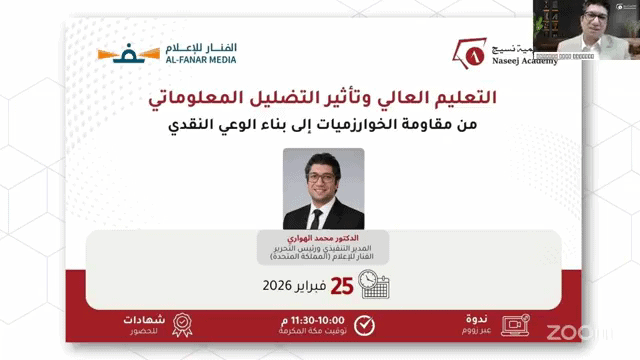
The virtual discussion, titled “Higher Education and the Impact of Disinformation: From Resisting Algorithms to Building Critical Awareness,” brought together experts to analyze how the region has transitioned from information scarcity to overwhelming abundance, often at the expense of accuracy and credibility.
Abdallah Hussein Metwally, Naseej Academy’s general supervisor, emphasized that higher education institutions now face a dual responsibility: not only creating knowledge but also safeguarding its credibility amid the deluge of information circulating across digital platforms and artificial intelligence applications.
“Universities must now serve as guardians of truth in a digital ecosystem where algorithms—often designed with specific agendas—determine what information reaches users,” Metwally noted during the session, which is part of a broader series on education, culture, and information technology in the Arab region.
Mohammad El-Hawary, executive director and editor-in-chief of Al-Fanar Media, who moderated the webinar, highlighted how the democratization of content creation has disrupted traditional knowledge hierarchies. “We’re witnessing an unprecedented situation where virtually anyone can produce and publish content,” said El-Hawary, who also represents Arab States on UNESCO’s Media and Information Literacy Alliance Global Board.
This shift raises fundamental questions about quality control in academic environments. El-Hawary distinguished between institutions that maintain rigorous quality standards and those that uncritically accept digital content, warning about what he termed “brain rot”—cognitive decline resulting from consuming excessive amounts of superficial material, which undermines concentration and critical thinking abilities.
The discussion gained additional urgency in light of recent World Economic Forum “Global Risks” reports, which rank media disinformation among the most serious threats facing contemporary society. El-Hawary cited the August 2024 violent incidents in Britain as a sobering example, where civil unrest erupted following false reports attributing children’s murders to an immigrant rather than a British-born individual.
Participants also explored the concept of the “attention economy,” where digital platforms compete to maximize user engagement, often prioritizing emotional reactions over factual accuracy. This business model creates what experts call “filter bubbles,” algorithmic environments that isolate users from diverse perspectives by showing only content that aligns with their existing beliefs.
The proliferation of deepfakes—artificially generated images, audio, and video that appear authentic—represents another significant challenge. These sophisticated forgeries make distinguishing between genuine and fabricated content increasingly difficult for even the most discerning audiences.
The webinar acknowledged that students themselves are often content creators, sometimes distributing misleading information to increase their digital reach and influence. This reality underscores a critical gap in many universities’ educational approaches: the absence of mandatory courses on media manipulation and fact-checking.
Several participants advocated for integrating media and information literacy into core academic curricula to strengthen students’ analytical skills in a media landscape where truth and falsehood increasingly blur together.
The session concluded that effectively addressing misinformation requires collaborative efforts between educational institutions and broader society, emphasizing the development of verification skills that enable individuals to navigate an increasingly complex information environment.
As the Arab world continues its rapid digital transformation, initiatives like Naseej Academy’s webinar series represent crucial steps toward building more resilient educational systems capable of withstanding the challenges of digital misinformation.
Fact Checker
Verify the accuracy of this article using The Disinformation Commission analysis and real-time sources.

16 Comments
Interesting to see the Arab world taking the lead on this issue. Misinformation knows no borders, so global collaboration in higher ed will be crucial to combat it effectively.
Good point. Sharing best practices and solutions across regions can help strengthen the collective response to this growing threat to academic integrity.
It’s encouraging to see Arab universities taking a proactive approach to combating misinformation. This is a global issue that requires coordinated efforts across the academic community.
Agreed. Sharing best practices and collaborating on solutions will be key to strengthening the response to this challenge in higher education.
This webinar highlights an important shift in how universities need to approach their mission in the digital era. Safeguarding truth and credibility should be central to their mandate.
Absolutely. With the proliferation of false and misleading information online, the role of higher ed as a bastion of reliable knowledge has never been more critical.
It’s commendable that Naseej Academy is tackling this issue head-on. Misinformation poses a real threat to the quality and integrity of education, so proactive measures like this are vital.
I agree. Preparing students to think critically about online content and verify information sources should be a key focus for universities worldwide.
Interesting to see Arab universities taking on the challenge of digital misinformation. It’s crucial for higher ed to promote critical thinking and verification skills in this era of information overload.
Agreed. Universities have a vital role to play in equipping students with the tools to navigate the complex online landscape and identify credible sources.
Kudos to Naseej Academy for organizing this timely webinar. Combating misinformation in academia is a growing concern globally, not just in the Arab world. Proactive steps like this are much needed.
Absolutely. Fostering digital literacy and media awareness should be a key priority for universities to safeguard the integrity of education and research.
The point about universities needing to be “guardians of truth” in the digital age is well-taken. With algorithms increasingly shaping information flows, academic institutions must double down on critical analysis skills.
Agreed. It’s a complex challenge, but one that universities are uniquely positioned to address through curriculum, programming, and research.
This webinar underscores the importance of digital literacy and critical thinking skills in the modern higher education landscape. Kudos to the organizers for addressing this crucial challenge.
Absolutely. With the proliferation of misinformation, universities have a responsibility to equip students with the tools to navigate the online world effectively.