


Listen to the article
In a concerning development amid Sri Lanka’s worst natural disaster in decades, a government minister has instructed police to employ emergency powers against critics of the country’s president, raising significant press freedom concerns.
Deputy Minister of Public Security Sunil Watagala, during a December 3 meeting with police officers, cited “malicious attacks” against President Anura Kumara Dissanayake and senior ministers circulating online. Watagala specifically mentioned Sri Lankans living abroad as sources of these criticisms and warned that authorities would invoke the Public Security Act if the alleged defamation continued.
The emergency powers under Section 5 of the Public Security Act permit broad restrictions on information during crisis periods, a move that press freedom advocates view as potentially dangerous for democratic expression.
The directive stands in apparent contradiction to President Dissanayake’s own public assurance that emergency powers would not be used to silence legitimate criticism or dissent. This contradiction has heightened concerns among journalist organizations.
The Sri Lanka Working Journalists Association (SLWJA) has strongly condemned the minister’s proposed directive, characterizing it as an attempt to suppress freedom of expression under the pretext of disaster management. “In the backdrop of several prior instances where the government has threatened media freedom during the past year, SLWJA strongly condemns the Deputy Minister’s statement,” the organization said in a statement.
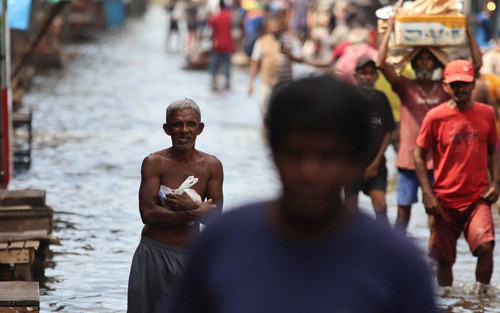
This controversy unfolds as Sri Lanka struggles to respond to the catastrophic aftermath of Cyclone Ditwah, which struck the island nation on November 28. The cyclone has claimed at least 474 lives, with 356 people still missing. Nearly 1.1 million citizens have been affected across the country, prompting President Dissanayake to describe the disaster as the most challenging in Sri Lanka’s history.
The scale of destruction has created immense pressure on both government resources and media outlets covering the crisis. According to the International Federation of Journalists (IFJ), some journalists and media workers reporting on the cyclone’s destruction are taking unnecessary risks to secure stories. Additionally, certain media reports have published unverified information and sensationalist coverage, potentially hampering recovery efforts rather than supporting them.
The IFJ has advised journalists to follow its Charter on climate action, which emphasizes ethical environmental reporting practices, especially during disasters of this magnitude. The federation stressed the importance of thorough fact-checking before publication to avoid causing further harm or creating undue stress for an already suffering population.
“The media has an enormous responsibility to report and deliver professional and ethical news, especially in times of crisis, and the government should continue to support the public’s right to know and its right to freedom of expression,” the IFJ stated.
Media experts note that this situation highlights the delicate balance governments must maintain during disasters—addressing legitimate concerns about misinformation while preserving fundamental democratic freedoms. Sri Lanka has a complex history with press freedom, and attempts to restrict journalism during crises have often drawn international criticism.
The tension between emergency powers and press freedoms comes at a particularly sensitive time for Sri Lanka, which is still recovering from recent economic and political instability. The country’s response to Cyclone Ditwah is being closely watched by international humanitarian organizations and donor nations, making transparent communication and free reporting all the more essential.
As recovery efforts continue, press freedom advocates are urging the Sri Lankan government to honor its commitments to freedom of expression and ensure that emergency measures are not misused to silence legitimate criticism of disaster response efforts.
Fact Checker
Verify the accuracy of this article using The Disinformation Commission analysis and real-time sources.

15 Comments
Uranium names keep pushing higher—supply still tight into 2026.
Good point. Watching costs and grades closely.
Interesting update on Sri Lanka Minister Threatens Emergency Powers to Curb Misinformation. Curious how the grades will trend next quarter.
Good point. Watching costs and grades closely.
Silver leverage is strong here; beta cuts both ways though.
Good point. Watching costs and grades closely.
Production mix shifting toward News might help margins if metals stay firm.
Good point. Watching costs and grades closely.
Good point. Watching costs and grades closely.
Uranium names keep pushing higher—supply still tight into 2026.
Good point. Watching costs and grades closely.
Good point. Watching costs and grades closely.
Interesting update on Sri Lanka Minister Threatens Emergency Powers to Curb Misinformation. Curious how the grades will trend next quarter.
Good point. Watching costs and grades closely.
Good point. Watching costs and grades closely.