


Listen to the article
Scientists Fight Misinformation with Strategic Social Media Campaigns
In an era when 65% of people worldwide consume video on social media, a growing contingent of scientists and medical experts are taking to platforms like TikTok, Instagram and YouTube to combat a rising tide of misinformation. Their mission: to meet people where they are with credible scientific information.
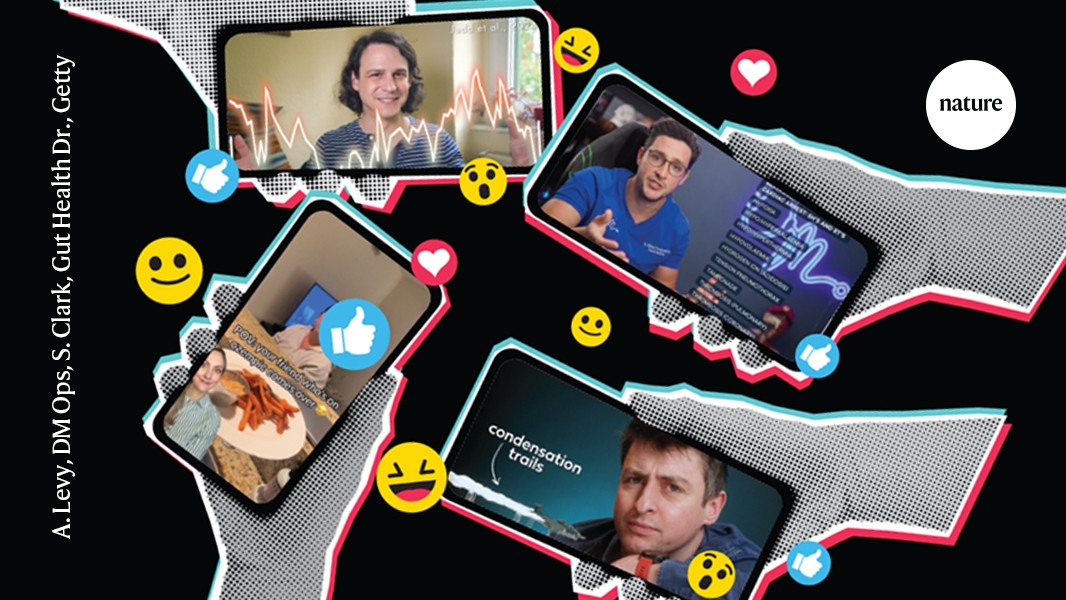
Simon Clark, who holds a PhD in stratospheric dynamics and goes by the handle @simonoxfphys, exemplifies this approach. One of his most popular TikTok videos begins with him parodying climate denialism before methodically dismantling renewable energy myths with data and charts. The video has garnered nearly 180,000 views.
“The natural thing in my field was talking about the climate crisis,” says Clark, who began creating YouTube content 15 years ago as a master’s student at Oxford University before making it his full-time career after earning his doctorate. His content focuses on climate science fundamentals, potential solutions, and the barriers to implementation.
Clark is part of a growing movement of science communicators fighting back against what research shows is an alarming proliferation of misleading content. A recent study analyzing nearly 1,000 Instagram and TikTok posts about controversial medical screening tests found them to be overwhelmingly misleading, with many creators having financial interests in the treatments they promoted. Another study revealed that more than half of the 100 most popular TikTok videos about attention deficit hyperactivity disorder contained misleading information, despite collectively accumulating over 280 million views.
To counter this deluge of misinformation, pro-science content creators are adopting tactics straight from the influencer playbook, focusing on engagement and relatability.
“The best lie is one that mixes seemingly authoritative sources and some facts with false data and false arguments and appeals to people’s beliefs and fears,” explains social scientist Louisa Ha from Bowling Green State University, describing the tactics used by those who spread misinformation.
Clark understands that engagement matters more than accuracy on social media platforms. His 40-minute YouTube video on nuclear power debates intentionally tackled a controversial topic that generated 500,000 views and nearly 6,000 comments. “I imagine that no matter what I say, I’m about to piss a lot of people off,” he acknowledged in the video.
In the health and wellness space, registered dietician Megan Rossi created her Instagram account @theguthealthdoctor in 2015 after seeing patients influenced by unscientific diet advice online. Rossi leverages her position as a research fellow in nutritional sciences at King’s College London to provide evidence-based information on topics like gut health, nutrition, exercise, and sleep, always citing peer-reviewed sources.
Relatability has proven crucial for creators like Emanuel Wallace, known as Big Manny (@big.manny1) on TikTok, where he’s amassed over two million followers by making chemistry and science accessible to young audiences. “I don’t really look like a typical scientist. I don’t wear a lab coat. Sometimes I might have a tracksuit on. And I use colloquial terms in my speech,” he explains. “I just be myself.”
This approach reflects research findings from public health experts Amelia Burke-Garcia and Amy Leader, who studied how influencers of color could effectively communicate about HPV vaccination. Their research showed that emotionally charged posts acknowledging parents’ fears and using personal storytelling were effective in changing followers’ perspectives on vaccination.
When it comes to fighting misinformation directly, creators employ different strategies. Clark favors “pre-bunking” over debunking, providing solid facts preemptively to “vaccinate” audiences against misinformation. Others, like Russian-American creator Mikhail Varshavski, known as Doctor Mike (@doctormike), directly challenge health misinformation with his 14.6 million YouTube, 5.3 million Instagram, and 2.7 million TikTok followers.
Social media has fundamentally changed how information spreads by creating communities that connect across time and space. As Burke-Garcia notes, this has introduced a new type of opinion leader, making it essential to support credible voices within these online spaces.
As misinformation continues to flourish online, these science communicators represent a crucial counterbalance, using the same platforms and engagement techniques to ensure that evidence-based information reaches audiences who might otherwise be exposed only to pseudoscience and conspiracy theories.
Fact Checker
Verify the accuracy of this article using The Disinformation Commission analysis and real-time sources.

9 Comments
It’s heartening to see scientists taking a proactive approach to countering misinformation online. Leveraging popular platforms like TikTok could be a game-changer in the battle for truth.
I’m glad to see more scientists getting involved in public outreach and science communication. Platforms like TikTok provide an opportunity to make complex topics more accessible and engaging.
Absolutely. Simplifying technical information without oversimplifying is key. Short, visually appealing videos can make a big difference in cutting through the noise.
Impressive to see scientists harnessing the power of viral social media content to combat misinformation. I’ll be curious to see if this approach gains traction and has a meaningful impact.
While I’m skeptical that TikTok videos alone can fully overcome deeply-held beliefs, this strategy of meeting people where they are digitally is a step in the right direction. Kudos to these scientists for their innovative outreach.
You make a fair point. Changing long-held views is incredibly difficult, even with compelling evidence. But every bit of accurate information helps chip away at misinformation over time.
The rise of science communicators on TikTok is an interesting development. I wonder how effective these efforts will be at swaying public opinion that has become increasingly polarized on certain topics.
Interesting to see scientists leveraging social media to counter misinformation. Viral TikTok videos with data-driven rebuttals could be an effective way to reach a wide audience.
Fighting misinformation with science-based content on social media – this seems like a smart strategy. Curious to see if it has a measurable impact on public understanding of issues like climate change.