


Listen to the article
Controversy Erupts Over Sha’Carri Richardson’s “Fastest Woman Alive” Title
A heated debate has ignited in the track and field community after American sprinter Sha’Carri Richardson appeared on the cover of Vogue’s August 2024 issue with the tagline “The Fastest Woman Alive.” The description has sparked significant backlash from fans and track enthusiasts who contend that the title misrepresents Richardson’s actual standing in the sport.
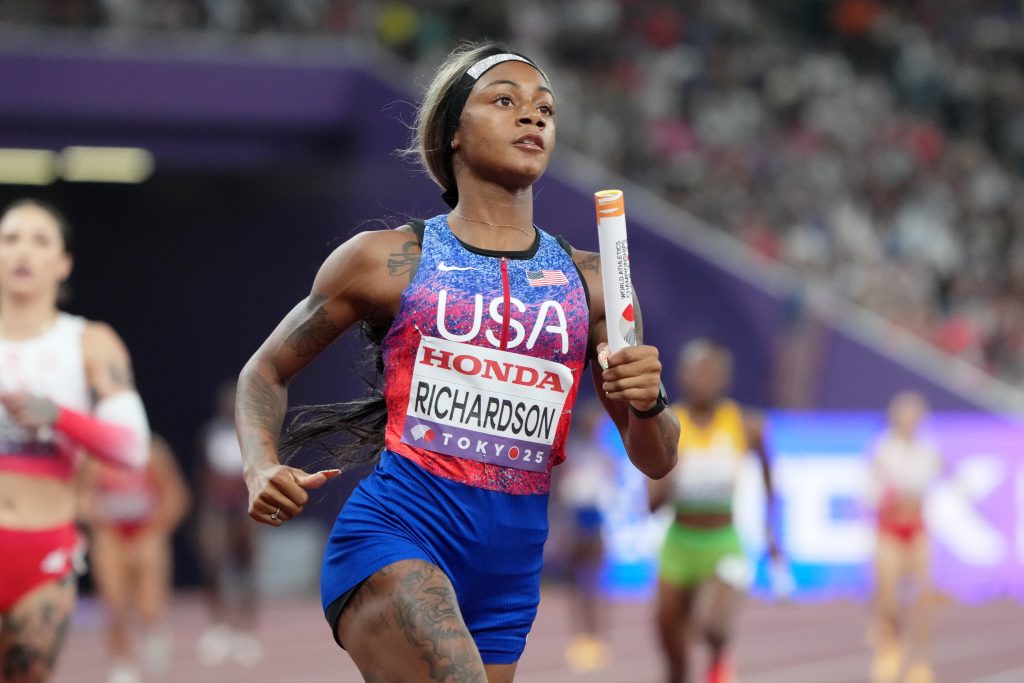
Richardson, who won gold in the 100 meters at the 2023 World Athletics Championships with a time of 10.65 seconds and claimed gold in the 4×100-meter relay at the 2024 Paris Olympics, has undeniably established herself as one of the world’s premier sprinters. However, critics argue that her personal records do not qualify her for the “fastest woman alive” designation.
The controversy highlights the sometimes uneasy relationship between sports achievements and media portrayal. Many fans have expressed frustration with what they perceive as fashion magazines prioritizing captivating narratives over factual accuracy when covering athletes.
“There is no fighting. There is TRUTH and there are LIES,” wrote one social media user. “She is not nor has EVER been the fastest woman alive. She’s not even the fastest living AMERICAN woman. You claim to be a journalistic entity therefore YOUR only obligation is to the TRUTH.”
Another commentator clarified that the issue wasn’t Richardson’s prominence but rather the accuracy of her portrayal: “NOBODY was enraged because she was on Vogue. Let’s start there. The issue the people from ‘a certain Caribbean island’ and elsewhere are having is the blatant misinformation being spread when it comes to her. She’s not the fastest alive; she’s not the fastest in America, and she’s not even in the top 5 fastest. FACTS!”
The discussion points to a broader concern about how mainstream media covers track and field, with some fans suggesting that publications unfamiliar with the sport’s nuances may inadvertently spread misinformation. As one user noted: “Who in the track world spread misinformation? That was a mainstream publication who probably don’t know anything about track.”
For context, the women’s 100-meter world record of 10.49 seconds, set by Florence Griffith-Joyner in 1988, remains unbroken. Several active athletes, including Jamaica’s Shelly-Ann Fraser-Pryce and Elaine Thompson-Herah, have recorded faster personal bests than Richardson.
While Richardson has not publicly addressed the controversy, the debate underscores fans’ desire for media coverage that prioritizes athletic achievements rather than public persona.
Meanwhile, Richardson continues to build her athletic resume. During the recent Easter weekend, she made history by winning Australia’s prestigious Stawell Gift, a 120-meter handicap race. Despite starting from the back of the field, Richardson surged to victory, becoming just the third woman in the event’s history to claim the title.
After her triumph, Richardson expressed enthusiasm about the unique format: “This has been the most exciting event I’ve participated in,” she said, noting that she felt confident about winning as she passed the 90-meter mark.
The Stawell Gift victory marks a strong start to Richardson’s 2026 season, with fans eagerly anticipating her next appearance, potentially at the upcoming Doha Diamond League. As one of track and field’s most recognizable stars, Richardson’s performances continue to attract attention both on and off the track.
As this controversy demonstrates, however, the intersection of athletic achievement and media portrayal remains complex territory, particularly for athletes whose public profiles extend beyond sports into broader cultural conversations.
Fact Checker
Verify the accuracy of this article using The Disinformation Commission analysis and real-time sources.

12 Comments
This controversy highlights the challenges of accurately portraying athletic achievements in the media. While Richardson’s accomplishments are impressive, the ‘fastest woman alive’ claim may be an overstatement that prioritizes a compelling narrative over factual precision.
You make a fair point. Sports journalism should strive for objectivity and factual reporting, even if a more hyperbolic framing might generate more attention.
This is an interesting case study in the sometimes uneasy relationship between sports achievements and media portrayals. While Richardson is undoubtedly an elite sprinter, the ‘fastest woman alive’ claim does seem to stretch the facts a bit too far.
You make a good point. The media should be careful not to overstate or sensationalize athletes’ accomplishments, even if it makes for a more compelling narrative.
This debate underscores the importance of maintaining a clear distinction between sports achievements and media portrayals. While Richardson is undoubtedly a world-class sprinter, the ‘fastest woman alive’ claim seems to be an overreach that could undermine the integrity of the coverage.
Well said. Sports journalism should prioritize factual accuracy and resist the temptation to exaggerate or sensationalize athletes’ accomplishments, even if it makes for a more compelling narrative.
The controversy highlights the delicate balance that sports media must strike between storytelling and factual reporting. While Richardson’s achievements are impressive, the ‘fastest woman alive’ claim appears to be an overstatement that could undermine the credibility of the coverage.
Exactly. Sports journalism should aim to provide objective, nuanced reporting on athletes’ accomplishments, rather than resorting to hyperbolic language that may not be fully justified.
The controversy highlights the need for sports journalism to balance factual accuracy with captivating storytelling. While Richardson’s achievements are impressive, the ‘fastest woman alive’ claim appears to be an exaggeration that could undermine the credibility of the coverage.
Exactly. Sports media should strive to report on athletes’ accomplishments objectively and with nuance, rather than resorting to hyperbolic language that may not be fully justified.
I can understand both sides of this debate. On one hand, Richardson’s gold medals and world-class times speak for themselves. But the ‘fastest woman alive’ label does seem like an exaggeration that could undermine the credibility of the coverage.
Agreed. Maintaining accuracy and nuance in sports reporting is crucial, even if it means resisting the temptation to use more sensational language.