


Listen to the article
In a striking display of misinformation, Representative Ilhan Omar (D-Minn.) faced public correction on social media after making inaccurate claims about U.S. military actions against predominantly Muslim nations.
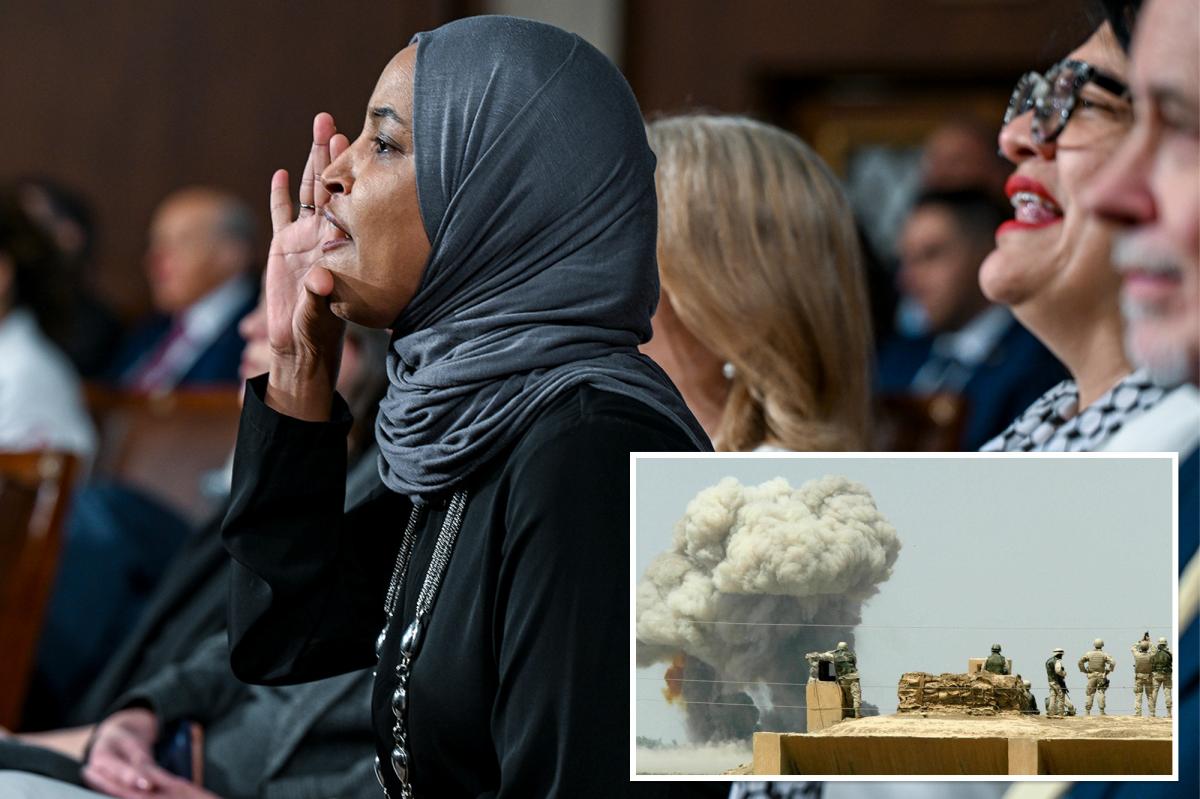
The progressive “Squad” member posted on X (formerly Twitter) Thursday evening, asserting: “Iraq was attacked by the US during Ramadan and it is sickening to know that the US is again going to attack Iran during Ramadan.” Her comments came as tensions mounted before the U.S. and Israel launched airstrikes against Iran early Saturday morning.
Omar further alleged that “The US apparently loves to strike Muslim countries during Ramadan,” suggesting religious bias rather than geopolitical concerns motivated these military actions. “I am convinced it isn’t what these countries have done to violate international law but about who they worship,” she wrote.
The platform’s community notes feature quickly flagged Omar’s post as containing factual inaccuracies. Users pointed out that Operation Iraqi Freedom, launched under President George W. Bush, began on March 20, 2003—approximately seven months before Ramadan that year. Similarly, Operation Desert Storm, initiated by President George H.W. Bush on January 17, 1991, commenced two months prior to the Islamic holy month and resulted in Kuwait’s liberation.
Dalia al-Aqidi, a Muslim Iraqi-American challenging Omar for her congressional seat in the upcoming midterm elections, criticized the representative’s comments, stating: “Claiming America ‘chooses Ramadan to attack Muslims’ is not advocacy, it is a deliberate lie meant to inflame anger and divide Americans.”
This incident represents the latest in a pattern of controversial statements and factual disputes involving the Minnesota congresswoman. Earlier this year, Omar dismissed questions about a $9 billion social services fraud scheme in her district by conflating annual federal funding figures with the total amount allegedly stolen over nearly a decade. When confronted by a reporter on the issue, Omar responded defensively, saying, “Your brain has told you that it is possible for half of the resources for our public service to have disappeared? Listen to yourself.”
Questions about her personal finances have also drawn attention. When faced with inquiries about how her family’s declared wealth reportedly increased from minimal holdings to up to $30 million within a year, Omar took to TikTok to dispute the characterization. She claimed reporters had misinterpreted her financial disclosure forms, arguing that values listed reflected her husband’s company’s total worth rather than his personal stake—an explanation that conflicts with standard financial disclosure requirements.
“Learn to read before you post misleading s–t,” she said in the video response.
Omar’s controversial X post came during a period of heightened Middle East tensions. The U.S. State Department had instructed embassy personnel in Israel to depart the region “while commercial flights are available,” signaling concerns about potential airspace closures due to military action or anticipated retaliation from Iran.
The ongoing situation highlights the sensitive intersection of U.S. foreign policy in the Middle East, public discourse among elected officials, and the increasingly important role of fact-checking in social media communications. As tensions in the region continue to evolve, the accuracy of statements made by public officials remains under heightened scrutiny from constituents and political opponents alike.
Fact Checker
Verify the accuracy of this article using The Disinformation Commission analysis and real-time sources.

12 Comments
Appreciate the effort to provide factual context around Rep. Omar’s comments. Reasonable people can disagree on the motivations behind military actions, but the dates should be accurate.
Well said. Factual accuracy is the foundation for any meaningful discussion on these complex issues.
I’m curious to learn more about the specific timeline and context around the US military operations mentioned. Fact-checking is important but the full picture can be complicated.
Absolutely, there’s likely more to the story than what’s presented in the initial news report. Digging into the details could yield a more complete understanding.
This fact-check highlights the need for careful analysis and verification when it comes to claims about sensitive geopolitical events. The timing details are noteworthy.
Absolutely, it’s important to avoid jumping to conclusions and to instead focus on the objective facts, even on controversial topics.
The US has a long and complex history of military interventions in the Middle East. While the timing of these actions is worth scrutiny, it’s a nuanced issue without easy answers.
You raise a fair point. The geopolitical factors behind US military decisions are often multifaceted and debated.
Interesting to see the facts checked on Rep. Omar’s comments about the timing of US military actions. Factual accuracy is important, even on sensitive geopolitical issues.
Agreed, it’s important to rely on verified facts rather than making assumptions about motivations.
This fact-check highlights the importance of verifying claims, especially on sensitive topics. While intent is debatable, the timeline of events seems clear based on the information provided.
Agreed, relying on facts is crucial when discussing geopolitical matters that can be polarizing. Nuance and context are important to consider as well.