


Listen to the article
AI-Generated Content Clouds Middle East Conflict Coverage as Misinformation Surges
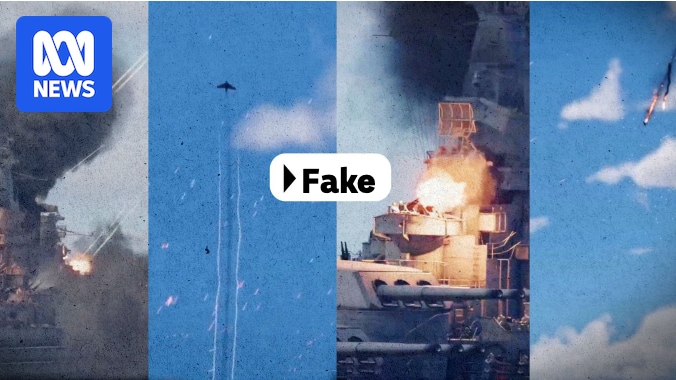
Spectacular footage showing a warship firing at an aircraft that dodges before bursting into flames and crashing into the sea has garnered over seven million views on X since March 2. The video, posted with the caption “An Iranian plane VS a US ship,” appears to show a dramatic military confrontation.
There’s just one problem: it’s completely fabricated, likely taken from the popular military simulation game “War Thunder.”
Despite the obvious red flags, the clip received more than 15,000 likes and was reportedly even shared—then quickly deleted—by Texas Governor Greg Abbott. While most commenters expressed skepticism, some viewers questioned if it was AI-generated, and others appeared to believe it was authentic footage.
This video is just one example of a growing wave of misinformation surrounding the escalating tensions in the Middle East, where distinguishing fact from fiction has become increasingly difficult.
“We see billions of images a day. Hundreds of thousands of hours of video being generated a day—generated through cameras, but also through AI now, and that is just a massive amount of data and media to understand, to grapple with,” explains Dr. TJ Thomson, an expert in digital media and visual communication at RMIT.
“That definitely does cloud and muddy our information environment and make it more difficult to understand what’s going on and to have trust in what’s going on,” he adds.
Other examples of misinformation include footage falsely claiming to show an attack on the US embassy in Saudi Arabia, which was actually a road accident recorded earlier this year. Additionally, widely shared photos purportedly depicting an Iranian drone strike on a US base in Iraq were revealed to be AI-generated or edited upon closer examination.
The rapid advancement of AI technology means the line between reality and fabrication is becoming increasingly blurred. Dr. Thomson warns we’re approaching a point where people may no longer be able to trust their own eyes.
“We are in this really tough, tricky era where we have so much quick advancement of technology and not enough catch-up with our abilities to be able to grapple with it and respond,” he notes.
While AI tools can assist in examining material related to conflicts, they have paradoxically contributed to the spread of unreliable information. NewsGuard has reported instances where AI overviews generated by Google produced inaccurate summaries of images related to the conflict.
ABC NEWS Verify found similar problems with Google Lens’s AI mode, including misidentifying images from a December 2023 fire in Abu Dhabi as the aftermath of Iranian missile strikes, and suggesting that footage from video games like “ARMA” depicted actual US-Israeli strikes or explosions in Iraqi cities.
The way people consume news exacerbates the problem. “The majority of people do use their smartphones to look at content online,” Dr. Thomson points out. “Eighty per cent or so are looking at really small screens, going through things quickly on social media. That doesn’t let us have the opportunity to scrutinize things at a very high degree.”
The potential consequences of this misinformation crisis extend far beyond momentary confusion. “AI can be lovely and wonderful and have productive, pro-social, beneficial uses, certainly. But conversely, it also has huge issues,” Dr. Thomson warns.
“If people don’t trust experts or fact-checked information or evidence, you really have a huge potential for collapse, societal discord, polarization, fractured institutions, making decisions not based on evidence, but based on feelings and emotions.”
For those hoping to avoid being misled, Dr. Thomson offers practical advice: “Focus more on sources, trustworthy sources, rather than on individual pieces of content,” he suggests. “I would say pause before sharing or pause before re-sharing and ask yourself, ‘Has this particular piece of content or this claim been re-shared by reputable, trustworthy organizations?'”
As tensions in the Middle East continue to evolve, the challenge of distinguishing between authentic and fabricated content remains a critical concern for media consumers worldwide, underscoring the importance of digital literacy in an age of increasingly sophisticated misinformation.
Fact Checker
Verify the accuracy of this article using The Disinformation Commission analysis and real-time sources.

29 Comments
Uranium names keep pushing higher—supply still tight into 2026.
Uranium names keep pushing higher—supply still tight into 2026.
Good point. Watching costs and grades closely.
Nice to see insider buying—usually a good signal in this space.
Good point. Watching costs and grades closely.
Good point. Watching costs and grades closely.
Interesting update on Real Attack or Video Game? Navigating Misinformation in Wartime During the AI Era. Curious how the grades will trend next quarter.
Good point. Watching costs and grades closely.
Good point. Watching costs and grades closely.
The cost guidance is better than expected. If they deliver, the stock could rerate.
Exploration results look promising, but permitting will be the key risk.
Good point. Watching costs and grades closely.
Uranium names keep pushing higher—supply still tight into 2026.
Good point. Watching costs and grades closely.
Uranium names keep pushing higher—supply still tight into 2026.
Good point. Watching costs and grades closely.
Good point. Watching costs and grades closely.
If AISC keeps dropping, this becomes investable for me.
Good point. Watching costs and grades closely.
Good point. Watching costs and grades closely.
Uranium names keep pushing higher—supply still tight into 2026.
I like the balance sheet here—less leverage than peers.
Good point. Watching costs and grades closely.
If AISC keeps dropping, this becomes investable for me.
Good point. Watching costs and grades closely.
Good point. Watching costs and grades closely.
The cost guidance is better than expected. If they deliver, the stock could rerate.
Good point. Watching costs and grades closely.
Good point. Watching costs and grades closely.