


Listen to the article
In a sharply worded response that highlights growing tensions between Washington and Bogotá, Colombian President Gustavo Petro has forcefully rejected recent statements by U.S. President Donald Trump regarding Colombia’s anti-narcotics efforts, characterizing them as factually inaccurate and potentially harmful to regional stability.
The diplomatic dispute erupted after Trump claimed Colombia was failing in its drug war commitments, suggesting his administration might consider punitive measures if the South American nation didn’t intensify its counter-narcotics operations. Trump’s comments came during a broader speech on border security, where he linked drug trafficking from Colombia to immigration issues along the U.S. southern border.
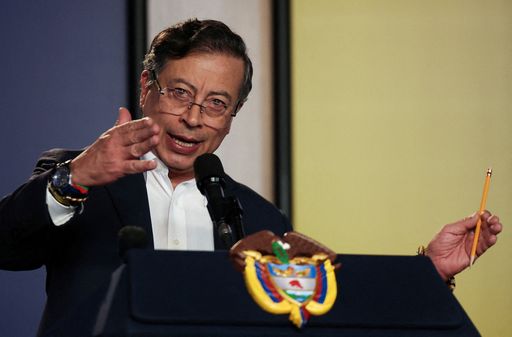
Petro, Colombia’s first leftist president in modern history, dismissed these assertions as “complete misinformation” during a press conference at Casa de Nariño in Bogotá yesterday. “The reality on the ground tells a different story than the narrative being pushed from Washington,” Petro stated, pointing to Colombian government statistics showing interdiction operations have actually increased by 12 percent during his administration.
“We cannot accept being used as a scapegoat for domestic political calculations in the United States,” Petro declared, referencing the upcoming U.S. election cycle where immigration and border security have become central campaign issues.
The Colombian government has maintained that its approach to drug trafficking represents a strategic shift rather than a retreat, focusing on rural development, voluntary crop substitution, and addressing the socioeconomic factors driving coca cultivation, while continuing traditional enforcement measures.
This clash occurs against a backdrop of evolving U.S.-Colombia relations since Petro’s election in 2022. The two nations have historically maintained close ties, with Colombia receiving more than $12 billion in U.S. aid since 2000, primarily directed toward military and anti-narcotics efforts under the Plan Colombia initiative.
Petro’s administration has sought to reframe this relationship, advocating for a more comprehensive approach to the drug problem that addresses root causes rather than focusing primarily on eradication and interdiction. This philosophical shift has created friction with Washington, where policymakers have grown accustomed to Colombia’s role as a steadfast security partner.
Of particular concern to Bogotá is Trump’s increasingly confrontational stance toward Venezuela. Petro specifically warned that U.S. threats against the Nicolás Maduro regime risk destabilizing the entire region, potentially triggering new waves of migration and undermining fragile security conditions in border areas already struggling with armed groups and smuggling networks.
“Colombia cannot afford another regional crisis on its doorstep,” Petro emphasized. “We are still managing the consequences of previous conflicts, with nearly two million Venezuelan migrants in our country. Further destabilization serves no one’s interests, least of all those genuinely concerned about narcotics trafficking.”
International relations experts view this diplomatic tension as part of a broader recalibration occurring throughout Latin America, where several nations are asserting more independent foreign policies while still maintaining critical relationships with the United States.
“We’re seeing a natural evolution in the hemisphere’s dynamics,” explained María Fernanda Restrepo, director of the Center for International Policy Studies in Medellín. “Countries like Colombia are seeking balanced relationships that respect their sovereignty while addressing shared challenges like drug trafficking through methods that work for their specific contexts.”
The U.S. State Department issued a measured response, acknowledging Colombia’s sovereignty while reaffirming Washington’s commitment to bilateral cooperation on security matters. “We continue to value our partnership with Colombia and respect their approach, while maintaining our position that aggressive counter-narcotics operations remain essential,” the statement read.
As both nations navigate this diplomatic friction, analysts suggest the underlying security cooperation infrastructure remains largely intact, despite the heated rhetoric. Whether this verbal sparring translates into substantive policy changes remains to be seen, though both countries have compelling incentives to preserve what has been one of Washington’s most enduring security relationships in Latin America.
Fact Checker
Verify the accuracy of this article using The Disinformation Commission analysis and real-time sources.

23 Comments
The cost guidance is better than expected. If they deliver, the stock could rerate.
Interesting update on Petro Accuses Trump of Spreading Misinformation About Colombia’s Drug War. Curious how the grades will trend next quarter.
Silver leverage is strong here; beta cuts both ways though.
Nice to see insider buying—usually a good signal in this space.
Good point. Watching costs and grades closely.
Uranium names keep pushing higher—supply still tight into 2026.
I like the balance sheet here—less leverage than peers.
Good point. Watching costs and grades closely.
Good point. Watching costs and grades closely.
Exploration results look promising, but permitting will be the key risk.
Good point. Watching costs and grades closely.
Good point. Watching costs and grades closely.
The cost guidance is better than expected. If they deliver, the stock could rerate.
I like the balance sheet here—less leverage than peers.
Interesting update on Petro Accuses Trump of Spreading Misinformation About Colombia’s Drug War. Curious how the grades will trend next quarter.
Good point. Watching costs and grades closely.
Nice to see insider buying—usually a good signal in this space.
Good point. Watching costs and grades closely.
Good point. Watching costs and grades closely.
Interesting update on Petro Accuses Trump of Spreading Misinformation About Colombia’s Drug War. Curious how the grades will trend next quarter.
Uranium names keep pushing higher—supply still tight into 2026.
Good point. Watching costs and grades closely.
Good point. Watching costs and grades closely.