


Listen to the article
Pakistan’s First HPV Vaccination Campaign Makes Progress Despite Initial Hesitancy
On the doorstep of her modest home in Rawalpindi town, Amina adjusted her scarf to cover her hair and told the visiting health workers she was not quite ready to allow her adolescent daughter to be vaccinated against the human papillomavirus (HPV).
She had listened to the information they had to offer. She had heard that the virus is responsible for the overwhelming majority of cases of cervical cancer, and learned that the vaccine, which began to roll out in Pakistan for the first time on September 15, has been shown capable of blocking 90% of cancer cases. But she was unsure; she wanted more time. She wanted to speak to her husband before she decided.
A couple of days later, the health team returned to address both parents’ questions and concerns. Furnished with clear responses, the parents agreed to let their daughter be vaccinated.
“A similar response of shift from confusion to acceptance was observed among almost 90% of parents of our target adolescent girls,” reported Maskeen Ullah, In-charge at the Health Centre in Rawalpindi’s Union Council Imam Bargah. Maskeen saw coverage ramp up from 10% of the target on day one of the campaign to more than 70% on the third day.
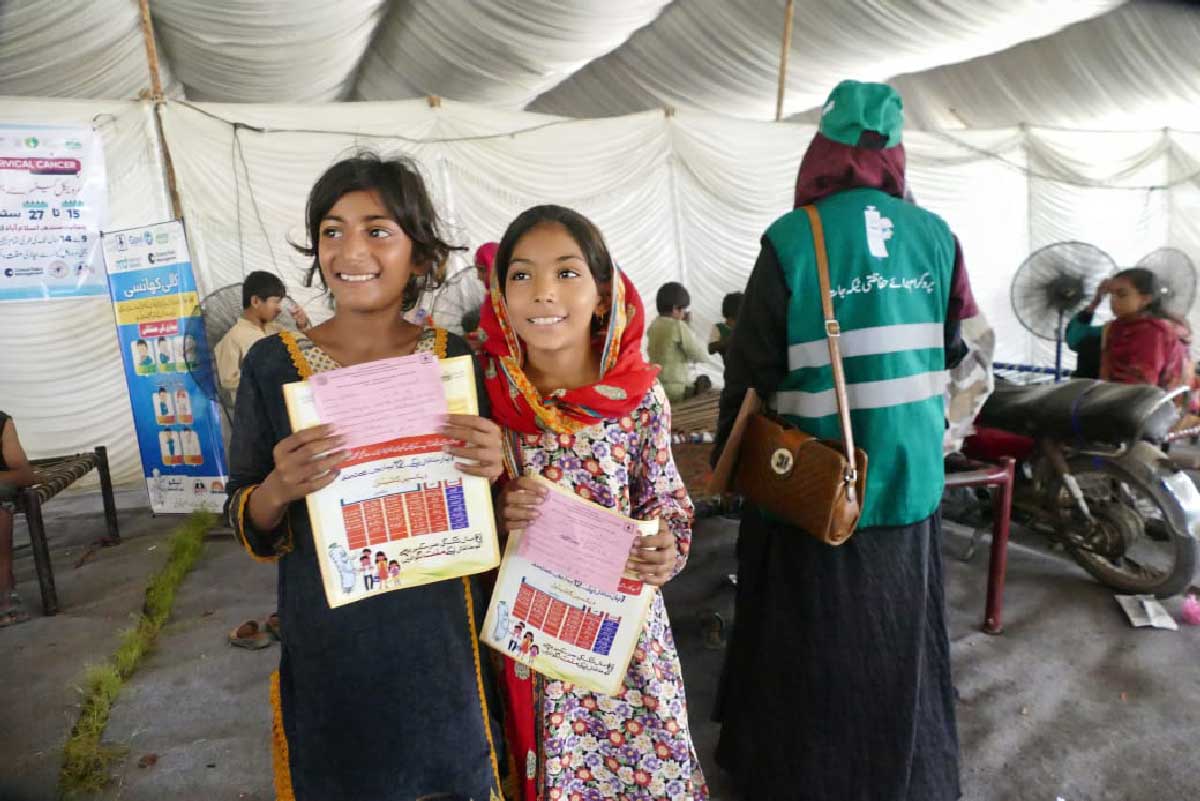
Pakistan’s first 12-day introductory campaign, which ran from September 15-27, aimed to reach 13 million adolescent girls aged 9 to 14 across Punjab, Sindh, Azad Jammu and Kashmir (AJK) region, and Islamabad. Second and third phases are scheduled for 2026 and 2027, which will extend protection to an additional 5 million girls in other parts of the country.
Introducing the HPV vaccine into the national routine immunization schedule presented significant challenges beyond just the scale of the eligible population. Although cervical cancer is the third-most common cancer among Pakistani women, killing approximately 3,500 each year – likely an underestimation of the true burden – a recent Jhpiego survey found that only 19% of caregivers had ever heard of the disease. Merely 2% knew a preventive vaccine existed.
This unfamiliarity bred concern. “Parental hesitancy towards HPV vaccine was anticipated, as myths and misinformation went viral on social media even before launching of the immunisation campaign, creating widespread fear and confusion among people,” said Dr. Muzafar Saeed, Programme Lead for the Rural Education and Economic Development Society (REEDS) on HPV.
REEDS, in collaboration with Federal Directorate of Immunization, Expanded Programme for Immunization (EPI) and Gavi, brought HPV vaccination to eight districts of Punjab province.
Parents frequently asked questions like “Why only girls?”, “Will it cause infertility?”, “Is it halal?” and even, “Why is it free of cost?” – reflecting the impact of widespread misinformation on social media platforms.
Building confidence in the unfamiliar immunization has demanded patience, Dr. Muzafar explained. Social mobilizers and Community Engagement Specialists made regular visits to hesitant parents. A majority of those initially wary in his catchment area have since given consent.
Similar experiences were reported from Sindh, where 3,611 teams worked to reach 4.1 million girls – including 2.2 million out-of-school girls. “As per statistics, vaccination coverage in Sindh province recorded above 50% on the fourth day of the campaign and is improving due to continuous follow-up visits and counter propaganda measures,” shared Dr. Arsalan Mamon, Monitoring and Evaluation Officer EPI Sindh.
Dr. Mamon said health officials had expected 80% coverage in Sindh, but the pace was impeded by misleading video messages.
To counter the misinformation, the Health Ministry launched a comprehensive strategy, releasing awareness videos featuring gynecologists, celebrities, politicians, religious scholars, and media personalities. Some anti-vaccine voices were directly approached by Health Department officials, who sought to provide them with evidence of the life-saving potential of the HPV vaccine.
Notable religious scholars also released video messages assuring the country’s population that the HPV vaccine is not harmful for young girls, urging parents to disregard misleading information circulating on social media.
In a powerful public statement on September 20, Federal Minister for National Health Services Syed Mustafa Kamal had his own daughter, Rija, vaccinated before the press. “This step aims to break harmful rumours about the HPV vaccine and inspire parents, especially those misled by propaganda, to take action and protect their daughters from cervical cancer through timely vaccination,” Mustafa told reporters.
The minister later reported that her public immunization had “a huge impact” on the campaign. “From the fifth day, refusal rates began dropping, and acceptance climbed to 70-80% in some districts,” he added.
To capitalize on the growing momentum, the government extended the vaccination campaign by three additional days. By the campaign’s conclusion, the Health Minister reported that it had “overcome early setbacks fuelled by sceptics online, and so far achieved over 70% of its goal at national level.”
Final data showed that after the three-day extension (September 29 to October 1), overall coverage reached 71% among eligible 9-14 year-old girls. This represents 9.2 million girls vaccinated – and protected against cervical cancer – in just 15 days. The extension alone contributed 1.4 million additional vaccinations, with Punjab’s coverage rates rising steeply during these catch-up days.
However, challenges remain, as 18 districts still report coverage rates below 60%. The government has recommended “intensified follow-up” for these low-coverage zones, alongside continued vaccination through clinics, schools, and outreach activities.
Fact Checker
Verify the accuracy of this article using The Disinformation Commission analysis and real-time sources.

11 Comments
It’s heartening to see the HPV vaccination campaign gaining traction in Pakistan. Overcoming misinformation barriers is no easy task, but the health teams’ efforts to engage with parents directly appear to be paying dividends.
HPV vaccination is a vital preventative measure, so I’m glad to see Pakistan making progress despite initial challenges. Equipping parents with the right information seems to be an effective strategy.
While concerning to hear about misinformation hampering the rollout, it’s great that the health teams were able to turn things around by providing clear, factual information. Ongoing community engagement will be key.
Kudos to the Pakistani health workers for their persistence in the face of misinformation. Vaccination hesitancy is a common challenge, but their approach of addressing parents’ concerns directly seems to be paying off.
Overcoming misinformation is critical for the success of public health initiatives like this. Kudos to the health workers for their diligence in following up with parents and addressing their questions.
Absolutely. Sustained community engagement and education will be vital to maintaining momentum and reaching vaccination targets.
HPV vaccination is an important preventative measure against cervical cancer. I’m glad to see Pakistan making strides, even if progress is incremental. Continued commitment from both health authorities and the public will be essential.
Agreed. This campaign has the potential to significantly improve women’s health outcomes in Pakistan if they can maintain high vaccination rates.
The shift from 10% to 90% coverage is an impressive achievement. It underscores the importance of public health education and tackling misinformation head-on. Wishing Pakistan continued success with this important initiative.
It’s encouraging to see Pakistan’s HPV vaccination campaign making progress despite initial hesitancy. Addressing parents’ concerns and providing clear information seems key to increasing acceptance and coverage.
Addressing vaccine hesitancy through open dialogue and factual education is the right approach. Kudos to the Pakistani health workers for their persistence and commitment to improving women’s health outcomes.