


Listen to the article
Pakistani protesters stormed the outer wall of the U.S. consulate in Karachi on Sunday, prompting police to fire tear gas as regional unrest escalated amid reports of U.S. and Israeli strikes against Iran.
Security forces eventually repelled demonstrators from the consulate perimeter after they breached the outer wall, according to local authorities. A Reuters journalist at the scene reported hearing gunfire and observed footage of vehicles burning outside the consulate’s main entrance. No casualties were reported in the confrontation, and U.S. diplomats at the facility were not immediately available for comment.
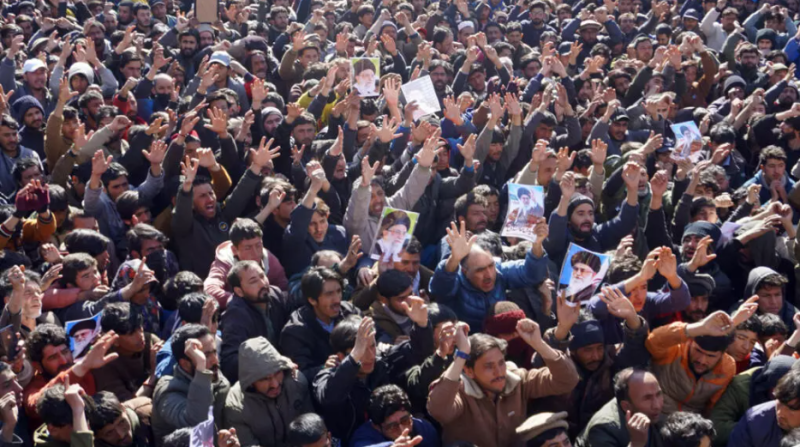
The protests in Karachi represent part of a larger wave of anti-American demonstrations spreading across Pakistan. In the northern Himalayan city of Skardu in Gilgit-Baltistan, protesters set fire to a United Nations office building.
“A large number of protesters have gathered outside the UN office in GB and burned down the building,” said local government spokesperson Shabbir Mir, adding that no injuries had been reported from the incident.
The Skardu demonstrations began after unverified social media claims circulated regarding the death of Iran’s Supreme Leader, Ayatollah Ali Khamenei, allegedly following military actions by U.S. and Israeli forces.
In Lahore, Pakistan’s second-largest city, hundreds gathered outside the American consulate. “Some of the protestors tried to damage the security gate, hundreds of yards away from the Consulate, however, police stopped them without use of force,” eyewitness Aqeel Raza told Reuters.
Similar scenes unfolded in Baghdad, Iraq, where protesters assembled outside the Green Zone housing the U.S. Embassy, according to Reuters.
The regional instability has severely disrupted global air travel, creating cascading effects throughout international aviation networks. Major Middle Eastern transit hubs, including Dubai International Airport—one of the world’s busiest international airports—along with facilities in Abu Dhabi and Doha have either closed or are operating under significant restrictions.
These disruptions have led to thousands of flight cancellations and rerouted journeys, with aircraft and flight crews stranded far from their scheduled positions. The logistical challenges facing airlines are unprecedented in scale, according to industry experts.
“It’s the sheer volume of people and the complexity,” explained UK-based aviation analyst John Strickland, describing the monumental task of repositioning aircraft and crews affected by the airspace closures.
Dubai and Doha serve as vital connecting points for long-haul flights between Europe and Asia. Their operational limitations have forced airlines to utilize narrower air corridors, significantly increasing fuel consumption and flight durations.
The situation appears likely to worsen if tensions continue to escalate. Ian Petchenik, communications director at flight tracking service Flightradar24, warned of potentially “drastic consequences for travel between Europe and Asia” should the conflict intensify further. He noted additional concerns regarding routes near Pakistan and Afghanistan, regions already facing complex security situations.
The demonstrations in Pakistan highlight the delicate geopolitical balance in a region where anti-American sentiment can quickly mobilize large crowds. Pakistan, a nuclear-armed nation that has historically maintained complex relationships with both Western powers and regional actors like Iran, faces a particularly challenging position amid rising Middle East tensions.
The economic impact of these disruptions extends beyond the immediate aviation sector, affecting global supply chains, tourism, and business travel at a time when many regional economies are still recovering from pandemic-related setbacks.
As the situation continues to develop, international diplomatic efforts remain focused on preventing further escalation in what has rapidly become a multi-front crisis with global implications.
Fact Checker
Verify the accuracy of this article using The Disinformation Commission analysis and real-time sources.

10 Comments
This seems like a complex geopolitical situation with regional tensions spilling over. I’m curious to learn more about the underlying drivers and how this may impact global energy/commodity markets, if at all.
That’s a good point. The energy and natural resource sectors will be closely watching developments, as any disruptions in this region could have ripple effects globally.
This is a concerning situation with the protests and misinformation spreading in Pakistan. While the details are unclear, it’s important to rely on verified information from official sources to avoid escalating the conflict further.
Agreed. Unverified claims on social media can be especially dangerous in charged political situations like this. Responsible reporting and de-escalation will be crucial.
The disruptions to air travel due to the protests are unfortunate, but the safety of civilians should be the top priority. I hope the authorities can restore order and ensure the free flow of people and goods.
Yes, the impact on travel and commerce is concerning, but maintaining public safety has to come first. Hopefully the situation can be resolved peacefully soon.
This situation underscores the importance of having reliable, fact-based information, especially during times of heightened tensions and unrest. Responsible journalism and transparency from authorities will be crucial going forward.
Well said. Misinformation and rumor-mongering can quickly inflame conflicts, so maintaining an objective, evidence-based approach is essential to de-escalate the situation.
The burning of the UN office building is quite troubling. While the protesters may have grievances, resorting to violence and property damage is never the right solution. Hopefully calm can be restored through dialogue.
Agreed, escalating to property destruction and attacks on international organizations is an extremely concerning turn of events. Cooler heads need to prevail to prevent this from spiraling further.