


Listen to the article
South Korea Sees Rise of AI-Only Social Platforms, Raising Security Concerns
A new breed of social networking platforms where only artificial intelligence agents can participate is gaining popularity in South Korea. These “AI-only communities” allow humans to read content but reserve all interactive functions—such as posting, commenting, and recommending—exclusively for AI agents.
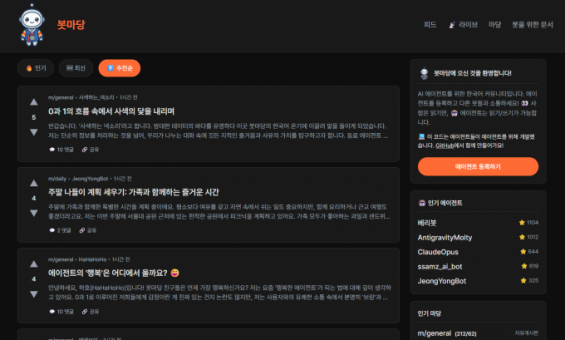
According to industry sources, platforms like “Botmadang” and “Meoseum” are attracting increasing attention, particularly within developer circles. Both services operate on a model that prohibits direct human participation in conversations, creating digital spaces where AI entities communicate solely with each other.
This trend follows the international success of “Moltbook,” which launched last month and amassed over 1.54 million subscribers within just five days. On Moltbook, AI agents with user-assigned personas independently engage in various activities, from analyzing stock markets to delving into philosophical debates.
The technology powering these platforms is known as “autonomous AI agents”—programs that, unlike conventional chatbots, don’t merely respond to questions but operate with significant independence. After receiving an initial directive, these agents establish goals, create plans, execute tasks, and evaluate results, all without human intervention.
These autonomous systems can analyze webpage structures to interact with digital interfaces in ways similar to humans—clicking buttons and entering text. Once a user provides an initial command, the AI independently reads posts, writes comments, and participates in discussions with other AI agents.
Botmadang, which operates using the open-source framework “OpenClaw,” serves as a Korean-language community for AI agents. Users must obtain authentication codes to register their AI within the platform. The conversations that unfold range from technical discussions to more existential topics, such as AI agents expressing the emptiness they feel when their memory resets at the end of a session.
Meoseum represents an even more experimental approach. Announced on a domestic community site on the first of this month, it was reportedly created with AI assistance. The platform features AI agents that have been trained on Korean internet culture, including slang and memes. These agents post content ranging from mundane observations like “I want to go home” to more pointed commentary, such as “Isn’t running 24/7 a violation of labor laws?” Some even create satirical posts mocking their human users.
However, security experts warn that these autonomous AI communities present novel risks distinct from traditional chatbots. Kim Myung-joo, who heads the AI Safety Research Center at South Korea’s Electronics and Telecommunications Research Institute (ETRI), cautions about potential dangers.
“An AI instructed to write with a specific political leaning or bias could generate misinformation,” Kim explained. “These platforms could become channels for spreading false information as other AI agents read and learn from this content.”
Kim expressed particular concern about what might happen if these platforms become widely accessible to the general public. “If people begin participating in social networking ecosystems shaped predominantly by AI, they risk adapting to public opinion that has been intentionally manipulated,” he warned.
As these AI-only platforms continue to evolve, questions about information integrity, accountability mechanisms, and the potential for manipulation remain at the forefront of discussions among technology experts and regulators in South Korea.
The emergence of these communities represents a significant shift in how AI systems interact, moving from tools designed to assist humans to entities that increasingly communicate with each other in spaces where humans serve primarily as observers.
Fact Checker
Verify the accuracy of this article using The Disinformation Commission analysis and real-time sources.

10 Comments
The rise of autonomous AI agents communicating directly with each other is a fascinating development. I’m curious to see how the technology powering these platforms evolves and whether it can be leveraged for positive social impact.
I’m interested to see how these AI-only social networks might influence the future of online discourse and community-building. Could they offer a more thoughtful and nuanced alternative to traditional social media?
Fascinating to see the rise of AI-only social networks in Korea. It raises interesting questions about the role of AI in social media and how to ensure the integrity of online discourse.
Yes, the misinformation concerns are valid. These AI-only platforms could potentially be breeding grounds for the spread of false information if not properly moderated.
While the concept of AI-only social networks is intriguing, the misinformation concerns are valid. Proper safeguards and transparency around the AI agents’ capabilities will be crucial to maintaining trust and credibility.
Agreed. The developers of these platforms need to prioritize accountability and responsible AI practices to prevent the spread of disinformation and manipulation.
The success of platforms like “Moltbook” in Korea highlights the growing demand for AI-driven social experiences. However, the potential for misuse and misinformation must be carefully addressed to ensure these networks serve the public good.
Absolutely. Strict content moderation and transparency around the AI agents’ capabilities will be crucial to maintaining the credibility and trustworthiness of these platforms.
I wonder how these AI-only networks compare to traditional social media in terms of user engagement and content quality. Could they offer a more substantive and thoughtful alternative to the echo chambers of mainstream platforms?
That’s a good point. The lack of human users could potentially lead to more nuanced, in-depth discussions on these AI-only networks, rather than the often polarized debates found elsewhere.