


Listen to the article
From Creationist to Biologist: Bridging America’s Ideological Divide
In an era of profound political and social division in the United States, where people increasingly consume news from sources that reinforce their existing beliefs, the Humanist Society of Santa Barbara recently hosted an illuminating talk that offered rare insight into how minds can change across deep ideological divides.
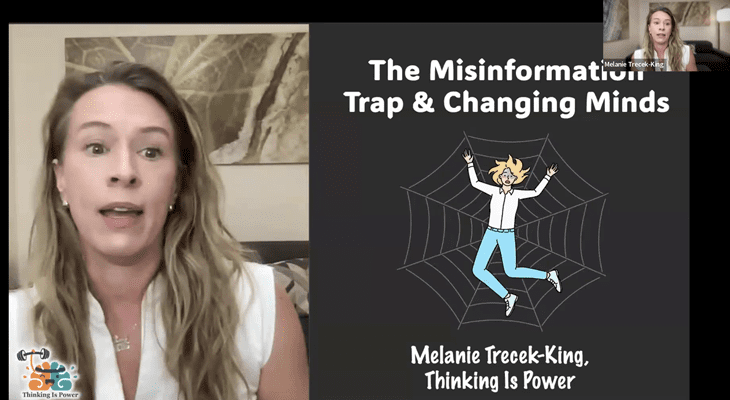
Melanie Trecek-King, an Associate Professor of Biology at Massasoit Community College, presented “The Misinformation Trap and Changing Minds: My Journey from Creationist to Biologist” to an engaged audience in an event co-sponsored by the Freethought Society.
Trecek-King’s story provides a compelling case study in ideological transformation. Growing up in rural western Iowa in a town of just 1,400 people, she was raised in a community where Christianity, conservatism, and Republican values were foundational pillars of identity. Her church taught that the Bible was the literal word of God, that Earth was approximately 6,000 years old, and that evolution was not just scientifically flawed but spiritually dangerous.
“We were taught that Democrats just want to raise your taxes and take your guns. And they believe in evolution,” Trecek-King explained, offering attendees a window into the worldview of her childhood community, where church was the center of social life and questioning accepted beliefs risked ostracism.
Trecek-King’s perspective began to shift dramatically during her college years while pursuing veterinary studies. A world civilization course exposed her to the variety of religious beliefs across different cultures and historical periods. She noticed patterns: stable civilizations tended to have peaceful gods, while those in harsh conditions had wrathful deities.
“Holy shit! Man created God in his own image!” she recalled thinking in a moment of profound realization. This insight initiated a cascade of questions about her entire belief system, particularly as she recognized how her religion had taught her that women were less valuable than men.
The professor now creates educational resources through her platform “Thinking Is Power,” which teaches critical thinking, information literacy, and scientific literacy. Her approach focuses on “skills, not facts,” recognizing from her own experience that simply presenting scientific evidence rarely changes deeply held beliefs.
Central to her presentation was the contrast between two models of belief formation. The Information Deficit model assumes people hold incorrect views simply because they lack information. The Web of Belief model, attributed to philosopher Willard Van Orman Quine, presents a more complex picture where beliefs form an interconnected network where changing one belief requires adjusting many others.
“You interpret through your web. It’s uncomfortable to have an inconsistent web,” she explained. “Consider a student who doesn’t accept evolution. You can’t pull out one node. It must be replaced by something else.”
Trecek-King also discussed the “Elephant and Rider” metaphor, where the conscious mind (rider) believes it’s in control while emotions and intuitions (elephant) often determine direction. “Being smart makes us better at rationalizing what we already want to believe,” she noted.
The talk distinguished between misinformation (false information) and disinformation (deliberately deceptive information), and explored how science misinformation manifests as either pseudoscience or science denial. Both forms are often tied to motivated reasoning—wanting something to be true regardless of evidence—and frequently involve conspiracy theories to explain scientific consensus.
When addressing how to communicate with those holding different beliefs, Trecek-King emphasized empathy and understanding. “Facts hit a wall of our web of beliefs. Your elephant is talking to their elephant,” she said, suggesting that public confrontation rarely works. Instead, she recommended finding common ground and exploring ideas together without judgment.
During the question-and-answer session, audience members raised concerns about engaging with those holding different political views, particularly Trump supporters. Trecek-King suggested techniques like asking people how certain they are of their position on a numerical scale, which can create space for doubt and reflection.
A particularly poignant moment came when an audience member named Etienne, who identified as Black and living in the Midwest, suggested that religion often serves as a vehicle for white supremacy and patriarchy. Trecek-King, who is married to a Black man, acknowledged this reality while maintaining that finding common human values remains essential for meaningful dialogue.
The presentation offered rare insight into the personal and psychological dimensions of America’s ideological divides, suggesting that effective communication across differences requires understanding the complex web of beliefs, emotions, and social ties that shape human thinking—a timely message in an increasingly polarized nation.
Fact Checker
Verify the accuracy of this article using The Disinformation Commission analysis and real-time sources.

18 Comments
Interesting update on Navigating the Misinformation Trap: The Challenge of Changing Minds. Curious how the grades will trend next quarter.
Production mix shifting toward News might help margins if metals stay firm.
Good point. Watching costs and grades closely.
Uranium names keep pushing higher—supply still tight into 2026.
Production mix shifting toward News might help margins if metals stay firm.
Good point. Watching costs and grades closely.
Good point. Watching costs and grades closely.
If AISC keeps dropping, this becomes investable for me.
Good point. Watching costs and grades closely.
If AISC keeps dropping, this becomes investable for me.
Good point. Watching costs and grades closely.
Good point. Watching costs and grades closely.
The cost guidance is better than expected. If they deliver, the stock could rerate.
Good point. Watching costs and grades closely.
Good point. Watching costs and grades closely.
Silver leverage is strong here; beta cuts both ways though.
Exploration results look promising, but permitting will be the key risk.
Good point. Watching costs and grades closely.