


Listen to the article
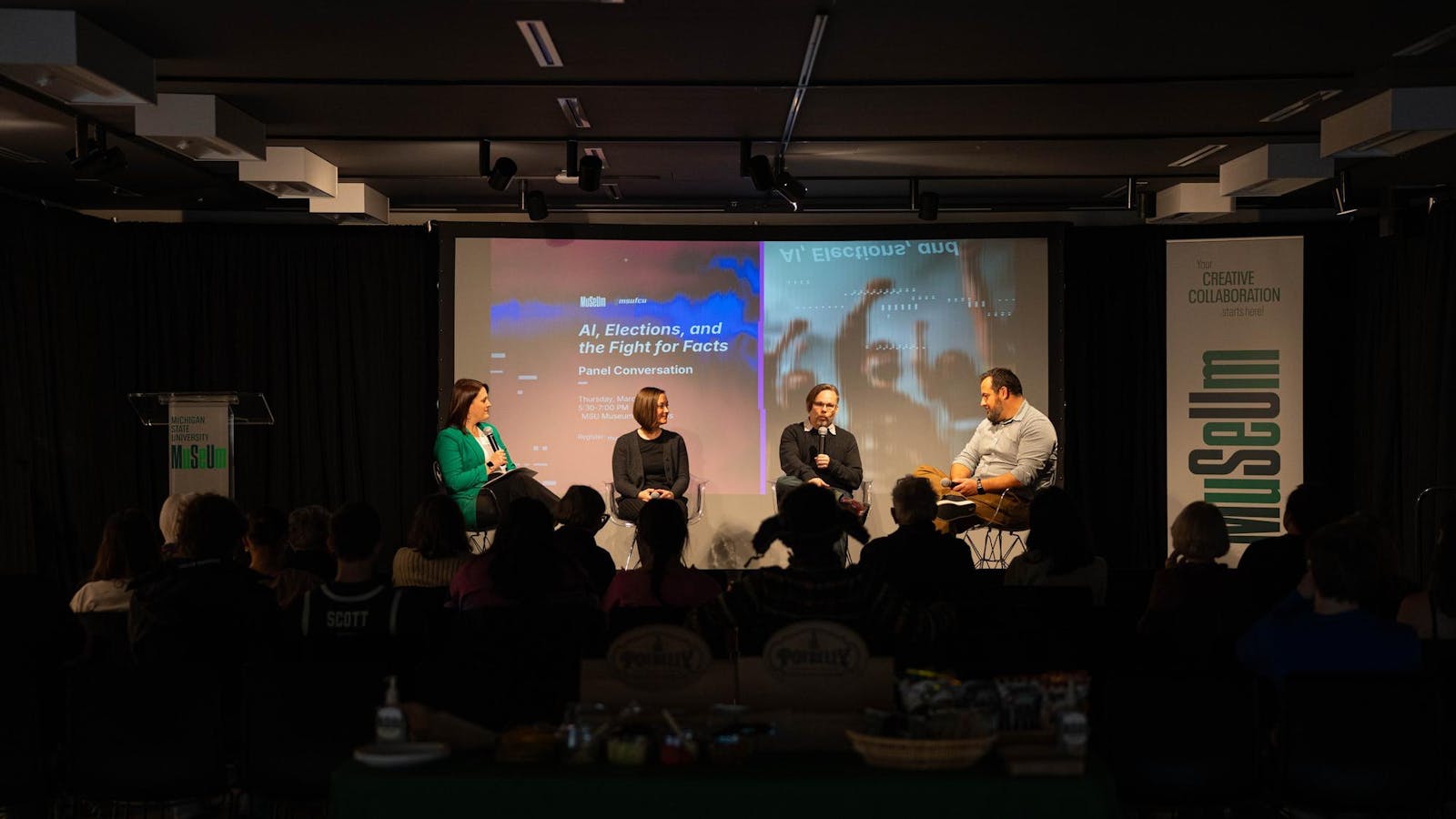
The MSU Museum has launched an initiative examining the intersection of artificial intelligence and misinformation, particularly relevant during this election year. On March 19, the museum hosted a panel discussion titled “AI, Elections, and the Fight for Facts” in collaboration with MSU’s Department of Political Science, building on their ongoing “Blurred Realities” exhibition that opened in January.
The panel featured Dr. Jennifer Gradecki and Dr. Derek Curry, Associate Professors of Art and Design at Northeastern University, who curated the “Generative Persuasion” exhibit within the larger exhibition. The event was moderated by Ashlee Smith, Senior Director of Content and Education for WKAR.
“Generative Persuasion” demonstrates how AI can create convincing but false narratives that potentially radicalize viewers. The exhibit draws inspiration from real-world examples, including the Cambridge Analytica scandal that harvested data from over 50 million Facebook profiles without consent to influence voters during the 2016 Brexit referendum and U.S. presidential election.
“Another source of information for the project is OpenAI’s threat reports, which reveal attempts by state and non-state actors to create disinformation campaigns using ChatGPT,” Gradecki explained. “These reports reveal how influence operations are integrating generative AI into their workflows.”
While the exhibit itself is fictional, it’s based on documented tactics used in actual influence campaigns. “The key thing to keep in mind is that disinformation is used to influence and manipulate; it may cause people to feel strong feelings, like pride, hatred, or outrage, or it may be used to distract or prevent dissent,” Gradecki noted.
Curry emphasized that their goal is to help visitors “develop media, data and AI literacies and to encourage them to be generally skeptical of online content”—an increasingly vital skill as AI becomes more sophisticated.
Moderator Ashlee Smith highlighted the panel’s timeliness, noting that discussing AI during an election year is “extremely poignant” as the technology makes it increasingly difficult for people to “distinguish between truth and fiction.”
Smith, who navigates AI considerations daily in her public media role, stressed the importance of human verification. “What is most important in my work in public media is that we can stand behind the fact that our offerings are human, factual, and editorially sound. We endeavor to remain a trusted source of information in a sea of synthetic media,” she said.
The rapid advancement of AI technology presents unique challenges for information consumers. “AI has become a subject that immediately turns people off, but it is so important to learn about the impact it’s having on society,” Smith said. “One of the most important things we can do as citizens and consumers is to be media literate.”
Claire Urban, a sophomore studying international relations at MSU’s James Madison College, shared her perspective on AI’s growing influence in politics. “I recently read an article in The Washington Post that said about 20 candidates in certain states’ primaries have been bought out or influenced by AI companies,” Urban said, also noting concerning partnerships between AI companies and government entities.
Despite AI’s increasing sophistication, Urban believes there are aspects of politics that technology cannot replicate. “AI can never replace diplomacy, nor the face-to-face connections that make up our relationships,” she said. “When we rely on AI for our elections or to inform us about what is going on in the world, we are getting a watered-down version that does not push us to think critically or contain empathy.”
The MSU Museum’s exhibition and panel represent a growing educational effort to help citizens navigate an increasingly complex information landscape where the boundaries between human and AI-generated content continue to blur, particularly as the nation approaches another election cycle.
Fact Checker
Verify the accuracy of this article using The Disinformation Commission analysis and real-time sources.

27 Comments
Uranium names keep pushing higher—supply still tight into 2026.
Silver leverage is strong here; beta cuts both ways though.
Good point. Watching costs and grades closely.
Production mix shifting toward News might help margins if metals stay firm.
Good point. Watching costs and grades closely.
The cost guidance is better than expected. If they deliver, the stock could rerate.
Production mix shifting toward News might help margins if metals stay firm.
Good point. Watching costs and grades closely.
Good point. Watching costs and grades closely.
Uranium names keep pushing higher—supply still tight into 2026.
Nice to see insider buying—usually a good signal in this space.
Good point. Watching costs and grades closely.
Good point. Watching costs and grades closely.
Nice to see insider buying—usually a good signal in this space.
Interesting update on MSU Museum Panel Explores Intersection of AI, Politics and Misinformation. Curious how the grades will trend next quarter.
Good point. Watching costs and grades closely.
Silver leverage is strong here; beta cuts both ways though.
Good point. Watching costs and grades closely.
Good point. Watching costs and grades closely.
Uranium names keep pushing higher—supply still tight into 2026.
Good point. Watching costs and grades closely.
Good point. Watching costs and grades closely.
Interesting update on MSU Museum Panel Explores Intersection of AI, Politics and Misinformation. Curious how the grades will trend next quarter.
Exploration results look promising, but permitting will be the key risk.
Exploration results look promising, but permitting will be the key risk.
Good point. Watching costs and grades closely.
Good point. Watching costs and grades closely.